

How to Choose Power Cables for SNES Consoles
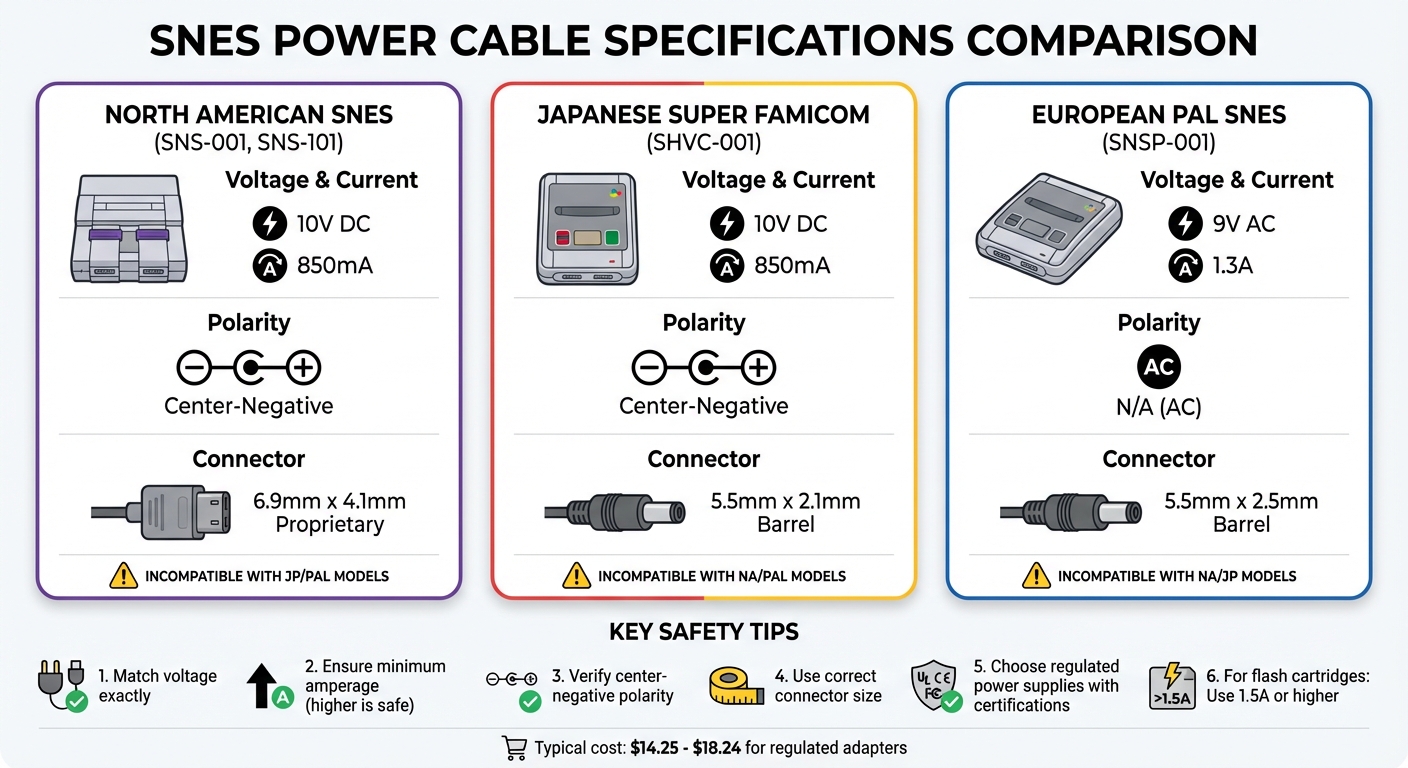
Choosing the right power cable for your SNES console is essential to avoid damage and ensure smooth gameplay. Different SNES models (North American, Japanese Super Famicom, and European PAL) have distinct power specifications, connector sizes, and polarity requirements. Here's a quick breakdown:
- North American SNES (SNS-001, SNS-101): Requires 10V DC, 850mA, center-negative polarity, and a proprietary 6.9mm x 4.1mm connector.
- Japanese Super Famicom (SHVC-001): Uses the same 10V DC, 850mA, center-negative polarity but has a 5.5mm x 2.1mm barrel connector.
- European PAL SNES (SNSP-001): Needs 9V AC, 1.3A with a 5.5mm x 2.5mm barrel connector.
Key Tips:
- Voltage & Current: Always match your console's voltage and ensure the adapter provides at least the required amperage (higher is fine).
- Polarity: SNES consoles use center-negative polarity; double-check before connecting.
- Connector Fit: Use the correct plug size for stable connections and to avoid damage.
- Flash Cartridges: If using custom or flash cartridges, opt for adapters rated at 1.5A or higher for reliable performance.
- Safety: Use regulated power supplies with certifications (UL, CE, FCC) and test with a multimeter for correct output.
BJ's Game Vault offers cables tailored to these specifications, with prices ranging from $14.25 to $18.24 for regulated options. Avoid unregulated adapters, as they can cause voltage fluctuations and overheating. A surge protector is also recommended to protect your console from power surges.
SNES Power Cable Specifications by Console Model
How to repair Super Nintendo with NO power! SNES Troubleshooting Steps taken and behind the scenes
Identify Your SNES Console Model
Before buying a power cable for your SNES, it’s crucial to know which model you own. The connector type, voltage, and polarity differ depending on whether you have a North American console, a Japanese Super Famicom, or a European PAL version.
To identify your model, check the sticker on the bottom of your console. North American units are labeled SNS-001 or SNS-101, Japanese consoles are marked SHVC-001, and European models are labeled SNSP-001. If the sticker is missing, look closely at the power port. North American models use a proprietary 6.9mm x 4.1mm jack with a center pin, while Japanese and European versions use standard barrel connectors. Here’s a breakdown of each model to help you find the right power cable.
Original North American SNES
The original North American SNES (SNS-001) features a boxy gray design with purple sliding power and reset switches. It also has a dark gray eject lever and a removable plastic cover on the bottom, which conceals the expansion port. This model requires 10V DC at 850mA with center negative polarity and uses a proprietary 6.9mm x 4.1mm power jack.
SNES Mini / SNES Jr.
The SNES Mini (SNS-101) is a smaller, rounded version introduced later in the SNES lifecycle. Unlike the original, it doesn’t have an eject button, power LED, or bottom expansion port. Despite its compact size, it uses the same power specifications and proprietary connector as the original North American SNES: 10V DC at 850mA with the 6.9mm x 4.1mm jack.
Regional Variants (e.g., Super Famicom)
The Japanese Super Famicom (SHVC-001) has a rounded gray casing with colorful controller buttons (red, yellow, blue, and green), resembling the European PAL SNES. However, it uses a standard 5.5mm x 2.1mm barrel connector instead of the North American proprietary jack. It also requires 10V DC, but the different connector means North American power cables won’t fit.
European PAL consoles (SNSP-001) look almost identical to the Super Famicom but run on 9V AC at 1.3A instead of DC. Using a PAL power supply on a Japanese Super Famicom can cause irreversible damage due to the incompatible current types.
Understand SNES Power Specifications
Once you've identified your console model, it’s important to check its electrical specifications. This step ensures you avoid any power-related issues or potential damage to your SNES.
Using the wrong voltage, current, or polarity can lead to serious problems, like preventing the console from powering on or even causing permanent damage.
Voltage and Current
For the North American SNES, the required input is 10V DC at 850mA. However, many aftermarket 9V DC power supplies work safely because the console has internal 7805 voltage regulators that reduce the voltage to 5V. The SNES typically consumes between 450mA and 600mA at 5V, though flash cartridges may draw more power.
It’s essential that your power supply provides at least 850mA. If it offers a higher amperage - like 1A or 2A - that’s perfectly fine because the console will only draw what it needs. On the other hand, using a supply with insufficient amperage could lead to system instability, crashes, or even complete failure.
"It's extremely rare for something to break from applying too low of a voltage. Too high a voltage can cause damage easily." – Hearth, electrical engineer
Polarity
Polarity refers to which part of the connector is positive and which is negative. For North American and Japanese SNES consoles, the polarity is center-negative (also called tip-negative). This is different from the center-positive standard used by most universal adapters. Using the wrong polarity can prevent the console from working or cause irreversible damage.
Always check the polarity symbol on the adapter. For the SNES, the symbol should indicate the negative (-) sign pointing to the center pin.
"You can't use any old 9v supply you've got lying around the house because the SNES uses a center negative pin which is the opposite of the de facto standard today." – Mazura, Stack Exchange contributor
Connector Size and Fit
Connector sizes vary depending on the region:
- North American SNES: Uses a proprietary 6.9mm x 4.1mm jack with a center pin.
- Japanese Super Famicom: Uses a standard 5.5mm x 2.1mm barrel connector.
- European PAL consoles: Use a 5.5mm x 2.5mm barrel connector.
It’s crucial to use the correct connector for your model. A proper fit ensures stable power delivery, while a loose connection can result in intermittent power loss, system crashes, or even damage to the power port over time. Never force a mismatched connector, as each design is intentionally different to prevent cross-regional compatibility issues.
Compare Types of Reproduction Power Cables
When replacing power cables for your console, you’ll encounter three main types. Each comes with its own advantages and limitations, so let’s break them down.
Direct Replacement DC Power Bricks
These modern power bricks are designed to replace the original SNS-002 unit. They provide a steady 9V regulated output, which helps reduce internal heat and can extend the lifespan of your console. Typically priced around $18.24, these bricks are compatible with 100–240V inputs and should be rated at 1.5A or higher if you’re planning to use flash cartridges.
"The original are unregulated, so the voltage indicated on the sticker is not real... the real voltage can vary around ±3V depending on the load. Mine are regulated, so the real voltage matches the sticker." – Retro Game Supply
Adapter Pigtail Cables for Generic DC Supplies
Adapter pigtail cables allow you to connect a generic, UL-listed DC power supply to your SNES via a proprietary plug. To ensure compatibility, the generic supply must output 9V center-negative and provide at least 850mA.
Multi-Console Power Cables
Universal adapters are a convenient option, offering multiple tips to power various consoles like the NES, SNES, and Genesis from one brick. However, many of these cables lack proper regulation and shielding, which can result in visible video noise. If you’re considering a multi-console cable, make sure it’s regulated and certified (look for CE, FCC, or UL marks), and check user reviews for any reported video quality issues.
"Poorly designed power supplies can introduce visible noise into the video outputs... this noise, while visible when using YPbPr, might not always be present when using composite video." – Nickolaus Mueller, HD Retrovision
sbb-itb-9a4764e
Safety and Testing Recommendations
Before connecting any reproduction power cable to your SNES, take a moment to ensure it's safe and functioning properly. A faulty power supply can harm your console's internal components or, in the worst-case scenario, send high mains voltage directly into your system.
Inspecting Cables and Power Bricks
Start by visually examining the cable. Look for signs of wear, such as frayed wires, damaged insulation, or exposed copper. If the plug feels loose or wobbly, avoid using it - this can lead to dangerous arcing or overheating. Always opt for power bricks that carry certifications like UL, CE, or FCC. If the brick becomes unusually hot within just a minute or two of use, unplug it immediately. This could indicate an internal short circuit. Once you've confirmed the cable is in good physical condition, move on to testing its electrical output.
Testing Output with a Multimeter
To test the cable's output, set your multimeter to the 20V DC range, which is suitable for North American SNES cables. For verifying the center-negative polarity, place the red probe on the outer metal sleeve of the plug and the black probe inside the center barrel. A positive voltage reading confirms the cable's center is negative. The voltage should remain steady, typically between 9V and 10V for most reproduction cables. Some unregulated power bricks might show higher readings, around 12V–13V when not under load, but this should drop to the correct range once connected.
Using Surge Protection
In the U.S., standard household voltage is 120 volts, but power surges caused by lightning or faulty wiring can spike beyond 170 volts, potentially damaging your console. To safeguard against this, use a surge protector with a clearly marked joule rating. If no joule rating is listed, it's just a basic power strip without surge protection. Also, check for an indicator light on the surge protector; if the light is off, the unit's protection has been depleted and it needs to be replaced. Avoid plugging high-power appliances into the same surge protector as your SNES to prevent localized voltage drops or fluctuations.
Choosing Power Cables at BJ's Game Vault
Matching Accessories to Your Console
Before diving into BJ's Game Vault's collection, make sure you know your exact console model. Check the label on your console to confirm its details. The power cable you choose needs to match your console's connector size and requirements. For NTSC consoles (both US and Japanese models), you'll need a 9V to 10V DC power supply with center-negative polarity. If you're working with a PAL console, keep in mind that European SNES units originally used 9V AC. However, many of these consoles can now function with DC adapters, as long as they have the correct 5.5 x 2.5 mm connector. Identifying these details ensures you pick a cable that delivers reliable performance for your system.
Prioritizing Stability for Custom Cartridges
Stability is especially important if you're using custom cartridges. BJ's Game Vault is well-known for its reproduction cartridges, ROM hacks, and custom builds, which often require more power than standard games. Flash cartridges and multi-carts, for example, can draw significantly higher current. For these cases, look for adapters rated between 1.5A and 2.0A. According to Retro Game Supply, using an adapter with a higher current rating than the minimum required is perfectly safe:
"The current value indicated on it, is the maximum current it can deliver, the console determines what quantity of current it needs. Having slightly more power has no impact and have no risk of damaging the device".
This flexibility allows you to choose an adapter that not only meets but exceeds the power needs of your system without worry.
Evaluating Product Descriptions
Once you've nailed down the technical requirements, take a close look at the product descriptions for power cables at BJ's Game Vault. Start by ensuring the cable is regulated, not unregulated. Unregulated power supplies, like the original SNES power bricks, could fluctuate up to 14V under load, while a regulated 9V adapter provides consistent output and reduces internal heat. Next, confirm that the adapter uses center-negative polarity - using the wrong polarity can permanently damage your console. Also, make sure the adapter delivers at least 1A of power, though 1.5A is a better choice for systems running reproduction cartridges. Lastly, check for certifications and built-in safety features to guarantee safe operation.
For pricing, high-quality reproduction adapters typically fall between $14.25 and $18.24. More basic universal adapters are usually more affordable, ranging from $6.99 to $8.99. Balancing these factors will help you find a reliable and compatible power solution for your console.
Conclusion
Choosing the right power cable for your SNES comes down to ensuring it matches your console's specific requirements. For NTSC models, always confirm a center-negative configuration to avoid potential damage. While original PAL consoles used 9V AC adapters, many now work with DC adapters featuring a 5.5 x 2.5 mm connector.
Regulated power supplies are a smart choice - they deliver consistent voltage, help reduce internal heat, and can extend your console's lifespan. This is especially important if you're using custom cartridges, ROM hacks, or flash cartridges, which tend to draw more power than standard games. For these setups, adapters rated at a minimum of 1.5A are ideal. BJ's Game Vault caters to these needs with a selection of cables designed for reliable performance and compatibility.
BJ's Game Vault offers retro gaming accessories tailored for collectors who value dependable functionality. Whether you're powering a North American SNES, SNES Mini, or Super Famicom, their cables meet strict technical standards and are tested to handle the demands of modern retro gaming.
When buying a power adapter, look for key details like regulated output, proper polarity markings, sufficient amperage ratings (at least 1A, and preferably 1.5A), and built-in safety features such as overload and short-circuit protection. High-quality cables from trusted vendors typically cost around $18 for premium regulated adapters, while budget-friendly multi-console options are available for about $10. Following these guidelines will help keep your SNES running smoothly and safely.
FAQs
What are the risks of using a power cable with the wrong polarity on an SNES console?
Using a power cable with the incorrect polarity can stop your SNES console from powering on and might even cause irreversible harm to its internal components. Since the SNES lacks protection against reversed DC polarity, it's essential to use a cable that aligns perfectly with the console's specifications.
Make sure to verify the polarity, voltage, and connector type of any power cable before using it. This simple step can save you from expensive repairs or potential damage that can't be undone.
Is it safe to use a power cable with higher amperage for my SNES?
Yes, using a power cable with a higher amperage than your SNES needs is completely safe. The console will only pull the amount of current it requires, as long as the voltage aligns with the required specifications. Just double-check that the connector type fits your SNES to ensure everything works as it should.
How can I check if my SNES power cable is working correctly?
To check if your SNES power cable is working correctly, you’ll need a digital multimeter. Start by setting the multimeter to measure DC voltage. For U.S. SNES models, the power cable should output around 9V DC, with the outer barrel as positive and the inner pin as negative. Place the black probe on the outer barrel and the red probe inside the pin. A properly functioning cable will show a voltage close to 9V on the multimeter. If the reading is much lower or the polarity is reversed, the cable might be defective.
For a more thorough test, try measuring the voltage while the cable is connected to a powered-off SNES console. If the voltage drops significantly under load, it’s a clear sign you need a replacement. If so, consider getting a reproduction cable from BJ’s Game Vault, known for offering retro gaming accessories that are tested for reliability. A good power cable is essential to keep your console safe and your gaming sessions uninterrupted.