


Best Component Cables for SNES and N64
When connecting your SNES or N64 to a modern TV, standard composite cables often result in blurry visuals and distorted colors. Component cables, on the other hand, split the video signal into three channels for sharper image quality and more vibrant colors. Here's a breakdown of the best options:
- HD Retrovision Component Cables: Top choice for RGB-quality visuals. Works natively with the original SNES (SNS-001) and requires an RGB mod for N64 and SNES Mini. Priced around $69.99, these cables deliver crisp visuals with durable build quality.
- Official Nintendo AV Cables: Affordable and plug-and-play, but limited to composite output, resulting in lower video quality. Prices range from $8 to $16.
- Retro Access Cables: High-performance RGB SCART cables requiring a SCART-to-Component transcoder. Compatible with modified consoles and priced between $39.99 and $69.99.
Quick Comparison:
| Cable Option | Video Quality | SNES Compatibility | N64 Compatibility | Price Range | Build Quality |
|---|---|---|---|---|---|
| HD Retrovision | RGB-quality YPbPr | Native (except Mini) | Requires RGB mod | ~$69.99 | Heavy-duty shielding |
| Official Nintendo AV | Composite (low quality) | Native | Native | $8–$16 | Basic shielding |
| Retro Access | SCART (requires mod) | Native (except Mini) | Requires RGB mod | $39.99–$69.99 | High-grade coaxial |
For the best picture quality, HD Retrovision Component Cables are the go-to option, though they require mods for certain consoles. If you're on a budget, Official Nintendo AV Cables are a simple, low-cost solution. For enthusiasts seeking high-end performance, Retro Access Cables are a solid choice with additional setup requirements.
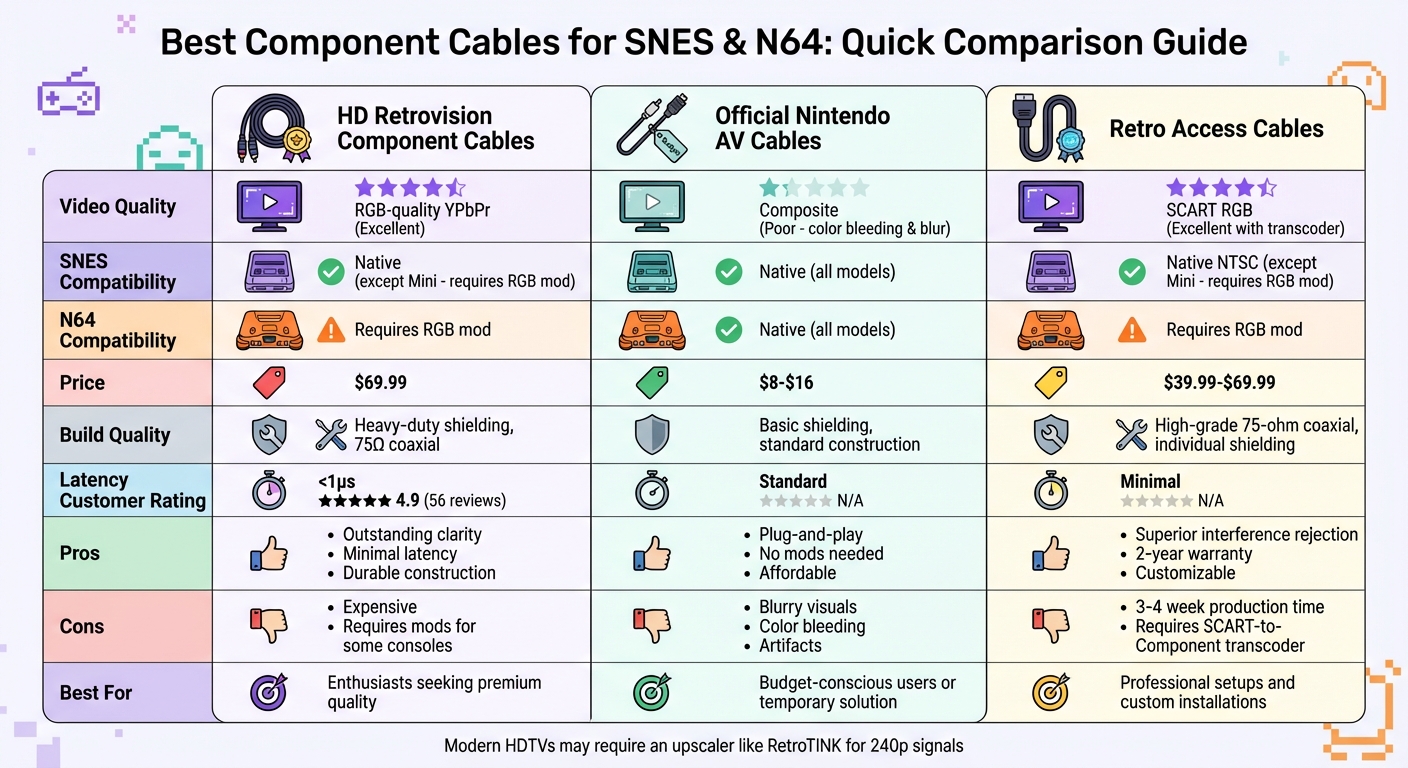
SNES and N64 Component Cable Comparison: HD Retrovision vs Nintendo vs Retro Access
1. HD Retrovision SNES Component Cables
Video Quality
HD Retrovision's cables are designed to keep video signals separate rather than merging them into a single composite channel. This approach results in sharper visuals, more accurate colors, and eliminates color bleeding. They also condition the RGB signal, fine-tuning brightness and reducing noise. Thanks to a custom sync extraction process, the cables maintain a clean signal with latency under 1μs. Many users have reported that these cables significantly reduce the screen warping often seen along the edges when using standard AV cables. This attention to detail ensures a superior video experience tailored for specific consoles.
SNES Compatibility
These cables are ready to work right out of the box with the original SNES (SNS-001) and Super Famicom (SHVC-001) models. However, for the SNES Mini (SNS-101), an internal RGB modification is required. An integrated contrast switch adds flexibility, allowing users to adjust brightness levels - choose the "darker" setting for later SNES revisions and the "brighter" option for older models.
N64 Compatibility
For Nintendo 64 consoles, these cables require an internal RGB modification to function. HD Retrovision advises having this modification done by trusted professionals, such as Voultar's Mod Shop, to ensure the warranty remains valid.
Price Range
The cables are priced between $59.99 and $69.99 USD (approximately €62.28 in Europe). They have received glowing reviews, with Stone Age Gamer customers rating them 4.9 out of 5 stars based on 56 reviews, and Rondo Products reporting a perfect 5 out of 5 stars from 14 reviews.
Build Quality
Built to last, these cables feature durable shielding with aluminum Mylar and braided protection. They use true 75Ω nominal impedance coaxial cabling, which helps preserve signal quality. Measuring 6 feet in length, they also offer extension options up to 30 feet without any loss in performance. The RCA connectors are designed to provide a secure fit while remaining easy to disconnect when needed.
2. Official Nintendo AV Cables

Video Quality
Nintendo’s official AV cables rely on standard composite connections, featuring three RCA connectors: yellow for video and red and white for stereo audio. These cables combine all video data into a single signal, which often results in visual issues like color striping, bleeding, and blurry edges. On top of that, users may notice a distracting wobbling effect from frame to frame, especially on modern HDTVs. For those switching to component cables, the difference in clarity is often described as "night and day" or "a complete game changer". While these cables work across various systems, their limitations in video quality are consistent.
SNES Compatibility
When it comes to compatibility, the official Nintendo AV cables work seamlessly with all SNES models equipped with the 12-pin Multi-Out connector. However, even though original SNES models are capable of outputting RGB signals, these cables only support composite output.
N64 Compatibility
The same AV cables are fully compatible with all N64 models. Like with the SNES, they only provide composite output, meaning the video quality constraints remain unchanged.
Price Range
Replacement AV cables from Nintendo are budget-friendly, typically priced between $8.97 and $16.00. They deliver composite video and audio output at a reasonable cost.
Build Quality
In terms of construction, official Nintendo composite cables feature basic shielding and a flexible outer jacket. While they are durable enough for everyday use, they don’t match the sturdiness of higher-end alternatives. The standard RCA connectors used ensure a secure and reliable connection during gameplay.
3. Retro Access Component Cables
Video Quality
Retro Access offers RGB SCART cables designed for top-notch video performance, featuring broadcast-grade 75-ohm mini-coaxial conductors. They provide two main cable options: the Mini-Coax series, which maintains a consistent 75-ohm impedance to reduce crosstalk over longer distances, and the Fortraflex line, equipped with 100% individual shielding and a flexible 7-mm outer jacket to block interference. Both options use "Sync on Luma" technology to minimize visual artifacts and interference. To connect these cables to component displays, you'll need a SCART-to-Component transcoder or an upscaler like the RetroTINK 5X-Pro or OSSC. These features ensure excellent performance, especially for SNES and N64 systems.
SNES Compatibility
For SNES systems, Retro Access cables are compatible with NTSC-U (USA) and NTSC-J (Japan) models. However, they won't work with PAL systems. If you're using the "New-Style" SNES Mini, an internal RGB mod upgrade is required for the cables to function properly.
N64 Compatibility
With the N64, Retro Access cables also require an RGB mod to deliver the best results. Once the console is modified, these cables provide outstanding picture quality, making them a reliable choice for retro gaming enthusiasts.
Price Range
When it comes to pricing, the Fortraflex cables are priced at approximately $39.99, while the Mini-Coax cables range from $49.99 to $69.99. All cables come with a two-year warranty, and production typically takes 3–4 weeks.
Build Quality
Retro Access cables are built to last, incorporating PCB-mounted 220 µF tantalum capacitors on the RGB lines for stable signal output. The Mini-Coax line stands out with its full individual shielding and an additional outer shield layer, making it ideal for professional setups or longer cable runs. Meanwhile, the Fortraflex line is designed for flexibility in tight spaces while still offering strong individual shielding to prevent issues like jail bars or audio interference.
sbb-itb-9a4764e
What Is This Magic? HD Retrovision Component Cables For SNES & N64!
Pros and Cons
Building on the earlier technical review, here's a closer look at the advantages and drawbacks of each cable option for your retro gaming setup. The comparison below evaluates video quality, compatibility, pricing, and build quality.
| Cable Option | Video Quality | SNES Compatibility | N64 Compatibility | Price Range | Build Quality | Pros & Cons |
|---|---|---|---|---|---|---|
| HD Retrovision Component | Excellent (RGB-quality YPbPr) | Native (except Mini) | Requires RGB mod | ~$69.99 | Premium; thick, shielded, heavy-duty |
Pros: Outstanding clarity with less than 1μs latency. Cons: Expensive and requires console mods for N64 and SNES Mini. |
| Official Nintendo (Composite) | Poor (color bleeding, blur) | Native | Native | $5–$15 | Standard |
Pros: Fully plug-and-play with no modifications needed. Cons: Blurry visuals, color bleeding, and artifacts that reduce image quality. |
| Retro Access (Component) | Excellent (coax shielded) | Native (except Mini) | Requires RGB mod | Premium | High (custom 75-ohm coaxial) |
Pros: Superior interference rejection, customizable lengths, and a two-year warranty. Cons: 3–4 week production time and SCART-to-Component transcoder required. |
Here’s a deeper dive into each option:
HD Retrovision Component Cables
These cables deliver sharp, RGB-quality video with sub-microsecond latency, making them a top choice for enthusiasts. Reviews from Stone Age Gamer rate them 5/5, with 56 reviewers praising their performance. One user noted:
The quality of the cable is excellent with a thick heavy-duty body and well-made plug ends. It just feels solid.
While the image quality is outstanding, the higher price point and the need for console modifications on certain systems (like the N64 and SNES Mini) may deter casual users.
Official Nintendo Composite Cables
If you're looking for affordability and simplicity, these cables are the go-to option. They’re fully plug-and-play, requiring no additional hardware or modifications. However, the trade-off is in video quality - expect blurry images, color bleeding, and jagged edges that can significantly detract from the gaming experience. These cables work best as a budget-friendly or temporary solution.
Retro Access Component Cables
Built with custom 75-ohm coaxial conductors, these cables are designed for minimal signal degradation and exceptional interference rejection. They also come with options for custom lengths and a two-year warranty, which speaks to their durability. However, the 3–4 week production time and the need for a SCART-to-Component transcoder add extra hurdles. While they’re a premium choice, they’re best suited for users who prioritize top-tier performance and are willing to wait.
Conclusion
When choosing a cable, focus on your console's compatibility, your budget, and the level of visual quality you want.
For top-notch analog output, the HD Retrovision cable is a standout choice at around $69.99. It offers excellent video quality with virtually no latency, earning a 5/5 rating from Stone Age Gamer reviews. Keep in mind, though, it requires an RGB mod for consoles like the N64 and SNES Mini. If you're aiming for the best possible image quality, this cable is hard to beat.
If you prefer a hassle-free, budget-friendly option for unmodified consoles, the Official Nintendo AV cables are worth considering. However, they come with a trade-off - image quality suffers, with blurred visuals and noticeable color bleeding that might impact your gaming experience.
For those seeking premium performance, Retro Access cables are a solid choice. They offer excellent interference rejection and a stable signal, making them a reliable option for retro gaming setups.
Before making your purchase, double-check your console model and TV inputs. Many modern HDTVs require an upscaler, like the RetroTINK, to handle 240p signals properly.
With these reliable options, you can complete your retro gaming setup and enjoy a seamless experience. Check out BJ's Game Vault to find the right cable for your needs.
FAQs
What do I need to make HD Retrovision cables work with an N64?
To connect HD Retrovision component cables to an N64, the console needs an internal RGB mod. This modification is essential because the cables are specifically designed to work with systems that support RGB output. Without this upgrade, the cables won't work correctly with the N64.
Why do Retro Access cables need a SCART-to-Component transcoder?
Retro Access cables are built to deliver RGB signals via a SCART connector. The challenge? Most TVs or devices with component video inputs expect YPbPr signals, which is a completely different format. To make these two work together, you'll need a SCART-to-Component transcoder. This device converts the RGB signal into the YPbPr format, ensuring your display can handle it seamlessly.
With this setup, you can experience the vibrant colors and crisp details of your SNES or N64 in their full glory, bringing these classic consoles to life on modern screens.
How do component cables enhance video quality compared to composite cables?
Component cables enhance video quality by splitting the video signal into three separate channels: luminance (Y) and two color difference signals (Pb/Pr). This division minimizes problems like color bleeding and dot crawl, resulting in sharper visuals, clearer text, and more vivid, precise colors.
For fans of retro gaming on consoles like the SNES or N64, this translates into a much cleaner and more enjoyable viewing experience, especially when played on modern screens.