

Checklist for Identifying Asian NES Models
Asian NES models, labeled as "Asian Version" (NESA-001), were Nintendo Entertainment System consoles distributed in Southeast and South Asia in the late 1980s and early 1990s. These systems are rare and sought after by collectors due to their unique regional branding, front-loading 72-pin cartridge slot, and compatibility with ASI-region cartridges. Here's how to identify them:
- Model Labeling: Look for "NESA-001" or "NESA-001 (HKG)" on the bottom label, along with "Asian Version" text.
- Cartridge Slot: Front-loading 72-pin slot with a hinged flap, unlike the Japanese Famicom's top-loading 60-pin design.
- Build Quality: Off-white/light gray casing with darker gray accents, robust construction, and tightly fitted components.
- Regional Markings: Includes ASI region codes on packaging and manuals.
- Lockout Chip: Equipped with the CIC 3196 chip, ensuring compatibility with specific cartridges.
- Video Standard: NTSC-compatible output for stable gameplay on modern displays.
Beware of unlicensed clones like Micro Genius, which often feature cheaper materials, 60-pin slots, and lack official branding. To confirm authenticity, inspect the console's physical design, labels, and video output.
For collectors, systems like the Samurai Electronic TV Game System (India) or Hyundai Comboy (South Korea) add regional variety, each with distinct branding and model codes. Verified sellers and retro gaming communities can help source tested consoles and accessories. Always request detailed photos and verify markings before purchasing.
Physical Design Features
Cartridge Slot and Console Layout
Authentic Asian NES models share the same front-loading, "VCR-style" NES-001 design as their North American counterparts. These consoles are equipped with a 72-pin horizontal cartridge slot hidden behind a hinged front flap. To insert a game, you slide the cartridge in, then press it down into place. This setup is a key difference from Japanese Famicom consoles, which use a top-loading 60-pin vertical slot and have controllers that are hard-wired into the unit.
Clone systems, on the other hand, usually feature a top-loading 60-pin slot and lack the characteristic flip-door. To confirm authenticity, check for the front-loading flip-door design, a 72-pin cartridge slot, and front-mounted power and reset buttons alongside controller ports. If any of these elements are missing or differ, the console may be a Famicom unit or an unlicensed clone.
Once you've confirmed the layout, move on to examining the console’s color scheme and construction quality for further verification.
Color Schemes and Build Quality
Authentic NES units are housed in an off-white or light gray shell with darker gray accents, matching the NES-001 color palette. The plastic casing typically has a matte or lightly textured finish, and the panels maintain consistent coloring unless discolored by age-related yellowing. This subdued design contrasts sharply with the Japanese Famicom's cream-colored shell with dark red accents and the glossy, vibrant colors often seen on unlicensed Southeast Asian clones.
Genuine NES consoles are also noticeably heavier due to their solid construction, which includes robust metal RF shielding and thick, durable plastic. The buttons on authentic units feel firm and responsive, and the controller ports are securely mounted. In contrast, clone consoles are often lighter, made with thinner, shinier plastics, and may show visible flaws like molding defects, seam gaps, or flexing when handled. Comparing the weight and button functionality to a known-genuine NES-001 can help reveal the shortcuts in build quality that are common in reproductions.
Regional Markings and Labels
Regional identifiers are another key aspect of verifying authenticity. Authentic Asian NES consoles often feature specific markings that are consistent across units. For example, the front lid or face may include text like "NES Asian Version" or simply "Asian Version", alongside the standard Nintendo Entertainment System branding. On the bottom or rear label, you’ll typically find the model code "NESA-001", which confirms the unit as an Asian model. Additionally, packaging, cartridges, and manuals may display the "ASI" region code, indicating a Southeast Asian origin.
Pay close attention to these markings, as clones often lack proper model codes or use generic labels such as "TV Game" instead of the specific NES designations. When purchasing a console online, high-resolution photos of the bottom sticker, rear panel, and front flap text are invaluable. These images allow you to compare the unit against verified examples and ensure its authenticity.
Model Numbers and Label Verification
Finding NES-001 Model Numbers
Once you've examined the physical design features, the next step in verifying authenticity is checking the label details. Flip the console over and take a close look at the bottom label. This label should display key information such as the model code, voltage, power consumption, and manufacturer details. For genuine Asian models, the model code typically reads NESA-001, often accompanied by phrases like "Asian Version." If you're dealing with a Hong Kong variant, the label will read NESA-001 (HKG) and might also mention compatibility with PAL-I RF signals.
On the other hand, standard North American consoles are simply labeled NES-001, without any regional designation. The label should also feature a serial number in Nintendo's standard alphanumeric format and voltage details, usually between 9–10 V DC, consistent with Asian-region electrical standards. Be cautious if the label appears misprinted, poorly aligned, or overly generic (e.g., labeled as "TV Game" instead of the proper Nintendo model code). Such discrepancies could indicate an unlicensed clone or a modified unit. Carefully inspecting this label can confirm whether the console adheres to the standards of authentic Asian models.
Regional Branding Variations
Regional branding offers additional clues to help confirm the console's authenticity. Several unique regional variants, like the Hyundai Comboy and Samurai Electronic TV Game System, feature distinct identifiers that go beyond the standard NESA-001 code.
The Hyundai Comboy, introduced in South Korea in October 1989 by Hyundai Electronics, uses the model number HGM-2000 instead of NESA-001. Internally, it's quite similar to the North American NES-001, but it includes a 3195 lockout chip and carries the KOR region code. Externally, the casing, packaging, and manuals prominently display "Hyundai Comboy" branding along with Hyundai's corporate logo, replacing the usual "Nintendo Entertainment System" label.
In India, the Samurai Electronic TV Game System serves as another licensed regional variant. This model is essentially a rebranded version of the NESA-001, produced locally under license. It features "Samurai Electronic" branding on both the console and its packaging. These units are especially rare, with initial sales reaching around 3,000 units per month in the early 1990s before dropping to about 300 units per month due to competition from bootleg systems. The Samurai version includes a 3196 lockout chip and retains the ASI region code typical of standard Asian models, while showcasing distinct visual branding.
Both the Hyundai Comboy and Samurai Electronic systems come with Nintendo-style model and regulatory labels on the underside, customized for their respective regions. To document these unique features, take clear photos of the front logo, bottom label, and distributor information.
Identifying Clones and Reproductions
Common Clone Characteristics
In the 1990s, the Southeast Asian market saw a flood of unlicensed NES clones, with Taiwan's Micro Genius becoming one of the most recognizable names. These clones lacked official Nintendo branding and often carried generic names like "Family Game", "Computer Video Game", or simply "Micro Genius." One key feature to watch for is their use of a 60-pin cartridge slot, derived from the Famicom design, which won't work with the 72-pin cartridges used by genuine NES consoles.
Authentic Asian NES units stand out with their high-quality build. They feature tightly fitted cases, consistent off-white plastic, and precise molding that mirrors Nintendo's original production standards. In contrast, clones often have rough seams where the shell halves meet, misaligned panels, and lighter, cheaper-feeling plastic. Genuine consoles also include verified regional branding and the ASI region code, while clones frequently display simplified Chinese text and skip official model identifiers like NESA-001.
Another telltale sign of a clone is the absence of the CIC lockout chip (3196). If a console plays every cartridge without showing the usual lockout behavior, it's likely not authentic. Reproductions may also include built-in multicart menus like "999 in 1", use unusually colored cartridge shells, and have labels that look freshly printed rather than aged. Once you've checked the physical authenticity, the next step is to confirm the console's video performance.
Verifying PAL or NTSC Compatibility
Video output standards are another way to differentiate authentic consoles from clones. Genuine Asian NES consoles run on NTSC standards at 60 Hz, just like their North American counterparts. To verify this, connect the console to an NTSC television using composite or RF cables. A genuine unit should produce a stable, full-color display. On the other hand, PAL consoles imported from Europe may show unstable images or black-and-white screens on NTSC-only TVs due to their 50 Hz timing.
A quick speed test can help confirm the video standard. PAL systems generally run about 17% slower than NTSC ones, which results in sluggish gameplay and lower-pitched music, especially noticeable in fast-paced games. Examining the console's labels can also provide clues. PAL imports often include region tags like GBR, NOE, FRA, or SCN, along with model codes such as NES-PAL-001 or NESE-001.
For example, the Hong Kong version (NESA-001 HKG) uses PAL-I RF modulation tuned to local broadcast channels but retains NTSC-compatible internals. If you find a console with PAL-I channel markings but NTSC video standards and proper Asian branding, it's likely the Hong Kong release. On the other hand, erratic video output combined with missing Nintendo branding strongly suggests you're dealing with a clone or reproduction.
sbb-itb-9a4764e
Verification and Collector Tips
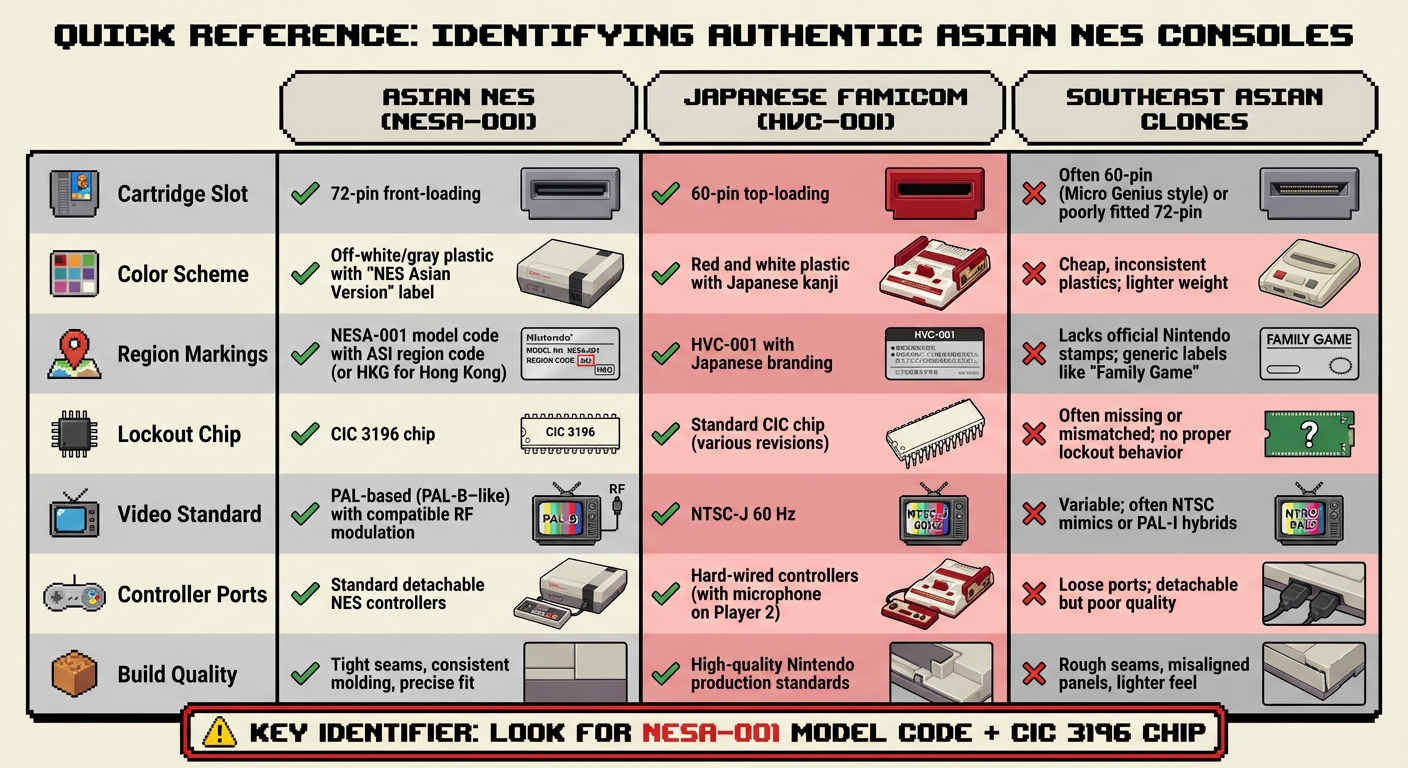
Asian NES vs Famicom vs Clone Consoles: Visual Identification Guide
Comparison Table of Features
Here’s a handy table to compare the key features of Asian NES models, Japanese Famicoms, and Southeast Asian clones. This can help you identify authentic units and spot imitations:
| Feature | Asian NES (NESA-001) | Japanese Famicom (HVC-001) | Southeast Asian Clones |
|---|---|---|---|
| Cartridge Slot | 72-pin front-loading | 60-pin top-loading | Often 60-pin (Micro Genius style) or poorly fitted 72-pin |
| Color Scheme | Off-white/gray plastic with "NES Asian Version" label | Red and white plastic with Japanese kanji | Cheap, inconsistent plastics; lighter weight |
| Region Markings | NESA-001 model code with ASI region code (or HKG for Hong Kong) | HVC-001 with Japanese branding | Lacks official Nintendo stamps; may feature generic labels like "Family Game" |
| Lockout Chip | CIC 3196 chip | Standard CIC chip (various revisions) | Often missing or mismatched; no proper lockout behavior |
| Video Standard | PAL-based (PAL-B–like) with compatible RF modulation | NTSC-J 60 Hz | Variable; often NTSC mimics or PAL-I hybrids |
| Controller Ports | Standard detachable NES controllers | Hard-wired controllers (with a microphone on Player 2) | Loose ports; detachable but of poor quality |
| Build Quality | Tight seams, consistent molding, precise fit | High-quality Nintendo production standards | Rough seams, misaligned panels, lighter feel |
One standout feature is the CIC 3196 lockout chip, which is unique to authentic Asian NES models. Use these details as a baseline, but rely on technical tools for more precise verification.
Tools and Resources for Verification
Visual comparisons are a good start, but technical tools can confirm a console’s authenticity. Online communities and resources like ConsoleMods.org and NESdev.org are excellent for diving deeper into hardware specs, serial number patterns, and subtle design details like plastic finishes, vent styles, and PCB codes.
When inspecting serial stickers, look for ones starting with "NESA" or featuring the "ASI" region code; mismatches could signal a clone. To go further, use a multimeter to test the CIC 3196 chip’s voltage or an RF modulator tester to verify the console’s output compatibility.
For community feedback, share clear photos of the console’s front labels, bottom stickers, and motherboard in collector forums. Experts can help pinpoint inconsistencies and confirm authenticity.
Looking for trusted retro items? BJ's Game Vault offers tested NES consoles and rare Asian cartridges. Their Collector's Guarantee - “Retro-tested, satisfaction guaranteed” - lets you confirm whether a NESA-001 console properly rejects non-Asian cartridges.
“Each game is tested and built for real retro consoles because collectors deserve the classics that never were.” - BJ's Game Vault
Here are some essential tools to assist with verification:
- 72-pin/60-pin adapter – Helps test cartridge compatibility across different formats.
- UV light – Detects faded or reprinted holographic labels, a common sign of counterfeits.
- RF modulator tester – Confirms whether authentic NESA-001 units output signals that work with U.S. television standards.
Finally, documenting your findings with detailed photos of labels, stickers, and motherboards not only builds trust when reselling but also strengthens your credibility in the collector community.
Conclusion
Key Takeaways
Spotting authentic Asian NES models requires attention to a few essential details. Start by checking for the NESA-001 model number paired with ASI region codes on the console's label. These indicate official distribution in Southeast and South Asia. Genuine consoles also feature a front-loading 72-pin cartridge slot and include key internal components like the CIC 3196 lockout chip. These elements set apart authentic consoles from the unlicensed clones that once flooded the market. For instance, in India, the influx of clones caused official sales to plummet from 3,000 to just 300 units per month.
Authenticity can also be confirmed through NTSC compatibility, as Asian NES models adhere to NTSC-M standards, matching U.S. RF channels 95/96. Rare models, such as the Samurai Electronic TV Game, hold particular value among collectors. To maintain collection integrity, cross-referencing physical traits with model numbers is crucial. This not only helps preserve the value of your collection but also ensures compatibility with region-locked ASI cartridges. Utilizing community resources and verification tools can further assist in confirming a console’s authenticity.
Armed with these identification tips, you can confidently add genuine pieces to your collection.
Next Steps for Collectors
Once you've verified authenticity, it’s time to expand your collection. BJ's Game Vault offers a curated selection of tested NES consoles, rare Asian cartridges, and custom ROM hacks designed for original hardware. Their Collector's Guarantee - "Retro-tested, satisfaction guaranteed" - ensures every item works seamlessly on authentic consoles.
"Each game is tested and built for real retro consoles because collectors deserve the classics that never were." - BJ's Game Vault
Browse their inventory of verified NES cartridges, which includes exclusive titles crafted specifically for authentic NES systems. By joining their mailing list, you’ll gain early access to rare finds and special retro deals. Whether you’re identifying a NESA-001 or building a comprehensive collection of Asian NES games, BJ's Game Vault provides the expertise and products you need to honor gaming history.
FAQs
How can I tell if an Asian NES model is authentic or a clone?
To spot a genuine Asian NES model, start with the build quality. Original units are crafted from sturdy materials and showcase precise construction. Pay attention to the labels - they should have sharp, clear printing, proper alignment, and regional identifiers specific to that model. If you're able to check the inside, the circuit board should display consistent markings that align with the original design.
On the other hand, clones tend to cut corners. They often use cheaper materials, feature blurry or misaligned labels, and include generic or non-standard circuit boards. If you're still uncertain, a detailed guide or advice from retro gaming experts can provide clarity and help verify the model's authenticity.
How can I tell if a Southeast Asian NES model is authentic?
To verify if a Southeast Asian NES model is genuine, start by closely inspecting the label quality. Authentic labels are sharp and clear, without any smudging or fading. Pay attention to the serial numbers and regional markings - they should align with the standard format used for Southeast Asian releases. Also, examine the casing material; genuine models will feel sturdy, with the right weight and texture.
For a deeper check, open the cartridge or console to inspect the PCB (printed circuit board). Genuine boards will feature correctly placed chips, official markings, and consistent manufacturing details. Don’t forget to look for unique physical features and logos that are specific to Southeast Asian models. These small details often make all the difference in identifying an authentic console from a reproduction.
What makes Asian NES models so valuable to collectors?
Asian NES models hold a special place in the hearts of collectors due to their scarcity, unique regional designs, and historical importance. These consoles often showcase hardware or packaging variations that highlight the specific cultural and market trends of their era.
For retro gaming fans, owning an authentic Asian NES isn’t just about reliving childhood memories - it’s about safeguarding a distinct piece of gaming history. Their limited availability and ties to particular regions make them a treasure among collectors.