


Open-Source Retro Games vs ROM Hacks
Want to relive retro games in new ways? You have two main options: ROM hacks and open-source retro games. Both offer unique ways to experience classic titles, but they differ in creation, purpose, and legality.
- ROM Hacks: Modify existing game ROMs to tweak graphics, levels, or gameplay using tools like hex editors and Assembly. They're great for fan translations, new storylines, or harder challenges. However, they operate in a legal gray area and require the original game ROM to apply patches.
- Open-Source Retro Games: Built from scratch or decompiled code, these games run on modern systems without hardware limits. They focus on preservation, cross-platform play, and community collaboration. Fully legal, they’re often shared on platforms like GitHub.
Quick Overview:
- ROM Hacks: Modify existing games; distributed as patch files; requires original ROMs; legal risks exist.
- Open-Source Games: Created from scratch; fully legal; standalone downloads; highly collaborative.
Both methods keep retro gaming alive, but their processes, tools, and goals cater to different audiences. Dive in to learn how they compare and why both are essential for preserving gaming history.
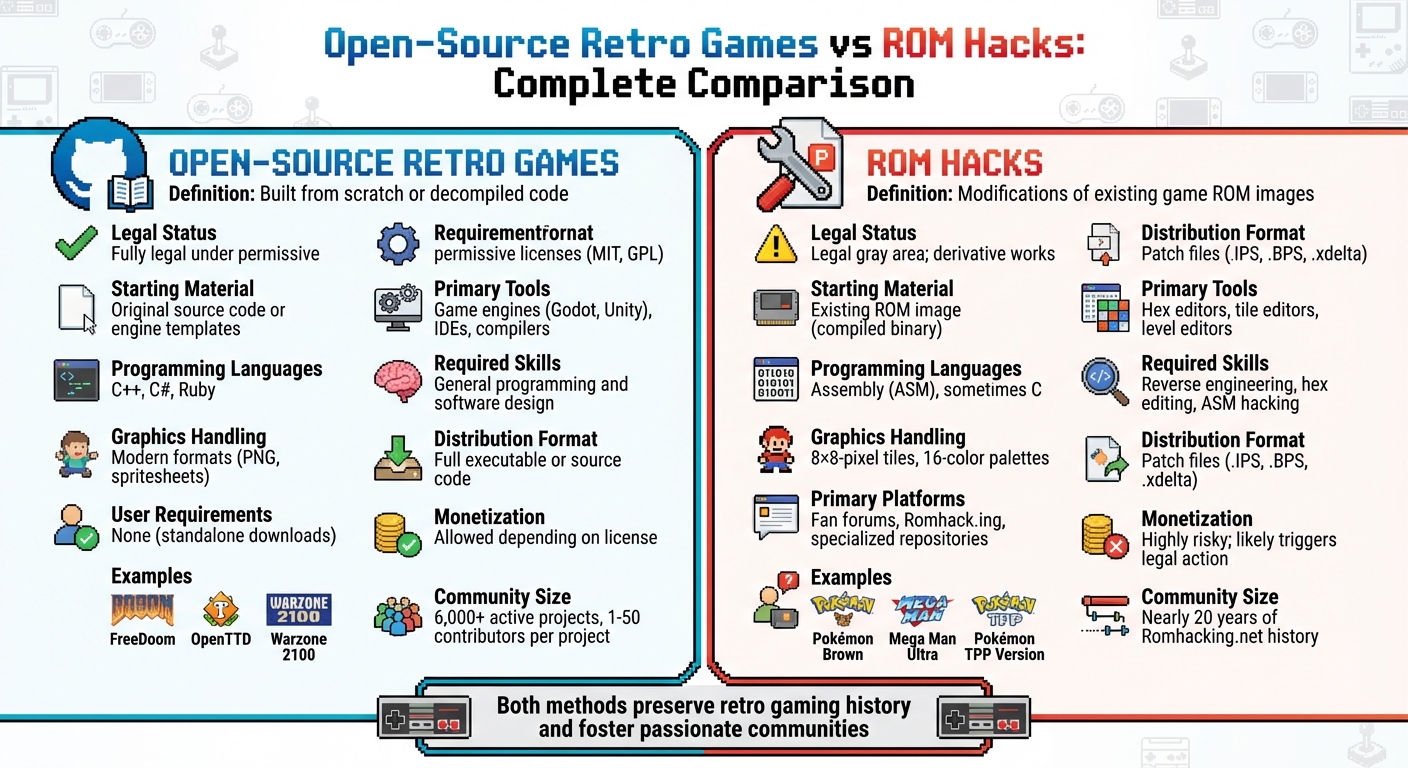
Open-Source Retro Games vs ROM Hacks: Complete Comparison Guide
What Are Open-Source Retro Games?
Definition and Core Features
Open-source retro games are video games where the source code is made publicly available, allowing anyone to study, modify, and share it freely. Unlike traditional commercial games, these projects emphasize openness and community collaboration.
At their core, these games provide unrestricted access to their source code, enabling developers to tweak and improve them without needing to decode complex, compiled files. The licenses typically used - such as the GNU General Public License (GPL) or the MIT License - ensure that modifications remain open and that others can freely sell, share, or alter the software.
"Open source doesn't just mean access to the source code. The distribution terms of open source software must comply with... Free Redistribution, Source Code, [and] Derived Works." - Open Source Initiative
A significant aspect of open-source retro games is their role in preserving classic titles. Developers often port these games to modern platforms, ensuring they remain playable. For example, as of September 2015, Steam hosted 1,500 games for Linux compared to 6,500 for Windows, highlighting the importance of open-source engines in bridging platform gaps. These efforts not only keep older games alive but also allow them to evolve with modern technology.
Let’s look at some standout examples of open-source retro games to see how these principles come to life.
Examples of Open-Source Retro Games
Several projects showcase how open-source gaming fosters creativity and preserves classics.
One notable example is FreeDoom, a community-driven project launched in 2001 and still active as of 2025. It creates entirely free replacement assets for the Doom engine (id Tech 1), offering two single-player campaigns and FreeDM, a multiplayer deathmatch collection. Licensed under BSD, the project allows players to enjoy these games without needing the original Doom, though a compatible source port like Chocolate Doom or ZDoom is required.
"Just as the GNU project was started to develop a free operating system to replace Unix, we aim to provide a free replacement for Doom." - Freedoom Project
Another standout is OpenTTD, a modern reimagining of the 1994 classic Transport Tycoon Deluxe. Hosted on GitHub, it continues to evolve with new features while maintaining its retro charm. Similarly, Warzone 2100, a real-time strategy game originally released in 1999, became open-source in 2004 when its code and assets were released under the GNU GPL. This move allowed the community to port the game to newer systems and keep its development alive.
The popularity of open-source retro games is evident in the "open-source-games" repository on GitHub, which, as of December 2025, boasts over 11,300 stars and 880 forks. Players can download these games from official project websites or access their source code on platforms like GitHub. This transparency allows users to contribute by fixing bugs, designing new levels, or creating custom assets.
This open, collaborative model stands apart from ROM hacks, which focus more on modifying existing games rather than building upon open-source foundations.
sbb-itb-9a4764e
What Are ROM Hacks?
Definition and How They're Made
ROM hacks are modifications of a game's ROM image - essentially its digital blueprint - using the original game engine to create new or enhanced versions of the game.
Creating a ROM hack involves a range of specialized techniques. Tools like hex editors allow direct changes to binary data, which can alter text dialogue or item properties. Tile editors, such as Tile Layer Pro, are used to redesign the game's 8×8-pixel graphics, while level editors like Lunar Magic for Super Mario World make it possible to overhaul maps without requiring manual coding. For more advanced changes, ASM hacking comes into play, rewriting low-level code through debuggers and assemblers to introduce entirely new mechanics and features.
"A ROM hack has most of the work already done for you - it's a complete engine at every step of your hack's production." - Bela, ROM Hacking Community Member
To avoid legal complications, ROM hacks are typically shared as patch files (e.g., IPS, BPS, or UPS formats). These patches are applied to unmodified ROM files by users, ensuring the original game data remains untouched.
The technical challenges of ROM hacking depend on the system being modified. For example, NES ROMs, written in 6502 Assembly, can be particularly tricky for beginners. On the other hand, Game Boy Advance ROMs can be expanded from 16 MB to 32 MB using the UPS patch format, effectively doubling the space available for new content.
These techniques form the backbone of the ROM hacking community, enabling fans to create projects that breathe new life into classic games.
Popular ROM Hack Examples
Using these methods, the ROM hacking community has created a wide array of impressive projects that showcase creativity and technical skill.
One standout is Pokémon Brown, created by Adam "Koolboyman" Vierra. This was the first Pokémon ROM hack to introduce a completely original storyline, featuring the new Rijon region and an expanded Pokédex. Another example is Pokémon TPP Version by pigdevil2010 and EliteAnax17, which included level 100 event battles and a "Battle Tent" facility. This ambitious project was completed in just 39 days.
For fans of Mega Man, Mega Man Ultra by "infidelity" offers a complete transformation of Mega Man 2. The hack features reskinned visuals, such as a temple backdrop inspired by Zelda II, along with custom-coded music tracks created using a hex editor.
"The creators of ROM hacks are Dr. Frankenstein, and the hacks that remix and conflate pieces of old games are their monsters." - David Craddock, Blogger and Author
ROM hacks span a variety of genres and purposes. Some focus on expanding the Pokédex to make all creatures catchable, while others, known as Difficulty or Kaizo hacks, ramp up the challenge significantly. Language hacks provide fan translations, and Full or Complete hacks essentially turn the original game into something entirely new.
For collectors who want to experience these fan-made creations on original hardware, BJ's Game Vault offers rare ROM hacks on custom cartridges for consoles like the NES, SNES, Sega Genesis, N64, and GBA - bringing these digital experiments into the physical world.
How Creation Processes Differ
Side-by-Side Comparison
As discussed earlier, ROM hacks involve modifying the binary files of existing games, while open-source retro games are developed entirely from scratch. These two approaches also differ significantly in how they are created.
ROM hacks begin with an already-compiled ROM - a binary file extracted from the original game cartridge. In contrast, open-source retro games are built from the ground up, using original source code or templates within modern game engines like Godot, Unity, or RPG Maker XP. Since ROM hacks reuse an existing game engine, they bypass some of the complexities of building an engine from scratch.
The technical skills required for each method also vary. ROM hacking involves reverse-engineering and working with low-level Assembly (ASM) languages tailored to specific console CPUs, such as 6502 Assembly for the NES or WDC 65816 for the SNES. Rainbow, an admin at PokéCommunity, explains:
"Programming is difficult and must be done with low-level languages... Most current hack programming is done in ASM, though C is also usable and will become much more accessible upon the completion of the disassemblies".
Open-source developers, on the other hand, typically use modern programming languages like C++, C#, or Ruby, which are generally easier for beginners to learn.
The tools used in each approach also highlight their differences. ROM hackers depend on hex editors, tile editors, and game-specific level editors to modify binary files. Meanwhile, open-source developers use standard software development tools, such as IDEs, compilers, and game engines with visual editors. ROM hacks also face stricter graphical limitations, often working with 8×8-pixel tiles and 16-color palettes. Open-source retro games, however, can take advantage of modern image formats like PNG files.
Here’s a detailed breakdown of these differences:
| Aspect | ROM Hacks | Open-Source Retro Games |
|---|---|---|
| Starting Material | Existing ROM image (compiled binary) | Original source code or engine templates |
| Primary Tools | Hex editors, tile editors, level editors | Game engines (e.g., Godot, Unity), IDEs, compilers |
| Programming Languages | Assembly (ASM) and sometimes C | C++, C#, Ruby, and others |
| Required Skills | Reverse engineering, hex editing, ASM hacking | General programming and software design |
| Graphics Handling | 8×8-pixel tiles and 16-color palettes | Modern formats (PNG, spritesheets) |
| Distribution Format | Patch files (e.g., IPS, BPS, UPS) | Full executable or source code |
Legal and Distribution Differences
Legal Status
The legal standing of open-source retro games and ROM hacks highlights a key difference between the two. Open-source retro games are fully lawful because they’re created from the ground up using original code or open-source engines. Developers release them under permissive licenses like MIT or GPL, which explicitly allow users to use, modify, and share the code freely.
ROM hacks, on the other hand, occupy a legal gray area. These modifications are considered "derivative works" under U.S. copyright law, as they alter existing copyrighted code. Alex Tutty, a Digital Media IP expert at Sheridans, explains the issue:
"Games are protected by copyright in the source code and in the representations on the screen as artistic works".
To navigate these legal challenges, ROM hackers distribute their work as patch files rather than full, modified games. These patches - commonly in formats like .IPS, .BPS, or .xdelta - only include the changes made to the original ROM. As PokéCommunity member Deokishisu notes:
"A patch only contains the changes made to the ROM, so it's technically only the hacker's work".
While this approach reduces legal risks for hackers, users still need to obtain the original ROM, which can lead to additional legal concerns.
Game companies actively protect their intellectual property through cease-and-desist orders. A notable example is Sega’s shutdown of Streets of Rage Remake in April 2011, just days after its release. This fan project had taken eight years to develop under the alias "Bomber Link". Tutty explains why companies take such action:
"If a company was to continually ignore infringements of a trade mark, the protection afforded by the mark is eroded and may render it invalid".
Adding to the complexity, U.S. video game copyrights typically last 75 years from the date of publication, giving companies a long window to enforce their rights. These legal dynamics heavily influence how open-source games and ROM hacks are shared and monetized.
How They're Distributed
The distribution strategies for open-source retro games and ROM hacks reflect their differing legal landscapes. Open-source projects thrive on platforms like GitHub and GitLab, where developers can share both source code and compiled executables. These platforms also provide tools for version control and collaborative development.
ROM hacks, however, rely on specialized fan communities and forums for distribution. For nearly two decades, ROMhacking.net was the go-to hub for these projects. However, on August 1, 2024, the site transitioned to a read-only news format, archiving its database on the Internet Archive to preserve its extensive collection. New platforms like Romhack.ing (RHDI), which launched public registration on March 1, 2025, have since stepped in to fill the void.
Interestingly, there are rare examples of ROM hacking receiving official recognition. One standout case is the Sega Mega Drive Classics Hub on Steam, launched in April 2016. This platform allows users to share and download ROM hacks of classic Genesis games through the Steam Workshop, offering a legally sanctioned space for community modifications.
| Feature | Open-Source Retro Games | ROM Hacks |
|---|---|---|
| Legal Status | Fully legal under permissive licenses | Legal gray area; derivative works |
| Distribution Format | Full executable or source code | Patch files (e.g., .IPS, .BPS, .xdelta) |
| Primary Platforms | GitHub, GitLab, official websites | Fan forums, Romhack.ing, specialized repositories |
| User Requirements | None (standalone) | Must own/source the original base ROM |
| Monetization | Allowed depending on license | Highly risky; likely triggers legal action |
The accessibility of these two approaches also varies. Open-source retro games are standalone products - users can download and play them immediately. ROM hacks, however, require additional steps, such as using patching tools and sourcing the original ROM. While this method helps shield distributors from direct copyright infringement, it can make ROM hacks less approachable for newcomers.
Community Involvement and Impact
How Open-Source Projects Work Together
Open-source retro game communities thrive on collaboration through platforms like GitHub. Here, developers, artists, and testers come together to contribute to projects. Right now, there are over 6,000 open-source game projects actively being worked on. Most of these have small teams - typically 1 to 15 core contributors, with up to 50 developers actively participating.
The guiding philosophy for these projects is all about openness and accessibility. As game designer Erlend Sogge Heggen puts it:
"When you've decided on a project you'd like to join, just create something you think they need and publish it. You don't have to ask permission. This is the epitome of open-source game development."
This mindset transforms gaming from something you just consume into something you actively shape. The source code is fully open, allowing anyone to modify and build upon it. Contributions vary widely - coding, creating art, composing music, writing documentation, and testing are all part of the mix. Collaborative tools help project leads track progress while giving newcomers a chance to learn alongside seasoned developers.
On the other hand, ROM hack communities take a slightly different approach, relying on remix culture and specialized forums to build their creations.
ROM Hack Communities
ROM hacking communities operate within a "remix culture", where existing game engines are reimagined to create fresh experiences. These communities often gather on specialized forums and repositories, with Romhacking.net standing as a cornerstone of the scene for nearly 20 years. The site is set to celebrate its 20th anniversary in December 2025.
The creative process involves blending assets from classic games while staying within the constraints of the original hardware. For example, in December 2025, developer Nerdalert released Super Bruh Bros, a ROM hack of Super Mario Bros. 3. This solo project, which took a year to complete, introduced seven new worlds along with features like wall jumps and a restart option in the pause menu. These innovations were made possible by Assembly code shared on GitHub by contributors like OrangeExpo and NEB Simmons.
The community is also making efforts to lower the barriers for newcomers. Romhacking.net has been clear about its mission:
"The site should be more of a simple tool rather than an obstacle that can get in the way of itself. We also want to see a reduction of gatekeeping, less strict rules, limited bureaucracy, and more inclusion."
For collectors who want to enjoy these creations on original hardware, there’s even an option to own physical copies. BJ's Game Vault offers rare ROM hacks and custom cartridges for systems like the NES, SNES, Sega Genesis, N64, and GBA. It’s a way to bring these imaginative mods into the tangible world of retro gaming.
Romhacking.net Is (Sort of) Dead, Let’s Talk About Rom Hacks, the History, the Limit Pushers
Conclusion
Open-source retro games and ROM hacks take different approaches to keeping the spirit of classic gaming alive. Open-source projects are built from scratch with original code, which makes them legally clear and highly collaborative, often hosted on platforms like GitHub. On the other hand, ROM hacks involve modifying existing games and distributing patches to address copyright issues. These contrasting methods highlight unique aspects of their creation and the challenges they face.
Both approaches play a crucial role in preserving retro games, essentially acting as a digital archive to prevent these titles from fading into obscurity. As Frank Cifaldi, founder of the Video Game History Foundation, aptly puts it:
"Emulation is the best tool for keeping older games in print in a cost-effective and accurate way."
While their methods differ, the communities behind these efforts share a passion for retro gaming. Open-source developers work together on shared codebases, often involving thousands of contributors, while ROM hackers focus on reimagining classic games with updates like SRAM save support and improved graphics.
For collectors who enjoy experiencing these creations on original hardware, BJ's Game Vault offers rare ROM hacks and custom cartridges for systems such as the NES, SNES, Sega Genesis, N64, and GBA. Whether you’re drawn to the collaborative spirit of open-source projects or the creativity of ROM hacking, both avenues provide meaningful ways to connect with and celebrate gaming history.
FAQs
Are ROM hacks legal to use?
ROM hacks are generally considered illegal under U.S. copyright law because they involve altering original game files, which are protected by copyright. Even if you legally own the original game, modifying, sharing, or using ROM hacks without the explicit permission of the copyright holder can still breach copyright regulations.
This can lead to issues such as copyright infringement claims or DMCA takedown notices, especially if the hack circumvents copy-protection measures. Since there’s no definitive legal precedent that clearly supports the fair use of ROM hacks, the safest course of action is to steer clear of them unless you have direct approval from the copyright owner.
What role do open-source retro games play in preserving gaming history?
Open-source retro games play a crucial role in keeping gaming history alive by making classic titles accessible on today’s hardware. When developers release original code or recreate these games under permissive licenses, it allows them to be updated, studied, and enjoyed without depending on old cartridges or outdated consoles. This approach helps ensure that iconic games don’t fade away as physical media wears out over time.
A big part of this preservation effort comes from the gaming community itself. Volunteers contribute by adding translations, fixing bugs, and creating detailed documentation, which makes these games available to more people around the world. Stores like BJ’s Game Vault also help by curating and distributing open-source retro titles, giving collectors and gamers a chance to keep these classics alive for future generations.
What do I need to create a ROM hack?
Creating a ROM hack involves blending technical know-how with the right tools. At its core, you'll need a hex editor to tweak the raw binary data of a game. If you're looking to redesign visuals, tools like graphics editors or tile editors will help you revamp sprites, palettes, and backgrounds. Want to dive deeper? Advanced hacks often call for assembly language editors or decompilers to overhaul game mechanics, levels, or even dialogue.
Beyond the tools, understanding the console's architecture is key. Familiarity with its memory map and assembly language can make a huge difference. Debugging is another must-have skill - testing for crashes or glitches is all part of the process. And let’s not forget the creative side: pixel art, level design, and writing all add character to your project. Not ready to tackle the technical side? Services like BJ’s Game Vault can transform completed ROM hacks into custom cartridges, letting you enjoy your modified games on original hardware without the hassle.