


Interview with Mario Adventure Creator DahrkDaiz
DahrkDaiz, a prominent figure in the NES ROM hacking scene, redefined expectations with his 2006 project, Mario Adventure. This ambitious hack of Super Mario Bros. 3 introduced new mechanics, non-linear progression, and technical features rarely seen on NES hardware. Over 16 months, DahrkDaiz transformed the game, adding power-ups, a weather system, and a save feature, all while juggling work and studies. The hack quickly gained attention, with over 11,000 downloads days after its release and praise from gaming communities for its creativity and depth.
Key Highlights:
- Introduced features like a spare item box, weather effects, and new power-ups.
- Removed traditional lives, replacing them with coins as currency.
- Levels required collecting hidden keys for progression, breaking from linear gameplay.
- Inspired future ROM hacks and set new standards for fan-made projects.
Despite challenges, including debugging issues and hardware glitches, Mario Adventure remains a milestone in retro gaming. It influenced creators and even led to sequels like Mario Adventure 3 in 2024. DahrkDaiz's work showcases the potential of ROM hacking and its impact on gaming culture.
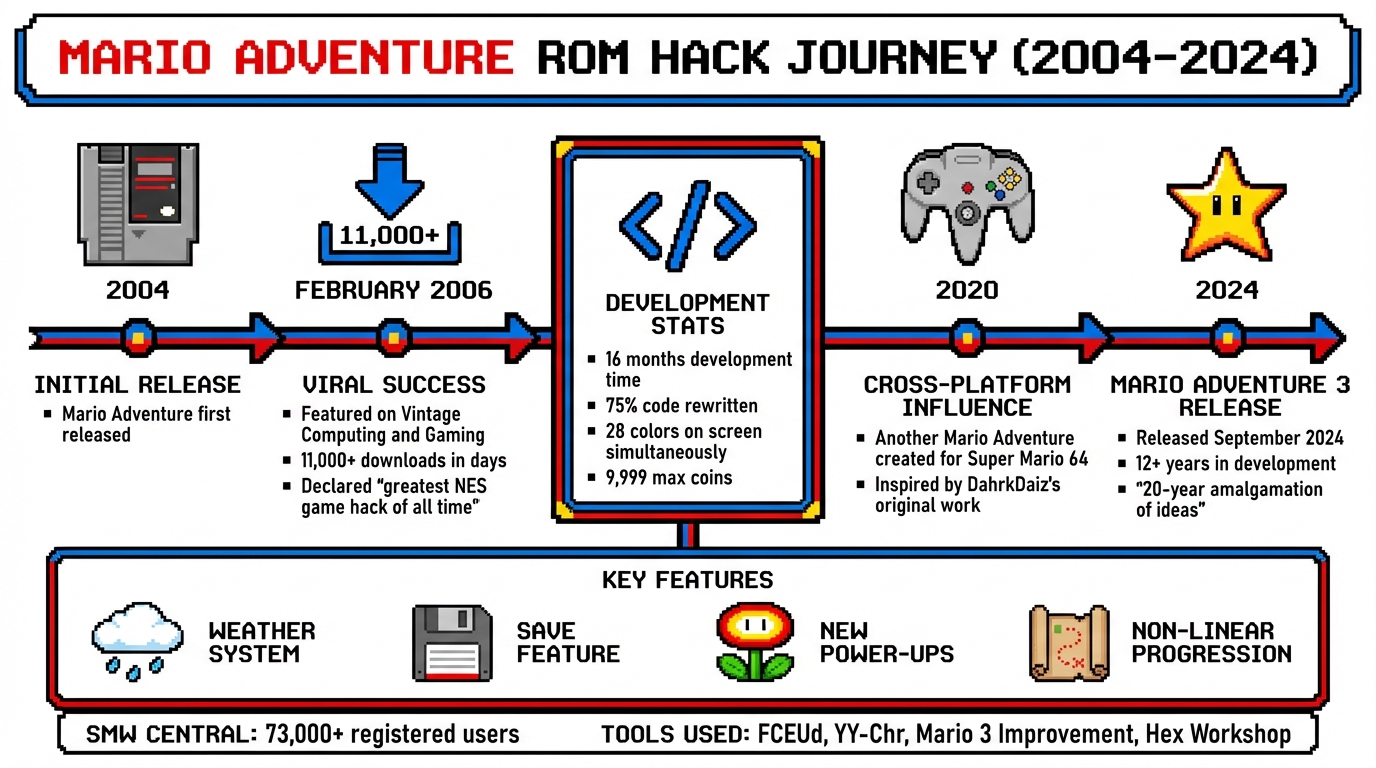
Mario Adventure Development Timeline and Key Milestones 2004-2024
Sunday Longplay - Mario Adventure (Super Mario Bros. 3 NES ROM Hack)
Creating Mario Adventure: Tools, Methods, and Problems
Developing Mario Adventure was no small feat. Over 16 months, DahrkDaiz blended technical know-how with the right tools, all while overcoming the constraints of NES hardware and expanding his understanding of game programming.
ROM Hacking Tools Used
To tackle the challenges of building Mario Adventure, DahrkDaiz relied on a handful of essential tools. First, he used FCEUd, an emulator equipped with a debugger that allowed him to analyze the Super Mario Bros. 3 code step by step. For graphics editing, he turned to YY-Chr, a tool designed for modifying sprites and visual elements. Level design was handled with Mario 3 Improvement, a specialized editor for Super Mario Bros. 3 levels. Finally, Hex Workshop served as his go-to hex editor, enabling direct edits to the ROM. Together, these tools became the backbone of his reverse-engineering efforts and the implementation of new game mechanics.
Technical Problems and Solutions
One of the toughest hurdles was finding unused space in the original ROM to add new code. DahrkDaiz explained:
At first it was very difficult. I slowly began to see a certain logic used behind the game. However, when reprogramming the code, I had to find unused space in the ROM.
Another major issue stemmed from an unexpected bug. During development, DahrkDaiz unknowingly leveraged a glitch present in most emulators. While the hack worked fine on emulators, it failed on actual NES hardware - the status bar would shift upward on the screen. Reflecting on this, he shared, "I reprogrammed the game to take advantage of a bug most emulators have, however, I did not realize at the time that it was a bug".
To resolve these issues, DahrkDaiz spent countless hours debugging, meticulously stepping through code. His dedication even extended to writing assembly code on paper during breaks at his fast-food restaurant job. These challenges not only tested his skills but also paved the way for the creative design elements that made Mario Adventure stand out.
Design Choices and New Features in Mario Adventure
DahrkDaiz took the beloved foundation of Super Mario Bros. 3 and gave it a bold makeover in Mario Adventure. His goal? To create the sequel he felt the Mario franchise deserved:
"The total lack of a proper Mario sequel. I was disappointed with the Mario Advance series and I saw other people's attempt at creating a new SMB3 experience and decided to take the matter into my own hands".
New Gameplay Mechanics
Mario Adventure introduced gameplay changes that shook up the traditional Mario formula. For starters, DahrkDaiz removed the concept of limited lives. Instead, coins - now collectible up to a staggering 9,999 - serve as currency. Players can spend these coins at Toad Houses to buy items or play mini-games. Another major tweak is the "spare box" system, inspired by Super Mario World. This feature lets players store a power-up and swap it in or out during gameplay using the Select button.
The game also boasts exciting new power-ups that redefine how Mario interacts with the world:
- Fire Fire Mario: Fires straight-shooting fireballs that pass through walls and allows for higher jumps.
- Invisible Mario: Lets Mario hide behind background elements to evade enemies temporarily.
- Magic Mario: Wields a wand, can take three hits, and fires powerful magic stars that eliminate most enemies in one shot.
- Kuribo's Shoe: Now usable as a stored power-up throughout the game.
Adding to the unpredictability is a random weather system. Each level can start with different conditions - sunny, raining, dark, dusk, or snowy. Snow introduces slippery surfaces, forcing players to adapt their strategies on the fly. These mechanics, paired with revamped level designs, make Mario Adventure feel fresh while staying true to its roots.
Level and World Design
Designed for seasoned Super Mario Bros. 3 players, Mario Adventure ramps up the difficulty considerably. DahrkDaiz explained his thought process:
"This hack was made with the hardcore SMB3 player in mind. I could practically beat the original with my eyes closed and figured it was time to up the difficulty".
One of the most striking changes is the game's structure. Instead of the classic linear progression, Mario Adventure introduces a central hub where players can access any world right from the start. DahrkDaiz shared his reasoning:
"Definitely the key collecting idea. I always liked having to back track through levels or world to get something out of the way to continue in a game. Point A to point B grows old quickly".
The levels themselves are anything but predictable. Enemies behave in unexpected ways - Boos turn invisible when Mario looks at them, Lakitus drop bombs that explode almost immediately, and Piranha Plants pop out of pipes even if Mario is standing on top of them. World 7, fittingly named "Desert Dares", is particularly unique. It features single-screen challenges where players must complete objectives like surviving for a specific time or collecting all the coins in the area.
These design choices ensure Mario Adventure constantly keeps players on their toes, offering a fresh take on a classic game while catering to those who thought they’d mastered Super Mario Bros. 3.
How the Community Responded to Mario Adventure
Player Feedback and Popularity
When Mario Adventure first hit the scene in 2004, it quickly became a standout in the gaming community. Its reputation skyrocketed even further after a February 2006 feature on Vintage Computing and Gaming. Gamers were blown away by how far the NES hardware had been pushed, marveling at the technical wizardry and ambitious scope of the hack. Greg Head, the author of the Mario Adventure FAQ, summed up the sentiment perfectly:
Mario Adventure is a ROM hack of Super Mario Bros 3 that's so good that calling it a ROM hack is almost an insult.
But not everyone was thrilled. Some players struggled with the game's "Nintendo Hard" difficulty, finding it more aggravating than enjoyable. Others pointed out technical hiccups, like a status bar bug on original NES hardware and a "key bug" that could make the game unwinnable if the player's inventory was full. DahrkDaiz, the creator, took these critiques to heart. Reflecting on the feedback, he shared:
I've listened to a lot of good and bad feedback on it and this new project I'm working on addresses those issues. But I like to thank everyone who's played this hack and given so much praise for it. It's really inspired me to take game development as a serious career.
The mix of praise and critique not only validated the hack's groundbreaking innovations but also solidified its place as a milestone in the ROM hacking community.
Influence on Other ROM Hacks
The strong reception to Mario Adventure didn’t just make waves - it redefined what ROM hacks could achieve. Before its release, most hacks were limited to simple tweaks, like level edits or graphical changes. DahrkDaiz raised the bar, showing that a ROM hack could feel like an entirely new game, complete with original mechanics, new power-ups, and complex systems. The hack introduced features that were unheard of on NES hardware, including a Super Mario World-style item storage system, a working battery save feature, and even real-time weather effects.
The influence of Mario Adventure stretched far beyond its initial release. In 2020, hackers created Another Mario Adventure for Super Mario 64, directly inspired by DahrkDaiz's groundbreaking work and featuring levels based on his designs. The legacy continued with the release of Mario Adventure 3 in 2024. DahrkDaiz described this sequel as:
more than a 12-year project, it's a 20-year amalgamation of ideas waiting to see fruition.
This new version pushed the NES even further, showcasing 28 colors on screen simultaneously and featuring roughly 75% rewritten code. Its impact was so enduring that it even helped inspire "Hacksterpiece Theatre", a recurring column on Vintage Computing and Gaming that highlights top-tier retro game hacks.
sbb-itb-9a4764e
DahrkDaiz's Takeaways and Tips for New ROM Hackers
Time and Effort Required
Creating Mario Adventure wasn’t a quick or easy task - it took DahrkDaiz 16 months of focused effort. His dedication extended far beyond his time at the computer. He even wrote assembly code on paper during breaks at his fast-food job. Reflecting on his process, he shared:
"Admittedly I did a poor job at coding it, hence all the bugs and glitches, but I did what I could with what knowledge I knew. A lot of time stepping through code and even writing code out on paper while at work during my break was required."
This journey taught him that persistence often outweighs perfection. Early on, he faced challenges like a status bar glitch on real NES hardware - a problem caused by relying on an emulator bug he didn’t realize existed during development. He also learned the importance of listening to feedback, using both praise and criticism to improve his future projects. These lessons form the backbone of his advice for anyone new to ROM hacking.
Getting Started with ROM Hacking
Drawing from his experiences, DahrkDaiz suggests a few key steps to help beginners get started. First, equip yourself with the right tools. He recommends starting with these four essentials:
- FCEUd: An emulator with a debugger for stepping through code.
- YY-Chr: A tool for editing graphics.
- Hex Workshop: For directly manipulating the ROM.
- Mario 3 Improvement: A program for level design.
These tools provide a strong starting point for understanding how games function on a technical level.
Another critical step is reverse engineering the game engine. DahrkDaiz spent countless hours observing how Super Mario Bros. 3 managed in-game mechanics. He explained:
"I slowly began to see a certain logic used behind the game. However, when reprogramming the code, I had to find unused space in the ROM, so that was pretty much hit and miss."
For newcomers, starting small is key. Modify a single character’s behavior or tweak one stage before diving into a full-scale project. Joining community forums like Acmlm's Board can also be incredibly helpful for learning from experienced creators and exploring other projects.
Lastly, when designing tougher sections, DahrkDaiz advises ensuring players have strategic ways to navigate challenges by fully utilizing power-ups. This approach keeps gameplay engaging while rewarding clever problem-solving.
Retro Gaming Resources at BJ's Game Vault

Custom Cartridges and Rare ROM Hacks
BJ's Game Vault brings retro gaming to life by offering custom cartridges, allowing fans to experience legendary ROM hacks like Mario Adventure on original NES hardware. For those who prefer the authenticity of playing on a classic console instead of using emulators, BJ's Game Vault delivers a solution. The demand for experiencing DahrkDaiz's celebrated hack on actual NES systems surged after it gained significant online attention.
These custom cartridges address technical issues, such as status bar glitches that could occur on NES hardware, by using modern production techniques. BJ's Game Vault doesn't just stop with the NES - they create retro-tested cartridges for systems like the SNES, Sega Genesis, N64, and GBA. Their collection includes reproduction vintage titles and rare ROM hacks, showcasing the creativity of independent developers who invest months reverse-engineering classic games. This physical format not only improves the gaming experience but also serves as a tribute to the history of gaming.
Preserving Retro Gaming History
Physical cartridges play an essential role in safeguarding retro gaming culture from the risks of digital data loss. By offering tangible copies, BJ's Game Vault ensures that homebrew projects - some of which take over a year to develop - are protected from hardware failures or corrupted files.
Beyond preservation, these cartridges fulfill the nostalgia of fans who crave classic 2D side-scrollers on original consoles. BJ's Game Vault's custom game services bring entirely new games to life while maintaining the charm of retro aesthetics. They also celebrate the dedication of homebrew creators like DahrkDaiz. Alongside their custom cartridges, the store offers gaming accessories and collectibles, all backed by fast shipping and reliable support.
Final Thoughts on Mario Adventure and ROM Hacking
Mario Adventure is a shining example of how individual creators can leave a lasting mark on gaming history. Over 16 months, DahrkDaiz poured their time and effort into reimagining Super Mario Bros. 3, creating what Vintage Computing and Gaming hailed as "the greatest NES game hack of all time". The hack's impact was immediate, racking up over 11,000 downloads just days after gaining attention. This quick success highlights how dedicated communities can rally around exceptional work.
The story didn’t end there. The legacy of Mario Adventure continued to grow, culminating in the release of Mario Adventure 3 in September 2024 - an incredible twelve years after development began. Now known as ScarlettVixen, the creator showed that passion and perseverance can lead to extraordinary accomplishments. This dedication has inspired a new generation of ROM hackers to push technical limits and even pursue careers in game development.
At the heart of ROM hacking lies a strong sense of community. Platforms like SMW Central, with over 73,000 registered users, act as hubs where creators share tools, offer feedback, and preserve projects that might otherwise be lost. In fact, when DahrkDaiz initially abandoned Mario Adventure 2, fans’ persistent requests eventually led to its public release. This kind of collective effort ensures that these creations are remembered and celebrated, whether through digital downloads or retro gaming collectibles like custom cartridges.
FAQs
What inspired DahrkDaiz to create the Mario Adventure ROM hack?
DahrkDaiz set out to create Mario Adventure because he believed Super Mario Bros. 3 never got the sequel it truly deserved. Disappointed by the approach of the Mario Advance series and let down by other attempts to reimagine SMB3, he decided to take things into his own hands, crafting an entirely new experience for fans of the iconic game.
His goal? To stretch the limits of what the original game could do, delivering something new and exciting while preserving the magic and charm of the classic Mario world.
What challenges did DahrkDaiz face while creating Mario Adventure, and how did he overcome them?
DahrkDaiz took the Super Mario Bros. 3 engine to a whole new level by painstakingly coding features like improved graphics, brand-new power-ups, and a clever save system. What’s even more impressive is that he managed to do this while working at a fast-food job, jotting down ideas on scraps of paper during his breaks. Over 16 months, he fine-tuned his work through relentless trial and error, demonstrating an incredible commitment to bringing his creative vision to life.
How did Mario Adventure influence the ROM hacking community?
Mario Adventure made waves in the ROM hacking world, quickly earning a reputation as one of the most impressive NES hacks ever created. Within a short time after its release, it racked up over 11,000 downloads and was praised for its inventive gameplay, imaginative level design, and overall polished feel. It raised the bar for what fan-made projects could achieve.
This game didn’t just stand out - it inspired a surge of creativity among developers, encouraging them to experiment and aim higher with their own projects. Today, it’s remembered as a milestone in retro gaming, a shining example of the potential in fan-driven innovation.