

Rare ROM Hacks Turned Custom Cartridges
Turning ROM hacks into physical cartridges has become a popular trend among retro gaming enthusiasts. This practice allows players to enjoy modified games on original consoles, blending modern creativity with vintage hardware. Two main methods exist: using donor cartridges or creating custom PCBs. Each has its pros and cons based on cost, technical skill, compatibility, and durability.
- Donor Cartridges: Involves repurposing old game cartridges by replacing internal components. It's cheaper upfront but requires advanced soldering skills and may permanently alter original games.
- Custom PCBs: Involves designing new circuit boards with modern features like flash memory and better save systems. While costlier and technically demanding, this method preserves vintage games and offers more flexibility.
Both methods cater to different needs, whether you're a hobbyist on a budget or a collector seeking long-term reliability. Retro gaming communities and services like BJ's Game Vault also support these projects, making it easier to bring ROM hacks to life.
Turning Pokémon Yellow Legacy into a physical Cartridge! 🎮🔥 (DIY Build)
1. Using Donor Cartridges
Using donor cartridges involves taking an original game cartridge and replacing its internal mask ROM with a programmed EPROM containing your ROM hack. This approach appeals to enthusiasts who appreciate authentic hardware, but it comes with its own set of hurdles, including cost, technical requirements, compatibility issues, and durability concerns.
Cost
While some less popular NES titles can be found for as little as $1.00, the real expenses often lie in the tools and materials needed for the process. For example, in 2016, hobbyist Callan Brown demonstrated how he created a reproduction of the Famicom game Moai Kun using a $1.00 "Fisher-Price I Can Remember" NES cartridge as a donor. However, specialized tools are required, such as:
- EPROM programmer: ~$40.00
- UV eraser: ~$20.00
- Nintendo security bit: $4.00–$8.00
Finished custom cartridges typically sell for $45.00–$55.00, making this a potentially expensive hobby for those starting out.
Technical Complexity
Replacing the original mask ROM with a programmed EPROM requires precise desoldering and soldering skills. As Callan Brown explains:
"Bigger games require a bit of rewiring to work. ... This tutorial covers only the most basic reproduction project."
Additionally, the ROM file often needs to be split into separate program (PRG) and graphics (CHR) components, then padded or mirrored to fit the capacity of modern chips. Clearing EPROM chips for reuse with a UV eraser can take about 15 minutes per pair. Even seasoned creators, like electrical engineer Andrew Reitano, who produced over 400 cartridges for his Kickstarter project Super Russian Roulette, found the process exhausting and eventually moved away from modifying donor boards.
Compatibility
Ensuring that your ROM hack works properly on donor hardware requires an exact match of specifications. Tools like NesCartDB can help verify that the cartridge's PCB type and mapper (e.g., CNROM, MMC1, MMC3) align with your ROM hack. However, compatibility issues can still arise. For instance, many modern ROM hacks use custom save systems that older donor hardware can't handle, leading to errors like the infamous "white screen." ROM hack specialist phantonomy explains:
"The white screen is a consequence of the save not working. If it's broken, you will get a white screen on emerald."
Durability
While donor cartridges use reliable original hardware, they have limitations. EPROMs can only endure a limited number of erase/program cycles - sometimes as few as 100. Additionally, aging CIC chips, which are essential for the cartridge's functionality, are difficult to replace. These challenges highlight the effort and passion within the retro gaming community to preserve authentic experiences while pushing the boundaries of custom cartridge production.
2. Using Custom PCBs
Custom PCBs offer a modern solution for retro gaming projects, bypassing the constraints of donor cartridges and introducing advanced capabilities. Instead of repurposing old hardware, creators design entirely new circuit boards equipped with components like microcontrollers, flash memory, and voltage regulators. While this approach demands more technical expertise upfront, it provides unmatched flexibility and long-term reliability.
Cost
At first glance, custom PCBs may seem like a pricier option compared to a $1.00 donor cartridge. However, the cost per unit drops significantly when ordered in small batches. For instance, building an N64 flash cartridge using an RP2040 microcontroller and flash memory costs about $9.00 in components, with PCB manufacturing adding $2.00–$4.00 for every five units produced. On the other hand, cheaper bootleg cartridges often lack essential features like Real-Time Clock support.
Technical Complexity
Creating custom PCBs isn’t for the faint of heart - it requires a solid understanding of advanced soldering techniques and firmware programming. For example, Andrew Reitano, an engineer, assembled more than 400 cartridges for his Kickstarter project, Super Russian Roulette, showcasing the level of expertise involved. Even seasoned developers encounter challenges; Troy Denton highlighted a costly mistake with an FTDI FT232H USB interface, emphasizing the importance of selecting the right components. Then there’s the matter of physical precision - N64 cartridges need to be exactly 1.2mm thick to fit properly into the console’s cartridge slot.
Compatibility
Custom PCBs have the upper hand when it comes to compatibility. They can emulate a variety of save types that donor cartridges and bootlegs often struggle with. For example, an RP2040-based N64 cartridge supports EEPROM (4/16Kbit), SRAM (256Kbit/1Mbit), and Flash RAM (1Mbit). This adaptability extends to handling different save systems and voltage requirements, something donor cartridges can’t easily manage. However, vintage consoles operate on 5V logic, so custom designs must either include level shifters or use components that are 5V-compatible. Developer Konrad Beckmann also advises ensuring the PCB edge connector has a 45-degree finger chamfer, as sharp 90-degree edges can damage the console’s cartridge connector over time.
Durability
Modern flash chips used in custom PCBs are built to last, supporting over 100,000 erase and program cycles. Compare that to the older EPROMs, which max out at just 100 cycles. This durability makes custom PCBs perfect for ROM hacks that might be reprogrammed frequently or shared within gaming communities. With these advancements, custom PCBs effectively overcome the limitations of donor cartridges, offering a more reliable and versatile option for retro gaming enthusiasts.
sbb-itb-9a4764e
Comparing Both Methods
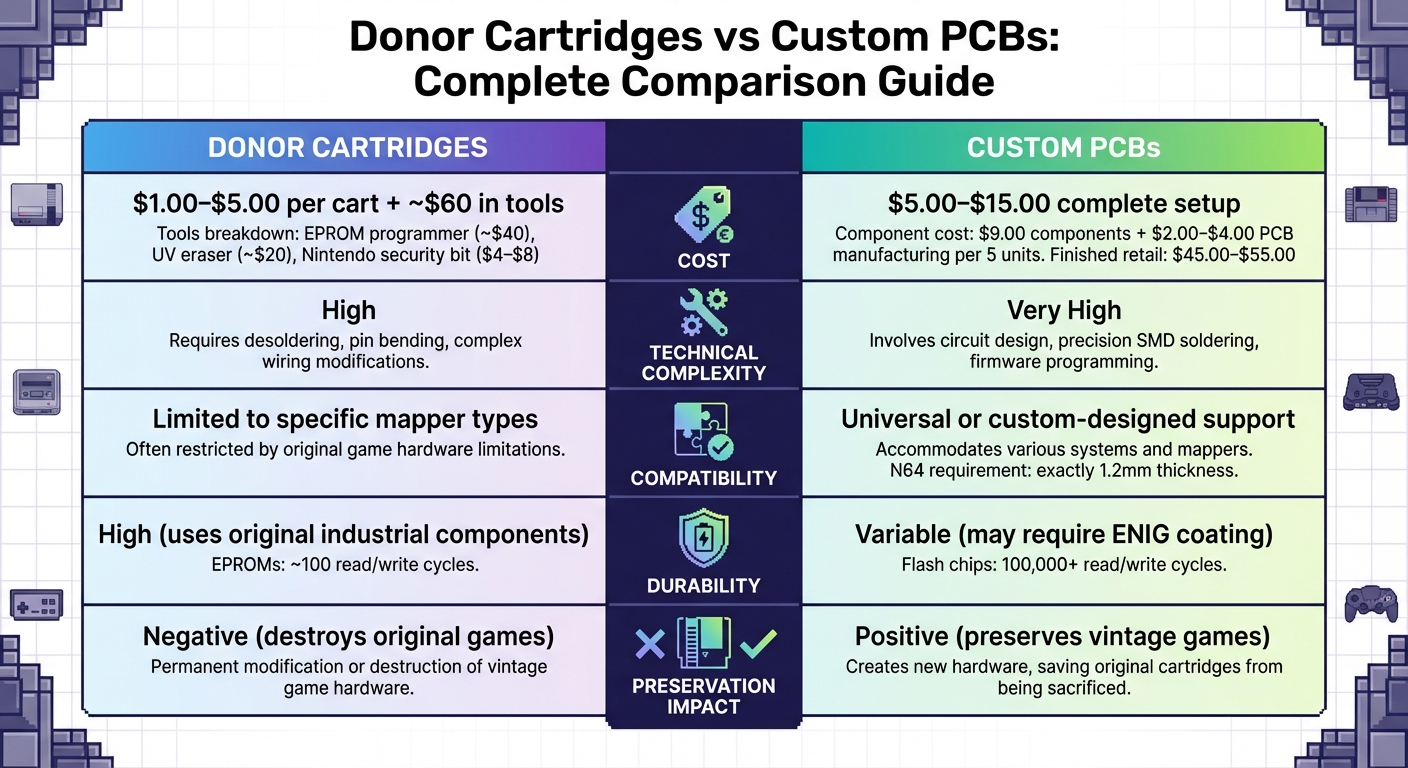
Donor Cartridges vs Custom PCBs: Cost, Complexity, and Durability Comparison
When it comes to donor cartridges versus custom PCBs, the decision often boils down to balancing cost, technical difficulty, compatibility, and durability. Each approach caters to different needs and skill levels, offering unique benefits based on the creator's goals.
Cost is one of the first factors to consider. Donor cartridges are an affordable entry point, typically costing between $1.00 and $5.00 each, though you'll also need tools like a Dremel or cutters, which can add up to around $60. On the other hand, custom PCBs become a cost-effective option when ordered in small batches. For example, the components generally cost about $9.00, with PCB manufacturing adding another $2.00–$4.00 for five units.
The technical complexity of each method is another key difference. Working with donor cartridges requires physically removing the original mask ROM, a process that involves tools like cutters and desoldering equipment. This method also demands manual jumper wiring because EPROMs aren’t direct replacements. By contrast, custom PCBs involve an entirely different level of expertise. You’ll need to design circuits, handle precise SMD soldering, and often use solder paste and reflow techniques. As Andrew Reitano explained during the production of Super Russian Roulette:
"It's exhausting, but really rewarding".
To make it easier to compare these methods, here’s a quick breakdown of their main differences:
| Feature | Donor Cartridges | Custom PCBs |
|---|---|---|
| Cost | $1.00–$5.00 per cart + ~$60 in tools | $5.00–$15.00 complete setup |
| Technical Complexity | High (desoldering, pin bending, wiring) | Very High (circuit design, SMD soldering, firmware) |
| Compatibility | Limited to specific mapper types | Universal or custom-designed support |
| Durability | High (uses original industrial components) | Variable (may require ENIG coating) |
| Preservation Impact | Negative (destroys original games) | Positive (preserves vintage games) |
The table highlights one of the most important distinctions: preservation impact. Donor cartridges permanently alter vintage games, which can be a significant drawback for preservation enthusiasts. Custom PCBs, however, avoid this issue entirely. They’re designed to protect the integrity of original games while also supporting modern features like Real-Time Clock functionality and advanced save types. This makes custom PCBs especially appealing for complex ROM hacks and larger production runs.
Ultimately, the choice between these methods reflects the community's ongoing effort to balance respect for gaming history with the need for modern functionality. Custom PCBs, with their ability to preserve vintage games and enable advanced features, are often the preferred option for those aiming to innovate while honoring the past.
How the Community Supports These Projects
The retro gaming community has been instrumental in turning ROM hacks into physical cartridges, making these projects more accessible and enjoyable for fans. Open-source tools like FlashGBX and specialized save patchers are at the heart of this movement. Take Lesserkuma's Custom 1M Flash Patcher, for instance - it prevents Pokémon ROM hacks from deleting save files after major milestones like defeating the Elite 4, a common issue for players.
Equally important is the wealth of shared knowledge within the community. Resources like "Pan Docs" provide crucial reverse-engineering insights into cartridge hardware and mappers. Meanwhile, forums such as PokéCommunity offer step-by-step guides on manufacturing and flashing ROM hacks, enabling enthusiasts to transfer games from emulators to original hardware. This collaborative spirit has even led to groundbreaking efforts, like the decapping of SNES DSP1 chips to extract firmware and replicate advanced calculations.
For those who prefer a simpler, more polished solution, professional services are available. Take BJ's Game Vault, for example. They offer custom cartridges that are tested on real consoles, priced between $29.99 and $59.99, with perks like free shipping and a Collector's Guarantee to ensure compatibility. Looking ahead, the store plans to launch a subscription box service in early 2026. The basic tier, at $45.00 per month, includes two ROM hack cartridges and a collectible, while the premium tier, priced at $85.00, features three cartridges and three collectibles.
Crowdfunding has also highlighted the community's enthusiasm for these projects. In March 2016, Andrew Reitano's Super Russian Roulette NES project raised more than $30,000 on Kickstarter, producing over 400 custom cartridges. Using universal reprogrammable boards and custom-made shells, this project showcased the strong demand for physical versions of ROM hacks, blending digital preservation with the joy of collecting.
Whether through DIY tools like Joey Jr v2++ or GBxCart, shared documentation, or professional services, the retro gaming community offers countless ways to bring ROM hacks to life. These efforts not only preserve gaming history but also inspire new creative possibilities.
Conclusion
When it comes down to it, the best choice depends on your specific needs and priorities. If you're on a tight budget and don’t require features like a Real-Time Clock for your ROM hack, donor cartridges (priced around $5.00) can be a solid choice. To avoid data loss, tools like Lesserkuma's Custom 1M Flash Patcher are invaluable for save-patching. On the other hand, if you’re a collector aiming to build a lasting library, custom PCBs with FRAM technology are a smart investment. These eliminate the risk of battery-related save failures, offering greater reliability over time.
The retro gaming community has played a huge role in making these advancements possible, driven by shared knowledge and collaboration. As Derek Andersen explained:
"The goal was never to make money, so I've really just invested time and money into this project because it's been fun to work on".
That same enthusiasm continues to fuel innovation in this space.
For those who want a hassle-free, ready-to-play option, professional services are available. Companies like BJ's Game Vault provide custom ROM hack cartridges, priced between $35.00 and $50.00, with free shipping included. They even offer a subscription service designed specifically for collectors, making it easier than ever to enjoy your favorite games without the technical challenges.
FAQs
What are the advantages of using custom PCBs instead of donor cartridges for ROM hacks?
Using custom PCBs for ROM hacks comes with some clear perks compared to donor cartridges. For starters, they’re simpler to produce and often allow reprogramming via USB, giving developers more freedom to tweak and update their creations. Plus, many modern custom PCBs do away with battery-backed storage altogether, cutting down on upkeep and boosting reliability.
This makes custom PCBs an affordable and practical option for crafting top-notch ROM hack cartridges, all while leaving vintage donor cartridges intact for collectors and fans who cherish them.
What’s the cost difference between using donor cartridges and custom PCBs for creating custom ROM cartridges?
The cost of producing custom ROM cartridges largely depends on whether you opt for donor cartridges or custom PCBs.
Donor cartridges are original game cartridges that are repurposed with new ROMs. Since they reuse existing hardware, this approach is generally more affordable. The process involves reprogramming the cartridge's internal components, which helps keep expenses down.
In contrast, custom PCBs require creating entirely new circuit boards from scratch. This involves designing the board, sourcing components, fabricating the PCB, and assembling the final cartridge. Naturally, this makes custom PCBs a pricier option, especially upfront. However, they provide greater flexibility and allow for modern features. For small-scale or hobbyist projects, though, donor cartridges often remain the more cost-effective solution.
What skills do you need to create custom ROM cartridges from donor games?
Creating custom ROM cartridges is a hands-on process that blends skills in electronics, hardware tweaking, and firmware programming. To get started, you'll need a solid understanding of circuit board layouts, the ability to solder with precision, and familiarity with chip pin configurations, such as those found on EEPROMs or mask ROMs. For instance, swapping out a ROM chip requires careful soldering and making sure the new chip's pins align perfectly with the board.
You'll also need the right tools to extract ROM data from an original cartridge and reprogram it onto a new chip. This often involves using specialized devices like cartridge programmers or flashers. On top of that, you’ll need to troubleshoot hardware connections and navigate firmware to confirm everything is functioning as it should. In short, creating custom ROM cartridges demands a sharp eye for detail and hands-on experience with electronics.