


How ROM Dumping Saves Retro Games
ROM dumping creates digital copies of old game cartridges, preserving them as their physical media deteriorates over time. This process safeguards iconic titles like Pokémon Red and The Legend of Zelda from issues like bit rot, failing save batteries, or wear and tear caused by repeated use. With 87% of classic games now classified as "critically endangered", ROM dumping ensures these games remain accessible for future generations.
Key points:
- Preservation: Prevents loss of data from aging cartridges and discs.
- Accessibility: Allows games to be played on modern devices via emulators.
- Community Efforts: Groups like No-Intro and Redump work to archive games accurately.
- Reproduction: Services like BJ's Game Vault turn ROMs into playable cartridges for original consoles.
ROM dumping isn't just about saving games - it’s about keeping gaming history alive. Whether you're a collector or a casual gamer, this process ensures that retro games can be enjoyed for years to come.
How To Make Roms // Back Up Retro Games and Saves * Tutorial *
The Problem: Cartridge Degradation and Loss of Gaming History
Retro game cartridges are at the heart of gaming history, but they’re slowly fading away. The solid-state media inside these cartridges is prone to bit rot, a process where electrical charges degrade over time, eventually making it impossible to store or read data. For instance, games like Pokémon Gold and Silver rely on internal batteries to save progress, but these batteries typically last no more than 15 years. When they die, decades of saved gameplay vanish, threatening not just individual memories but the very playability of these games.
Physical damage only adds to the issue. Jacob Mehnert from iFixit explains:
"Every time you insert a game cartridge into your console, the contacts are worn down".
Environmental conditions make matters worse. Cartridges left in garages or attics are exposed to dust, bright light, and humidity, all of which can damage their delicate circuits. Some unlicensed cartridges, designed to handle just 3.3V, can even be damaged when used in original consoles that output 5V.
The numbers paint a grim picture. According to the Video Game History Foundation, 87% of classic video games released in the United States are now classified as "critically endangered". Only 13% of games released before 2010 are still commercially available. When Nintendo shut down the 3DS and Wii U virtual storefronts in March 2023, just 25 out of 1,873 Game Boy titles remained accessible for purchase.
Frank Cifaldi, a games historian, highlights another troubling aspect:
"I think we're in danger of losing the history around these games as opposed to losing the ability to launch and play them".
This loss isn’t limited to the games themselves. Magazines, guidebooks, reviews, and other materials that document their cultural significance are also disappearing. Most publishers focus on preserving bestsellers like Mario or Sonic, while less-known but historically important titles are left to fade into obscurity.
Andrew Borman, another games historian, underscores the urgency:
"Time isn't on our side... If we wait too long, there won't be anything left to preserve".
The clock is ticking, and the window to save these pieces of gaming history is closing fast.
How ROM Dumping Works: Tools and Techniques
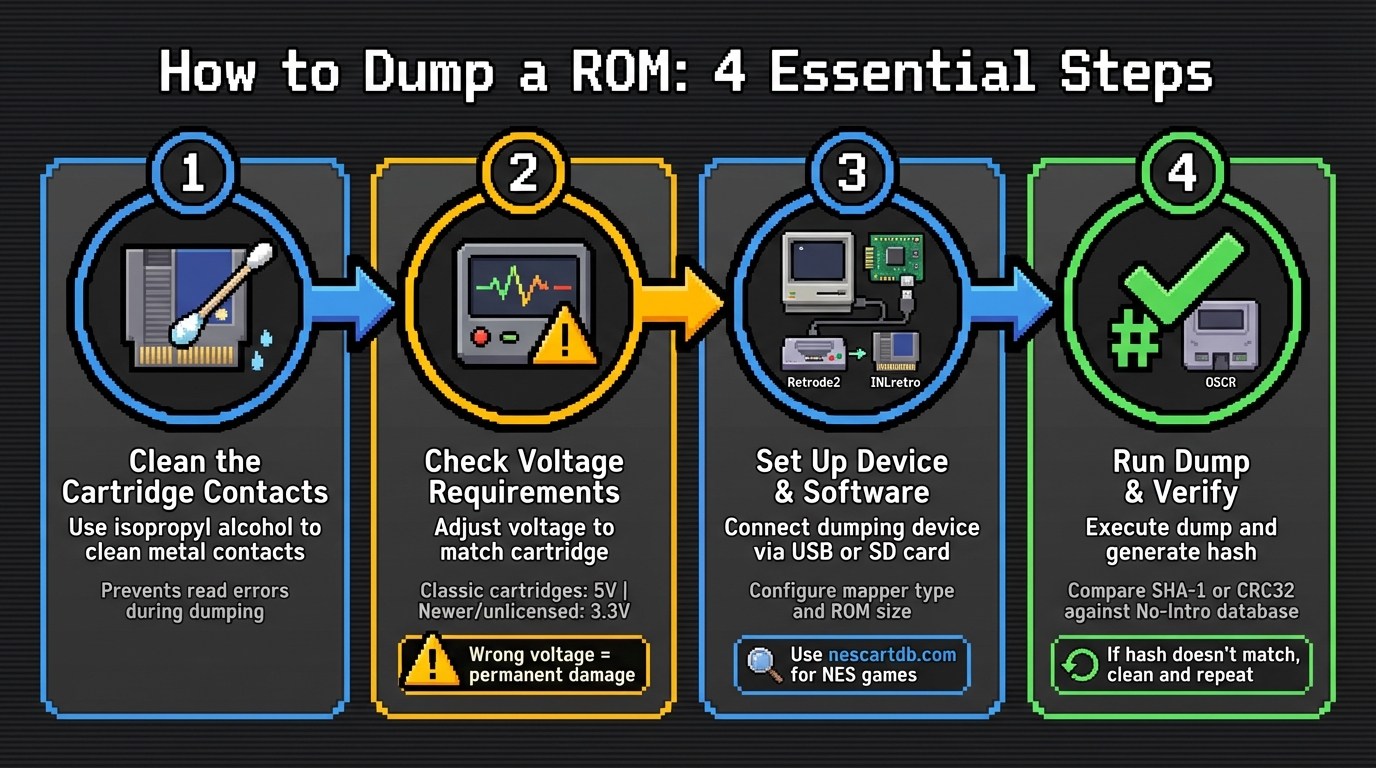
4-Step ROM Dumping Process for Retro Game Preservation
What is ROM Dumping?
ROM dumping is the process of creating an exact digital copy of a game cartridge's code, graphics, sound, and save data. This digital file can then be stored on a computer or used with emulation software, allowing you to play the game without risking wear or damage to the original cartridge.
Tools Needed for ROM Dumping
There are several tools available that make ROM dumping straightforward for both collectors and preservation enthusiasts. One of the easiest to use is the Retrode2, a USB device that lets your computer recognize cartridges as if they were standard storage drives. Just connect it, insert your SNES or Genesis cartridge (or use adapters for N64 and Game Boy), and copy the ROM file like you would from a USB drive.
For those comfortable with command-line tools, the INLretro Dumper is a versatile option. It connects via USB and uses Lua scripts to extract game data from various systems. Another popular choice is the Open Source Cartridge Reader (OSCR), a standalone device that writes ROM files directly to an SD card without requiring a computer. It supports multiple systems through specific adapters. If you're on a budget, you can even build a DIY NES dumper for around $35 using a NUCLEO-F070RB development board, a 72-pin connector, and some jumper wires.
Step-by-Step ROM Dumping Process
After choosing your tool, follow these steps to ensure a successful ROM dump:
- Clean the cartridge contacts: Use isopropyl alcohol to clean the metal contacts on the cartridge. This helps prevent read errors during the dumping process.
- Check voltage requirements: Adjust the voltage to match the cartridge. Most classic cartridges use 5V, but newer unlicensed or indie cartridges may need 3.3V. Using the wrong voltage could permanently damage the cartridge.
- Set up your device and software: Connect your dumping device via USB or insert an SD card. Configure the software to match the cartridge's mapper type and ROM size. For NES games, you can use databases like nescartdb.com to identify the correct mapper and size.
- Run the dump and verify the file: Execute the dump command or copy the ROM file. Generate a SHA-1 or CRC32 hash of the file and compare it against preservation databases like No-Intro to ensure accuracy. If the hash doesn’t match, clean the contacts again and repeat the process.
Benefits of ROM Dumping: Preservation and Accessibility
Preventing Game Loss
Over time, game cartridges can degrade. Issues like bit rot and worn contacts can lead to the permanent loss of valuable data. For many SNES and Genesis games, internal batteries are responsible for maintaining saved data. When these batteries fail, the saved data is gone forever.
Creating a ROM dump provides a digital backup before this degradation occurs. As Jacob Mehnert from iFixit explains:
"If you download a ROM that has been uploaded to the internet, then this is an act of piracy. However, if the ROMs are dumped from the original hardware... then this is legal as you are making backups of your own games."
This process effectively extends the lifespan of a game, protecting it from the physical limitations of aging hardware.
Making Games Playable Through Emulation
Once a ROM is safely backed up, emulation makes it possible to actually play the game without relying on aging hardware. Emulators allow you to run ROMs on modern platforms like PCs, smartphones, or handheld devices. This eliminates the need for functioning original hardware or components that may no longer be available.
Beyond simple preservation, emulation enhances the gaming experience. Features like upscaled graphics, customizable save states, and gameplay modifications make classic games more accessible and enjoyable for today’s players.
Keeping Gaming History Alive
Retro games are more than just entertainment - they’re snapshots of a bygone era, reflecting both cultural and technological milestones. ROM dumping preserves these games in their original form for future generations to study and enjoy. As one preservation guide emphasizes:
"ROMs play a crucial role in preserving retro games for future generations. Many early titles are considered digital artifacts, representing the cultural and technological evolution of the gaming industry".
For researchers and historians, having a ROM in its original, unaltered state provides an invaluable resource. Once a game is played, save data and other writable memory can change, making it impossible to study the game in its factory condition .
To ensure long-term preservation, store ROM backups on external SSDs or cloud storage. This redundancy protects your digital collection from hardware failures, ensuring your efforts to safeguard gaming history remain intact.
sbb-itb-9a4764e
Community Efforts and Organized ROM Preservation
No-Intro and Redump Projects
Preserving ROMs is far from a one-person job - it's a massive collective effort involving thousands of volunteers around the globe. Leading the charge are organizations like Redump and No-Intro, each focusing on different types of media but united by a common goal: preserving the legacy of gaming.
Redump.org specializes in optical media, such as CDs, DVDs, and Blu-rays. Their approach involves creating exact replicas - or "blueprints" - of disc data, capturing not just the game files but also the physical details of the disc itself. Their work spans dozens of systems, from popular consoles like the PlayStation 3 and Xbox 360 to lesser-known devices like the VTech V.Smile Pro and Bandai Pippin.
On the other hand, No-Intro focuses on cartridge-based and handheld systems, including classics like the NES, SNES, and Game Boy. Their mission is to produce clean, accurate ROM dumps by filtering out hacks and corrupted headers, ensuring compatibility with emulators. They also catalog official regional variants, creating a definitive reference for these systems. Both organizations maintain detailed metadata databases - covering cryptographic hashes, titles, and version numbers - while avoiding hosting the actual game files to steer clear of legal complications. This blend of technical precision and community-driven passion connects local efforts to global preservation initiatives.
Verification is a cornerstone of their process. For instance, Redump requires a second user to independently dump any unverified entry before it’s considered accurate. This double-checking system ensures the database remains reliable and reproducible, reducing errors caused by faulty hardware or damaged media.
How Individual Collectors Contribute to Preservation
While organized projects provide structure, individual collectors are the lifeblood of ROM preservation. With the right tools, anyone can contribute by dumping their physical games and adding valuable metadata and documentation to these archives. Collectors also share photographs of PCBs and game packaging, which help confirm authenticity and provide insight into manufacturing details. Additionally, they help maintain "Undumped" or "Missing" lists, identifying titles or versions that still need digital preservation.
Collaboration happens across platforms like the Video Game Preservation Collective (VGPC) Discord and various project-specific forums, where members exchange tools, techniques, and troubleshooting tips. Non-profits like Hit Save! even loan out specialized hardware, such as RetroBlaster cartridge dumping kits, to make the process more accessible.
Collectors adhere to strict guidelines to ensure the quality of their contributions. For example, they often dump sealed games before playing them to preserve factory-state data. They also document the specific hardware and firmware used during the process. When discrepancies arise - like a dump not matching existing records - they investigate whether it’s due to dirt, damage, or an entirely new revision.
As Redump.org aptly puts it:
"Nothing lasts forever. Optical media is especially susceptible to damage in the form of scratches, cracks, heat, sunlight, etc. Preserving these discs now will ensure that future generations aren't deprived of our video game history".
Using ROM Dumps with BJ's Game Vault Reproduction Cartridges

BJ's Game Vault brings retro gaming to life by transforming ROM dumps into physical cartridges, blending the digital preservation of classic games with the joy of playing them on original hardware.
Turning ROM Dumps into Playable Cartridges
Ever wondered if your favorite ROM hack or fan-made game could exist as a real cartridge? BJ's Game Vault makes it happen. They convert ROM dumps - whether they're hacks, fan translations, or lost prototypes - into fully functional cartridges compatible with consoles like the NES, SNES, N64, Sega Genesis, and Game Boy. These aren't just files for emulators; they're tangible cartridges ready to be inserted into your console for a truly authentic experience.
Take Viewpoint 2064 Final, for example, a long-lost N64 sequel originally developed by Sammy Corp. BJ's Game Vault released it as a physical cartridge in early 2026 for $54.99. Or consider Smash Remix v2.0, a fan-made expansion of the classic 1999 Super Smash Bros., available for $49.99. These cartridges are built with precision - using 72-pin connectors for NES and 60-pin formats for Famicom - to ensure seamless compatibility across regions. By bridging digital archives with physical gaming, BJ's Game Vault keeps retro gaming alive for collectors and enthusiasts alike.
Custom Cartridges for Rare and Fan-Made Games
BJ's Game Vault also offers custom cartridge creation, turning select ROM hacks into physical copies. This service breathes new life into games that never hit store shelves, such as unreleased prototypes, fan-made mods, and English translations of regional exclusives.
Their catalog includes unique offerings like a 2-player Super Mario Bros. hack for NES, priced at $44.99, which introduces true co-op gameplay. Another standout is Super Mario Land 2: 6 Golden Coins reimagined for the N64, available for $45.00. This version even requires an Expansion Pak to run on original hardware. All custom cartridges are designed with region-free shells, solving the age-old problem of regional restrictions, and are rigorously tested to ensure they perform flawlessly on vintage consoles.
Guaranteed Performance for Retro Consoles
Every cartridge from BJ's Game Vault undergoes extensive testing on original hardware to ensure it works perfectly - not just on emulators. This commitment to quality is backed by their "Collector's Guarantee", which promises reliability and satisfaction for retro gaming enthusiasts.
As BJ's Game Vault puts it:
"Each game is tested and built for real retro consoles because collectors deserve the classics that never were".
With prices ranging from $36.44 to $66.11 for NES cartridges and $45.00 to $54.99 for N64 titles, plus free shipping on all orders, BJ's Game Vault makes the dream of owning rare and custom retro games both accessible and reliable.
Conclusion: Securing the Legacy of Retro Gaming
ROM dumping plays a critical role in safeguarding classic games from the inevitable decay of physical media. As cartridges and discs deteriorate over time, creating digital backups becomes a necessity to preserve these pieces of gaming history.
"Once a cartridge or disc becomes unreadable, the game is lost unless it has been backed up digitally." – GameBoyShells
But preservation doesn’t stop at digital backups. Turning ROM dumps into physical cartridges adds a layer of tangibility to the process, allowing gamers to connect with history in a hands-on way. For example, BJ's Game Vault takes these digital archives and transforms them into functional cartridges compatible with original hardware. This blend of digital preservation and physical reproduction ensures that retro gaming remains accessible and authentic.
Frank Cifaldi, Founder and Director of the Video Game History Foundation, highlights the importance of this work with a powerful analogy:
"Imagine... if movies were only released on, like, VHS, ever. You want to watch Back to the Future? All right, you have to go on eBay, and you have to find an antique VHS copy that's degraded a bit from use."
Thanks to ROM dumping, the gaming industry avoids such a fate. It guarantees that future generations can enjoy the iconic titles that shaped gaming’s past - whether through emulators or carefully recreated cartridges for original consoles.
FAQs
What is ROM dumping, and how does it help preserve retro games?
ROM dumping involves creating digital backups of game data from physical cartridges. This process helps ensure that even if the original cartridge deteriorates or gets damaged, the game itself remains intact. By preserving these digital copies, retro gaming fans and historians can keep classic games alive for future generations.
ROM dumping is also essential for preserving gaming history, especially for rare or out-of-print titles that might otherwise fade into obscurity. For retro gaming enthusiasts, stores like BJ's Game Vault provide custom cartridges and reproduction titles, making it possible to enjoy these timeless classics without risking damage to the original copies.
What do I need to dump ROMs, and how does it work?
To create ROM backups, you'll need a cartridge reader - a hardware device specifically designed to extract game data from retro cartridges. These readers connect to your computer, usually through a USB port, and allow you to create a digital copy (ROM) of the game stored on the cartridge. This is an excellent way to preserve your games as the physical cartridges naturally wear out over time.
Most cartridge readers come with user-friendly software that guides you through the process step by step. Some models are compatible with multiple systems, such as NES, SNES, Sega Genesis, N64, and GBA, making them a handy tool for retro gaming fans. By creating these digital backups, you not only protect your favorite games but also contribute to preserving gaming history for years to come.
How do communities help preserve retro games?
Communities are at the heart of preserving retro games, working tirelessly to protect both the data and the history behind these classics. Fans and enthusiasts join forces to catalog, verify, and archive game files, making sure that rare titles and unique versions don’t fade into obscurity. These collective efforts ensure that the legacy of retro games remains intact for future generations.
Beyond archiving, community members create tools and methods for dumping ROMs from aging cartridges, safeguarding digital content as the physical media begins to degrade. By sharing expertise and resources, these groups cultivate an environment of preservation and appreciation, ensuring retro games remain accessible and celebrated - even in the face of hardware deterioration or the loss of original copies.