

10 Rarest NES Games Ever Made
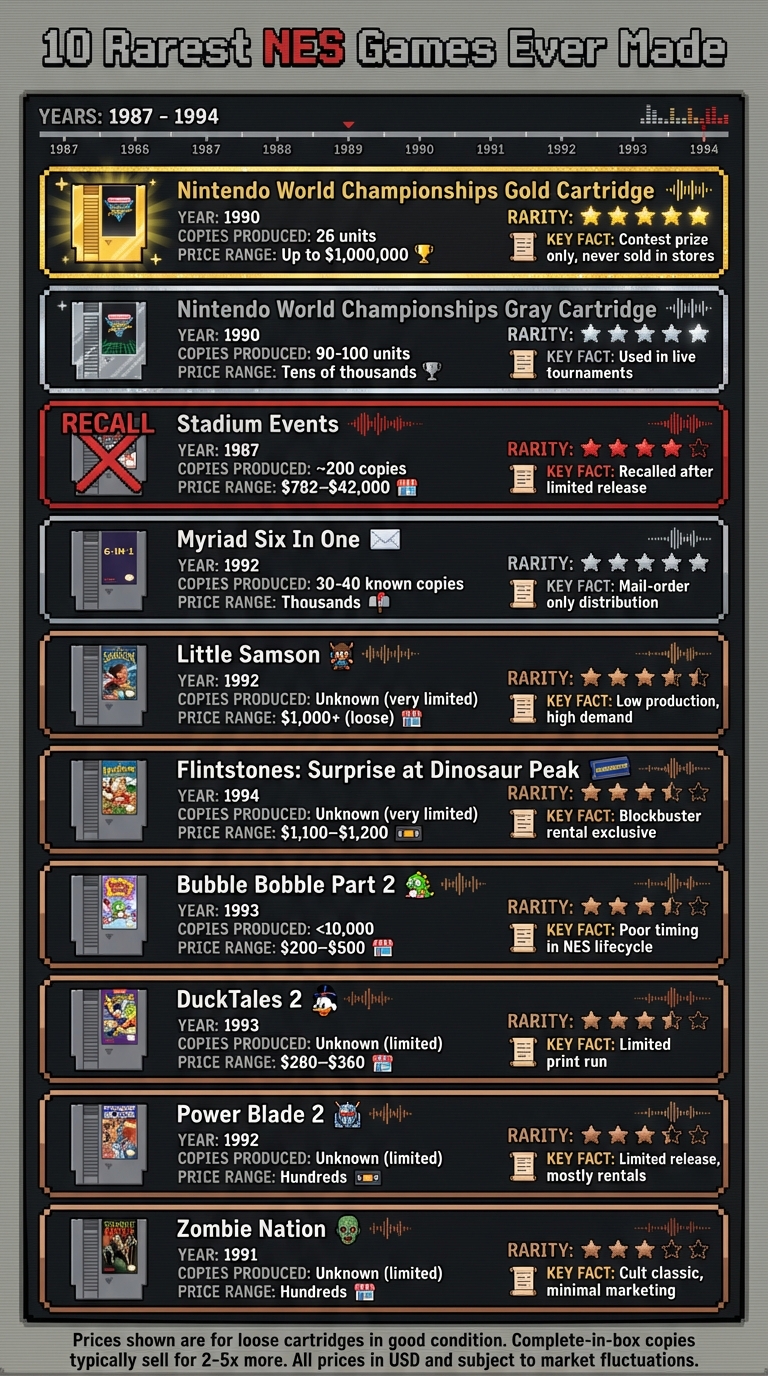
The NES era produced some incredibly rare games that collectors treasure today. These titles became scarce due to limited production, recalls, or exclusive distribution, often tied to the system's declining years. Some, like Stadium Events and the Nintendo World Championships Gold Cartridge, are legendary for their rarity and value, with the latter fetching up to $1,000,000. Others, such as Little Samson and Flintstones: Surprise at Dinosaur Peak, were released late in the NES lifecycle, limiting their availability. Here's a quick overview:
- Nintendo World Championships Gold Cartridge: Only 26 units exist; designed for a 1990 competition.
- Nintendo World Championships Gray Cartridge: 90-100 units; used during the same 1990 event.
- Stadium Events: Approximately 200 copies remain due to a recall.
- Little Samson: Released in 1992 with low production; prices start at $1,000 for loose cartridges.
- Flintstones: Surprise at Dinosaur Peak: Only available as a Blockbuster rental in 1994.
- DuckTales 2: A 1993 release with limited sales due to the rise of the SNES.
- Bubble Bobble Part 2: Poor timing in 1993 left fewer than 10,000 copies in circulation.
- Power Blade 2: A limited 1992 release, now a rare late-era NES title.
- Myriad Six In One: Less than 100 copies exist, distributed via mail order.
- Zombie Nation: A quirky 1991 release with minimal marketing.
Quick Comparison:
| Game | Year | Estimated Copies | Price Range (Loose) | Notes |
|---|---|---|---|---|
| Nintendo World Championships Gold | 1990 | 26 | Up to $1,000,000 | Rare contest prize |
| Nintendo World Championships Gray | 1990 | 90-100 | Tens of thousands | Used in live tournaments |
| Stadium Events | 1987 | ~200 | $782–$42,000 | Recalled after limited release |
| Little Samson | 1992 | Unknown | $1,000+ | Low production, high demand |
| Flintstones: Surprise at Dinosaur Peak | 1994 | Unknown | $1,100–$1,200 | Blockbuster rental exclusive |
| DuckTales 2 | 1993 | Unknown | $280–$360 | Limited print run |
| Bubble Bobble Part 2 | 1993 | <10,000 | $200–$500 | Poor timing in NES lifecycle |
| Power Blade 2 | 1992 | Unknown | Hundreds | Limited release, rental copies |
| Myriad Six In One | 1992 | ~30-40 known | Thousands | Mail-order only |
| Zombie Nation | 1991 | Unknown | Hundreds | Cult classic, limited release |
For gamers who want to relive these classics without spending a fortune, reproduction cartridges are an option. They work with original NES hardware and cost around $45–$60. However, for collectors, verifying authenticity through grading services is vital to ensure the originality of these rare finds.
10 Rarest NES Games: Rarity Rankings, Values, and Production Numbers
Top 10 Most Expensive NES Games!
1. Nintendo World Championships Gold Cartridge
The Nintendo World Championships Gold Cartridge stands as the ultimate prize for NES collectors. Back in 1990, Nintendo created just 26 of these cartridges: one for the tournament winner and 25 for the runners-up. These weren't available in stores or even used during the competition - they were strictly contest prizes. That exclusivity is a big reason why pristine examples have been known to sell for as much as $1,000,000.
What makes these cartridges so special? Each one contains custom-timed versions of Super Mario Bros., Rad Racer, and Tetris, designed to replicate the gameplay from the 1990 tournament. Players had a total of 6 minutes and 21 seconds to rack up the highest combined score across the three games. Adding to their allure, the cartridges feature a distinctive gold foil label with a hand-written serial number in black ink at the bottom-right corner - a key detail collectors use to confirm authenticity.
Because of their rarity and value, verifying a gold cartridge's authenticity is crucial. Professional grading services like WATA or VGA are often called upon to authenticate these treasures. Experts scrutinize everything: the label's print quality, the gold foil's finish, and the font spacing. They might even open the cartridge to inspect the internals. The unique shell color and molding from 1990 are also checked to ensure it's not a modern reproduction.
The gold cartridge has achieved legendary status in the NES collecting world, not just for its rarity but for its connection to gaming history. The 1990 Nintendo World Championships was one of the earliest large-scale, officially sanctioned console esports events in North America, laying the groundwork for the competitive gaming scene we know today. The gold version, produced in such limited numbers, symbolizes a unique moment in gaming history.
For those who can't afford the six-figure price tag, reproduction cartridges provide a more accessible option. Retailers like BJ's Game Vault create custom NES cartridges that are clearly marked as reproductions. These replicas work with original NES hardware, letting fans experience the same timed challenge format without breaking the bank.
2. Nintendo World Championships Gray Cartridge
The Nintendo World Championships Gray Cartridge may not be as scarce as the gold version, but it still fetches prices in the tens of thousands. Around 90 to 100 gray cartridges were created for the 1990 tournament, making them roughly three times more common than the gold ones. However, their rarity remains undeniable.
These gray cartridges were the actual hardware used during the 1990 competition, which toured 29 cities across the U.S., kicking off in Dallas, Texas. After the event concluded, Nintendo awarded these cartridges to regional finalists and top performers. While the gold versions were strictly prizes, the gray cartridges were used in live tournaments, adding a layer of historical significance. Each cartridge features the same timed challenge: Super Mario Bros., Rad Racer, and Tetris.
A defining feature of an authentic gray NWC cartridge is the rectangular cutout on the front-left side of the shell, exposing four dip switches. Tournament officials used these switches to tweak time limits and scoring settings. The label is straightforward and non-glossy, displaying the "Nintendo World Championships 1990" logo along with a unique identification number. Due to extensive use in tournament kiosks, many surviving cartridges show signs of wear, including damaged labels or replacement shells. While this affects their condition, it doesn't diminish their historical value.
Given the high price tag, authentication is a must. Grading services meticulously verify authenticity by comparing the PCB layout, ROM markings, and internal configuration to known originals. They also examine the label's print quality, texture, and font alignment, ensuring it doesn't use modern reproduction materials like glossy paper or incorrect colors. The dip switch cutout and internal layout are crucial markers for distinguishing genuine tournament cartridges from fakes.
For those who want to experience the timed challenge without owning an original, reproduction cartridges are an option. Shops like BJ's Game Vault produce custom NES cartridges clearly marked as reproductions, allowing fans to relive the competition on original hardware while preserving the legacy of the originals.
3. Stadium Events
Stadium Events holds legendary status in the world of NES collecting, with complete-in-box copies fetching anywhere between $782 and $42,000, depending on their condition. The game's rarity stems from a recall shortly after its September 1987 release, making its existence a fascinating story of limited production and unexpected scarcity.
Bandai initially released Stadium Events as part of its Family Fun Fitness line, bundled with the Family Fun Fitness Pad. However, Nintendo soon acquired the rights, recalled the remaining copies, rebranded the pad as the Power Pad, and re-released the game under the name World Class Track Meet. Out of the 2,000 copies reportedly produced, only about 200 made it into consumers' hands before the recall.
The gameplay itself includes Olympic-style events such as the 100m dash, long jump, and skeet shooting. While the mechanics are identical to those in World Class Track Meet, it’s the original Bandai branding and packaging that elevate Stadium Events to a collector's dream. Its historical significance as one of the earliest home fitness games - a precursor to modern titles like Wii Fit - adds another layer of appeal. This distinction, combined with its rarity, cements its value among enthusiasts.
For collectors, verifying authenticity is essential. The NTSC-U version (intended for North America) is far rarer than the PAL version released in Europe. Genuine cartridges feature specific label designs, accurate placement of the Nintendo Seal of Quality, and precise mold markings on the cartridge shell. Many serious buyers rely on services like WATA or VGA to grade and authenticate their copies, ensuring both originality and condition.
If your interest leans more toward gameplay rather than collecting, World Class Track Meet offers the same experience at a fraction of the cost. On the other hand, if you're captivated by the historical value and want to own a piece of NES history, reproduction cartridges - clearly marked and affordable - are available through sellers like BJ's Game Vault. These reproductions provide a budget-friendly way to enjoy a slice of gaming nostalgia.
4. Myriad Six In One
Myriad Six In One stands out as one of the rarest NES cartridges ever released in North America. This unlicensed multicart, distributed between 1992 and 1993 by the little-known Myriad Games, features six simple Famicom-style games. Essentially, it’s a rebranded version of the Caltron 6-in-1 multicart. However, what makes this cartridge so sought after isn’t the gameplay - it’s the extreme scarcity. Collectors estimate that fewer than 100 authentic copies were made, with only about 30–40 known copies accounted for in private collections today.
The story behind Myriad Six In One is just as intriguing as its rarity. Myriad Games acquired unsold Caltron stock, slapped on new labels, and distributed the cartridges through mail orders and small regional retailers instead of large national chains. This low-profile approach, combined with the declining NES market in the early '90s, meant very few copies ever made it into players’ hands. Unlike better-known rarities like Little Samson or Flintstones: Surprise at Dinosaur Peak, this cartridge never graced the shelves of major retailers, making it a true hidden gem for hardcore collectors.
Because public sales are so rare, the pricing for Myriad Six In One is unpredictable. Loose cartridges typically fetch several thousand dollars, placing it among the priciest NES collectibles. Some seasoned collectors even argue it’s "rarer than Stadium Events." Complete-in-box versions are almost mythical, and when one does surface, it sets a new benchmark. Sites like PriceCharting often lack recent sales data simply because these cartridges change hands so infrequently.
Given the high stakes, verifying authenticity is a must for anyone considering a purchase. Collectors carefully examine the label design, font, and print quality, often comparing them to high-resolution reference images from grading services or community databases. For added assurance, opening the cartridge to inspect the PCB layout, ROM chip markings, and soldering work is essential. Many buyers turn to grading services like WATA or VGA to authenticate and assess condition. Provenance from reputable auction houses or long-time collectors also adds a layer of trust.
For those who want to experience the gameplay without risking their investment, reproductions offer a practical alternative. Retro gaming specialists, such as BJ's Game Vault, create custom NES multicarts that replicate the original gameplay. This allows collectors to preserve their genuine copies while still enjoying the games as they were meant to be played.
5. Little Samson
Little Samson is one of the NES's rarest treasures, highly sought after by collectors due to its limited release. Taito launched this side-scrolling platformer in June 1992, at a time when gamers were already shifting their attention to the Super Nintendo. Unfortunately, the game didn’t get much exposure, and its small production run only added to its rarity. Today, that scarcity makes it a prized possession, often fetching sky-high prices at auctions.
What makes Little Samson stand out is its unique gameplay. Players can control four different characters - a knight, a dragon, a mouse, and a golem - each with their own special abilities. This variety not only makes the game fun to play but has also contributed to its growing appeal among collectors.
The numbers speak for themselves. A loose cartridge of Little Samson typically starts at around $1,000, while complete-in-box copies often sell for $2,000–$3,000 or more. These prices place it among the most expensive non-prototype NES games, often mentioned alongside other rare titles like Flintstones: Surprise at Dinosaur Peak and DuckTales 2.
However, with such high stakes, authenticity becomes a major concern. Collectors carefully examine Taito branding, label design, and the holographic seals on cartridges. For added assurance, many turn to professional grading services like WATA or VGA, which can verify the game’s authenticity and protect against counterfeits.
If you’re just looking to experience the gameplay without the hefty price tag, reproduction cartridges are an option. Check out BJ's Game Vault for safe alternatives.
6. Flintstones Surprise at Dinosaur Peak
Flintstones: Surprise at Dinosaur Peak stands out as one of the rarest NES cartridges ever made. This platformer, developed and published by Taito, hit the North American market in August 1994 - right when the NES was nearing the end of its lifecycle. Its late release during a time of industry change played a big role in its rarity.
Unlike most games, this title wasn’t widely available in retail stores. Instead, it was primarily distributed through video rental chains like Blockbuster Video, which significantly limited its availability in personal collections.
These days, a loose copy of the game typically sells for around $1,100–$1,200. If you’re lucky enough to find a complete-in-box copy, expect to pay several thousand dollars. While Flintstones: Surprise at Dinosaur Peak was once considered the rarest licensed NES platformer, that title now belongs to Little Samson. Even so, it remains firmly in the top 5–10 rarest licensed NES games released in North America. With such high price tags, confirming authenticity is absolutely essential.
Collectors take great care to verify these cartridges, examining everything from the Taito branding and label quality to the internal PCB details, including date codes and soldering. Many rely on professional grading services like WATA and CGC Video Games to ensure their investment is genuine.
For those who want to enjoy the game without breaking the bank, reproduction cartridges are a great option. Companies like BJ's Game Vault create clearly labeled custom NES cartridges, allowing fans to revisit this classic without the risk or expense of owning an original.
sbb-itb-9a4764e
7. Bubble Bobble Part Two
Bubble Bobble Part 2 hit North American shelves in August 1993, right as the NES era was winding down. Developed and published by Taito, this platformer entered the market during a time when gamers and retailers were shifting their attention to the Super Nintendo. That unfortunate timing played a big role in its low sales and eventual rarity.
Although it had a standard retail release, most stores weren’t stocking many NES games by then. Taito never disclosed exact production numbers, but collector communities estimate fewer than 10,000 copies were made. This estimate comes from how infrequently the game appears on the secondary market. One retro gaming collector even ranked it #5 among the rarest officially released North American NES games, excluding special competition cartridges. Its scarcity, despite being a retail title, sets it apart from other late-era NES games.
The game itself is the fourth NES installment in the Bubble Bobble series, following the original Bubble Bobble, Rainbow Islands: The Story of Bubble Bobble 2, and Parasol Stars. Its limited release and poor timing have made it a sought-after collector’s item today.
If you’re looking to add it to your collection, be prepared to spend a significant amount. Loose cartridges typically go for $200–$500, while complete-in-box versions can fetch between $800–$1,500, depending on their condition. To ensure authenticity, collectors often rely on grading services like WATA or VGA. They’ll also inspect the label for sharp Taito printing, verify holographic seals, and open the cartridge to confirm it contains period-correct PCB components with accurate date codes.
8. DuckTales Two
DuckTales 2 hit North American shelves in June 1993, developed and published by Capcom. By then, the Super Nintendo had been out for nearly two years, and gamers were gravitating toward 16-bit consoles. Retailers, noticing the shift, ordered fewer NES games, prompting Capcom to produce a much smaller print run compared to the original DuckTales or other Disney favorites like Chip 'n Dale: Rescue Rangers.
The game saw a standard retail release, but shrinking shelf space for 8-bit titles meant distribution was limited. Many copies found their way to rental stores, where boxes were often damaged or manuals lost. As a result, finding complete-in-box (CIB) copies in good condition today is a challenge, adding to their rarity.
Even with its limited release, DuckTales 2 improved on the original’s pogo-cane platforming by introducing puzzle-solving and treasure-hunting mechanics. Critics praised it for feeling like polished "lost levels" rather than a groundbreaking sequel. It also marked one of Capcom's final standout 2D platformers for the NES, closing out an era of beloved Disney-licensed games just as 16-bit entries began to dominate. These gameplay refinements, combined with its scarcity, have significantly boosted its value among collectors.
Current market prices reflect both its rarity and Disney nostalgia. Loose cartridges with clean labels and no rental stickers typically sell for $280–$360, while complete-in-box sets with intact boxes, manuals, and inserts fetch $1,400–$2,000. Factory-sealed copies graded by services like WATA can command $5,000–$8,500+, depending on condition and grading scores. All prices are in U.S. dollars and subject to market fluctuations.
To confirm authenticity, collectors often open the cartridge to check the PCB for the Nintendo logo and the chip code "NES-D2-0". The cartridge shell should have a gritty texture with a "Made in Japan" stamp, and authentic back labels will display an embossed two-digit factory code. Reproduction cartridges, which usually sell for around $45–$60, lack these authentic details, making internal inspection crucial for high-value purchases.
9. Power Blade Two
Released in September 1992 by Natsume and published by Taito, Power Blade 2 hit the market just as retailers began shifting focus to the Super Nintendo, leaving behind the NES. With the original Power Blade achieving only modest sales, stores placed smaller orders for the sequel. In response, Taito produced a limited print run, making Power Blade 2 one of the harder-to-find NES titles from the system's twilight years.
Although the game received a standard retail release, its limited distribution meant many copies ended up in rental stores rather than on the shelves of major retailers. As a result, finding complete-in-box copies with intact manuals and pristine packaging is especially challenging. Rental copies often lost their original boxes and inserts, adding to the difficulty for collectors. Today, Power Blade 2 is considered a rarity, standing alongside other elusive NES titles like Little Samson and Flintstones: Surprise at Dinosaur Peak.
Apart from its scarcity, Power Blade 2 is celebrated as a polished and demanding action-platformer that highlights Natsume's technical prowess. The studio was known for crafting other NES cult classics like Shatterhand, S.C.A.T., and Shadow of the Ninja. Like Power Blade 2, these games saw limited print runs and have since become highly sought after by collectors. As one of Natsume's final NES releases, Power Blade 2 represents the end of an era of well-crafted but underappreciated 8-bit action games.
In today’s U.S. market, prices for Power Blade 2 reflect its rarity and status as a late-release NES title. Loose cartridges in good condition typically sell for several hundred dollars, while complete-in-box copies can command much higher prices, often reaching into the high hundreds or more depending on their condition. Factory-sealed or professionally graded copies are even more valuable, frequently selling for low thousands of dollars, with prices varying based on demand and grading.
To ensure authenticity, collectors often examine the PCB for correct Nintendo board codes, chip layouts, and Taito-specific markings. The cartridge shell should feature accurate Nintendo model numbers and the correct screw types, while the label must display sharp printing with properly aligned Taito branding. Reproduction cartridges, which are common for high-value games like this, often use non-Nintendo PCBs with generic or modern components. For peace of mind, many U.S. collectors rely on professional grading services like WATA to verify authenticity before making significant investments. For those who want to experience the game without the hefty price tag, reproduction cartridges are available from retailers like BJ's Game Vault.
10. Zombie Nation
Zombie Nation, released in January 1991 by Meldac, hit the shelves just as the NES era was nearing its end. With Meldac being a relatively unknown publisher, the game had a limited print run. Its bizarre concept - guiding a giant floating samurai head to destroy aliens and cause chaos - helped it gain a cult following over the years.
While exact production numbers are unclear, collectors consistently rank Zombie Nation among the top 10 rarest licensed NES games in North America. Its late release, Meldac's small game library, and minimal marketing efforts all contributed to low sales and limited availability. Unlike ultra-rare finds like Nintendo World Championships or recalled titles such as Stadium Events, Zombie Nation surfaces more frequently on the secondary market. However, it’s still scarce enough to be a high-value collectible, sitting just below the rarest NES games. Its limited release reflects the broader shift in the gaming market as the NES era wound down, adding to its appeal among collectors.
Prices for the game reflect its rarity. Loose cartridges typically sell for several hundred dollars, while complete copies range from $600 to over $1,000. Factory-sealed versions fetch even higher prices, making it a prized item for serious collectors. The combination of genuine scarcity, a quirky storyline, and its cult status keeps demand strong.
To ensure authenticity, collectors examine the cartridge shell for proper Nintendo branding, check for the correct screw types, and inspect the label for sharp publisher markings. The internal PCB is also checked for proper licensing codes. Reproduction cartridges are common with high-value games like this, often using non-Nintendo boards with generic parts. Many collectors turn to professional grading services to confirm that their copy is genuine. For those who just want to experience the game without breaking the bank, reproduction cartridges are available through sellers like BJ's Game Vault.
How Collectors Verify and Price Rare Games
Verifying the authenticity of rare NES games involves a meticulous review of their physical features. The first step is inspecting the label. Collectors carefully analyze the label's color accuracy, font style, and wear patterns that match the game's production era. For example, genuine Stadium Events cartridges from 1987 have labels with faded purple tones, while counterfeit versions often display overly sharp edges or printing inconsistencies. Once the external label checks out, the next step is examining the cartridge's internal components for further verification.
Opening the cartridge reveals the internal circuit board, which offers additional clues about its authenticity. Collectors look for Nintendo holograms, date codes, and revision stamps that align with the game's original release period. High-value items like the Nintendo World Championships Gold Cartridge require extra scrutiny, as these cartridges feature distinctive gold plating and custom chips. With only 26 ever produced, verifying these details is crucial to avoid counterfeits and maintain the integrity of such rare titles.
To determine a game's market value, collectors often rely on price databases like PriceCharting.com, which aggregates real-time auction data. For example, Flintstones: Surprise at Dinosaur Peak currently sells for about $1,147.49, while the Nintendo World Championships Gold Cartridge has fetched prices as high as $1,000,000. The condition of a game significantly affects its value - complete-in-box copies can sell for two to five times more than loose cartridges. Many collectors also consult eBay "sold" listings and records from Heritage Auctions to confirm fair market prices.
For rare games valued over $500, professional grading services like WATA or VGA are often used. These services authenticate internal components and assign condition scores, helping buyers confidently navigate the market and avoid counterfeit items.
When the cost or fragility of original cartridges becomes a concern, reproduction games offer a practical alternative. Companies like BJ's Game Vault produce high-quality replicas of sought-after titles like Little Samson and DuckTales 2. Priced between $44.99 and $59.99, these reproductions feature accurate labels and 72-pin connectors compatible with original NES consoles. Each cartridge is retro-tested to ensure it works properly. This option allows gamers to enjoy rare titles on authentic hardware while preserving their valuable originals from wear and tear.
Conclusion
As outlined earlier, every rare NES game - from exclusive contest prizes to hard-to-find retail releases - represents a distinct chapter of retro gaming history. These treasures from the console's golden era (1985–1994) aren’t just games; they’re pieces of a bygone time. Titles like Nintendo World Championships cartridges, Stadium Events, and Little Samson stand out not only for their high price tags but also for their historical significance. They highlight moments like limited competitions, late-stage releases, and overlooked gems crafted by developers such as Taito and Natsume. For many retro gaming enthusiasts, these titles are symbols of dedication and passion.
While the soaring prices of these games have turned them into valuable collectibles, their worth often goes beyond monetary value. Collectors cherish them for their historical importance and the personal connection they bring. These games also preserve the authenticity of playing on original hardware, offering a nostalgic glimpse into the pre-internet era when discovering a hidden gem felt like uncovering a secret world.
FAQs
What makes NES games like Stadium Events and Nintendo World Championships so rare and valuable?
The allure and hefty price tags of NES games like Stadium Events and Nintendo World Championships stem from a combination of factors. First, their limited production runs mean only a handful of copies were ever manufactured. On top of that, exclusive distribution channels - like being sold at specific events or select stores - make these games even tougher to come by.
Their place in gaming history also adds to their appeal, as they represent key moments in the evolution of video games. And let’s not forget the condition of the cartridges - collectors are willing to shell out serious cash for copies in pristine shape, especially if they come with their original packaging. These elements together make these titles highly sought-after gems in the gaming world.
What’s the best way to confirm if a rare NES game is authentic before buying?
To determine whether a rare NES game is genuine, begin by inspecting the label quality. Authentic labels will have sharp, clear printing with accurate colors that don’t look faded or off. Next, examine the cartridge markings - original games often feature manufacturer stamps or engravings that can help confirm their legitimacy. To be extra sure, compare the game to verified images of known authentic copies. If you're still unsure, seek advice from retro gaming experts or reputable retailers like BJ's Game Vault, who specialize in rare games and can provide professional insights.
Is there a budget-friendly way to enjoy rare NES games without owning the original cartridges?
If you're looking to enjoy rare NES games without breaking the bank, reproduction cartridges and ROM hacks are excellent alternatives. These options let you dive into the nostalgia and gameplay of classic titles without shelling out for pricey original cartridges. Many retro gaming stores carry well-made reproductions, giving collectors and fans an affordable way to revisit their favorite NES classics.