


SNES Sound Chip Features Explained
The SNES sound chip, officially called the S-SMP, was a standout feature of Nintendo's 16-bit console. Designed by Sony’s Ken Kutaragi, it operated as an independent audio processor, delivering 16-bit stereo sound at 32 kHz using sample-based audio. Key highlights include:
- 8 Channels: Each channel could play compressed audio samples with effects like echo, reverb, and pitch modulation.
- 64 KB Audio-RAM: Limited memory required efficient storage using BRR compression, which reduced audio sizes while maintaining quality.
- SPC700 CPU + S-DSP: The SPC700 managed sound logic, while the S-DSP handled playback and effects.
Compared to rivals like the Sega Genesis (FM synthesis) and PC Engine (basic wavetable), the SNES offered richer, more realistic soundscapes. Its design influenced modern audio systems and remains iconic in gaming history.
SNES Audio System Overview - SPC700 Series pt. 1
sbb-itb-9a4764e
How the SNES Sound Chip Works
The SNES sound system functioned as a self-contained module called the SHVC-SOUND, which included three key components: the SPC700 CPU, the S-DSP (Digital Signal Processor), and 64 KB of dedicated Audio-RAM. A DAC (Digital-to-Analog Converter) transformed processed digital signals into analog audio for playback. Communication between the SNES's main CPU and this audio module relied on four I/O ports ($F4–$F7). These ports allowed the system to send music data and commands while the sound module operated independently.
SPC700: The Sound CPU
The SPC700 acted as the core controller for the SNES audio system. This 8-bit processor, running at 1.024 MHz, used its own instruction set, which was similar to that of the MOS 6502. It managed the audio system by executing code provided by the main CPU and directing the DSP.
Operating independently, the SPC700 handled audio logic, timing, and communication. It featured three internal timers - two running at 8 kHz and one at 64 kHz - to ensure precise music tempo and synchronization. When the system reset, a 64-byte IPL ROM initialized the sound module, preparing it to load the sound driver code and music data. The processor shared the Audio-RAM with the S-DSP, with the SPC700 accessing memory once for every two accesses made by the S-DSP.
While the SPC700 managed timing and logic, the S-DSP focused on generating the actual audio output.
S-DSP: Digital Signal Processor
The S-DSP was the workhorse responsible for generating sound. Running at 3.072 MHz, it produced 16-bit stereo audio at approximately 32,000 Hz across 8 independent channels. Each channel played audio samples compressed in the BRR (Bit Rate Reduction) format, which reduced 16-bit samples at a 32:9 compression ratio.
To ensure smooth playback at different pitches, the S-DSP used 4-point Gaussian interpolation to process audio samples. Each channel came with controls for stereo panning, pitch modulation, and envelope shaping through ADSR (Attack-Decay-Sustain-Release) or Gain settings. The chip also had the ability to generate white noise on any channel and create echo effects using a portion of the Audio-RAM as a feedback buffer. The S-DSP produced one stereo sample every 768 resonator cycles, with the final digital signal converted to analog by a 16-bit stereo DAC (commonly the NEC µPD6376) before amplification. The SPC700 oversaw these operations through 128 memory-mapped registers, accessible via hardware registers at $F2 (DSPADDR) and $F3 (DSPDATA).
64 KB of PSRAM: Audio Data Storage
The 64 KB Audio-RAM served as the storage hub for both program data and audio samples. The SPC700 used this memory to store its program code and variables, while the S-DSP accessed it for compressed audio samples and echo buffer data. This limited memory required sound programmers to carefully manage resources, balancing the size of program code, sample storage, and echo buffers within the fixed 64 KB capacity.
To make the most of this space, developers relied on BRR compression. By reducing 16-bit audio samples to 4-bit data, they could store far more content in the limited memory. The S-DSP decoded these compressed samples in real-time during playback, using Gaussian interpolation to maintain high audio quality.
This efficient use of memory laid the groundwork for the next topic: the specifics of BRR compression techniques, a standard for 16-bit game audio.
Audio Features and Effects
The S-DSP brought a range of tools to the table, including echo and reverb processing, stereo panning with pitch modulation, and noise generation with envelope control. These features gave sound designers the ability to craft more immersive and dynamic audio experiences.
Echo and Reverb Processing
One standout feature of the S-DSP was its dedicated hardware echo pipeline. Using a programmable buffer within the 64 KB Audio-RAM, the system allowed developers to define the size and location of the echo effect via the Echo Start Address (ESA) and Echo Delay (EDL) registers. The EDL value, which ranged from 0 to 15, controlled the delay length.
To enhance the echo's quality, the chip included an 8-tap FIR (Finite Impulse Response) filter. This filter used eight signed coefficients (FFC0–FFC7) to shape the echo's frequency response, simulating environments ranging from small rooms to vast halls. Developers could even apply echo selectively to individual audio channels, giving some instruments added spatial depth while leaving others unaffected.
The system also featured a feedback loop (EFB), which fed a portion of the echo output back into the buffer, creating sustained reverb effects. Games like Star Ocean and The Simpsons: Bart's Nightmare took this a step further by dynamically modifying the FIR filter to produce phaser or flanger effects. However, these effects came at a cost - managing echo buffers required careful handling due to the limited 64 KB Audio-RAM.
Beyond echo and reverb, the S-DSP fine-tuned audio with stereo and pitch controls for even greater depth and placement.
Stereo Panning and Pitch Modulation
The S-DSP’s ability to deliver 16-bit stereo audio at 32 kHz across eight channels was a significant leap forward. Each channel allowed independent panning and pitch modulation, enabling sound designers to create dynamic vibrato effects and evolving sound textures.
The system also supported multi-channel surround effects by using inverted-phase signals. When paired with compatible decoders via standard stereo RCA cables, games like Super Turrican and Jurassic Park could generate center and rear audio channels, adding a layer of spatial realism. Combined with echo and delay, this feature gave game soundtracks a richer sense of space and depth.
Noise Generation and Envelope Control
To complement its sample playback capabilities, the S-DSP included a noise generator and envelope control, which added flexibility for creating non-tonal sounds and shaping audio dynamics. The noise generator could be activated on any channel, offering 32 frequency steps to produce everything from low rumbles to sharp white noise. This made it ideal for effects like percussion, explosions, and ambient sounds.
Envelope control provided developers with precise volume shaping tools for each channel. The ADSR mode (Attack, Decay, Sustain, Release) followed a four-stage curve triggered by key-on and key-off events. Alternatively, Gain mode offered five distinct settings - direct, linear decrease, exponential decrease, linear increase, and "bent line" increase - allowing for more intricate volume adjustments.
Advanced sound engines, such as the David Whittaker engine, showcased the potential of these features by combining noise and envelope settings with pitch slides and random number generation. For example, random offsets applied to starting pitches or noise frequencies ensured that repetitive sounds like footsteps or gunshots felt varied and natural.
BRR Compression and Audio Storage
To pack intricate music, sound effects, and voice samples—often found in custom ROM hack cartridges—into the SNES's modest 64 KB of audio RAM, Nintendo introduced BRR (Bit Rate Reduction) - a custom compression system that the S-DSP could decode directly. This format was a clever workaround for the hardware's tight constraints.
How BRR Compression Works
BRR is based on Adaptive Differential Pulse-Code Modulation (ADPCM) and processes audio in compact 9-byte chunks. Each chunk includes a 1-byte header and 8 bytes of sample data, which represent 16 individual samples. The header carries three key pieces of information: a shift value (0–12) for scaling amplitude, a filter selector (0–3) for predictive coding, and flags to indicate whether the sample loops or ends.
The 8 data bytes are made up of 16 signed 4-bit nibbles. During playback, the S-DSP converts these nibbles into 16-bit samples by applying the shift value and one of four predictive filters. These filters reconstruct the waveform by predicting future values based on prior samples. Filter 0 skips prediction and is ideal for percussion or the start of a sample. Filters 1–3, on the other hand, use predefined coefficients to predict values, encoding only the difference to save space. This method compresses raw 16-bit PCM data - 32 bytes for 16 samples - down to just 9 bytes, achieving a compression ratio of 32:9 (or roughly 3.56:1).
| Feature | Specification |
|---|---|
| Block Size | 9 Bytes (1 Header + 8 Data) |
| Samples per Block | 16 Samples |
| Compression Ratio | 32:9 (approx. 3.56:1) |
| Bit Depth (Compressed) | 4-bit nibbles |
| Bit Depth (Output) | 16-bit signed PCM |
Fitting More Audio in 64 KB RAM
With a standard sampling rate of 32 kHz, BRR compression delivered a bit rate of 144 kbps per channel. This efficiency allowed developers to cram layered instruments, ambient effects, and voice clips into the limited 64 KB RAM.
However, this came with challenges. Loop points had to align with 16-sample boundaries to maintain the block structure and avoid glitches like clicks or gaps. Additionally, the Gaussian interpolation filter, while smoothing transitions, could dull high frequencies. To counteract this, designers often used higher sampling rates to retain audio clarity and brightness.
For simpler sounds, such as square or sawtooth waves, developers could manually design BRR blocks to create seamless loops with minimal RAM usage. The predictive filters, using fixed coefficients like 15/16 or 61/32, acted as leaky integrators, reducing the risk of error buildup and ensuring reliable playback.
This compression approach not only squeezed more audio into the system but also played a big role in shaping the SNES's distinct sound, setting it apart from competing consoles.
SNES Sound Chip vs Other Consoles
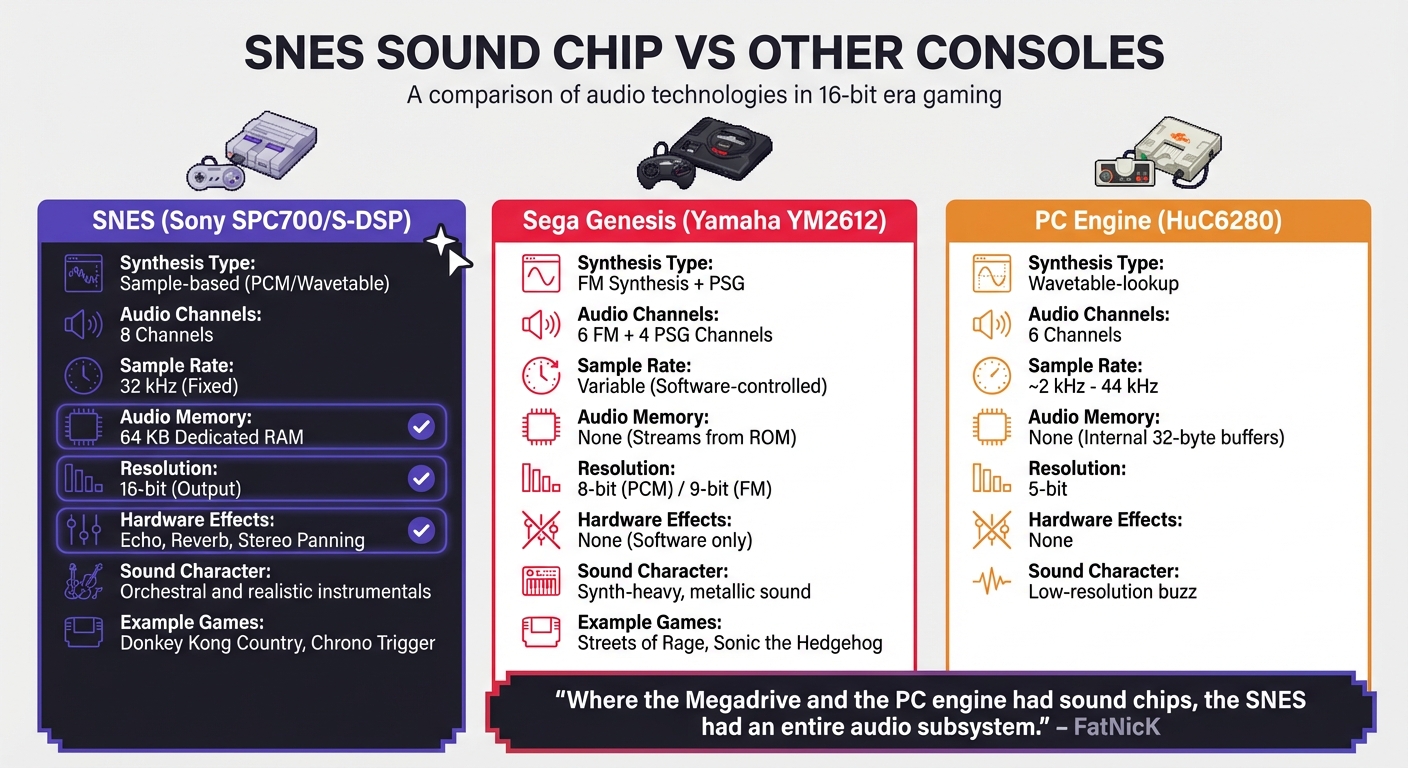
SNES vs Genesis vs PC Engine Sound Chip Comparison
The SNES's audio system stands out when compared to its competition, thanks to its sample-based approach, which allowed for realistic instrument sounds. This was a stark contrast to its rivals. The Sega Genesis, for instance, relied on FM (Frequency Modulation) synthesis via its Yamaha YM2612 chip, which generated sounds through mathematical algorithms. Meanwhile, the PC Engine (TurboGrafx-16) used wavetable synthesis but faced severe limitations, as its samples were capped at a mere 32 bytes with a 5-bit resolution. This resulted in what developers often described as a "low-resolution buzz".
"Where the Megadrive and the PC engine had sound chips, the SNES had an entire audio subsystem – the Nintendo S-SMP." - FatNicK
The SNES's design included 64 KB of dedicated audio RAM, giving it a notable advantage. In contrast, the Genesis lacked dedicated sample memory, forcing it to stream PCM data directly from cartridge ROM. This not only created additional CPU overhead but also limited the audio quality. Similarly, the PC Engine relied on its system RAM to store tiny wavetable fragments, leaving developers with little room to maneuver.
Another key strength of the SNES was its built-in hardware effects, such as echo, reverb, stereo panning, and ADSR (Attack, Decay, Sustain, Release) controls. These features significantly reduced CPU usage, enabling composers to craft rich, atmospheric soundscapes without taxing the system. By contrast, developers working on the Genesis had to rely on software to simulate similar effects, which consumed valuable processing power. The PC Engine offered no such effects at all.
Feature Comparison Across Consoles
Here's how the SNES stacked up against its competitors:
| Feature | SNES (Sony SPC700/S-DSP) | Sega Genesis (Yamaha YM2612) | PC Engine (HuC6280) |
|---|---|---|---|
| Synthesis Type | Sample-based (PCM/Wavetable) | FM Synthesis + PSG | Wavetable-lookup |
| Audio Channels | 8 Channels | 6 FM + 4 PSG Channels | 6 Channels |
| Sample Rate | 32 kHz (Fixed) | Variable (Software-controlled) | ~2 kHz - 44 kHz |
| Audio Memory | 64 KB Dedicated RAM | None (Streams from ROM) | None (Internal 32-byte buffers) |
| Resolution | 16-bit (Output) | 8-bit (PCM) / 9-bit (FM) | 5-bit |
| Hardware Effects | Echo, Reverb, Stereo Panning | None (Software only) | None |
Each console's audio design reflected its priorities. The Genesis leaned into its synth-heavy, metallic sound, which suited fast-paced, arcade-style music like Streets of Rage and Sonic the Hedgehog. On the other hand, the SNES excelled at producing orchestral and realistic instrumentals, making it ideal for games that required rich, immersive soundtracks. As developer Shiru noted: "SNES is far superior than SMD [Sega Mega Drive] and TG16 [TurboGrafx-16] [in digital sound]... pure hardware sampler vs. synth plus software-controlled low-quality DAC". This contrast - Genesis's sharp, synth-driven tones versus the SNES's lush, realistic audio - cemented the SNES as a standout in gaming sound design.
The Legacy of the SNES Sound Chip
The SNES sound chip changed the game - literally - by moving the industry from synthesis-based audio to sample-based sound. This shift wasn’t just a technical upgrade; it set the stage for the PCM-based audio systems that power today’s gaming experiences.
What made this chip stand out was its design. Acting as a self-contained audio subsystem with its own CPU, DSP, and 64 KB of PSRAM, it revolutionized how audio was processed. This independent architecture wasn’t just ahead of its time - it became a blueprint for modern consoles. Designed by Sony engineer Ken Kutaragi in 1989, this innovation not only gave the SNES its iconic sound but also nudged Sony toward creating the PlayStation brand.
The chip didn’t just push technical boundaries; it also set a new standard for creativity. With over 49 million SNES units sold, its audio profile became one of the most recognizable in gaming history. Features like built-in echo, reverb, and pitch modulation brought a cinematic feel to home consoles, something unheard of before. Composers such as David Wise (Donkey Kong Country) and Yasunori Mitsuda (Chrono Trigger) worked wonders within the chip’s 64 KB PSRAM limit, proving that restrictions can spark incredible creativity.
As Matthew Paul Argall remarked:
"The limitations of the built-in sound source... have fostered creativity and produced many famous songs."
– Matthew Paul Argall
Even today, the chip’s legacy is alive and well. Tools like the C700 VST and SNES GSS trackers allow modern musicians to replicate its nostalgic lo-fi sound in new projects. Meanwhile, the .SPC file format - a memory snapshot of the 64 KB PSRAM and SPC700 CPU registers - ensures classic SNES soundtracks are preserved for future generations. By blending technical ingenuity with artistic vision, the SNES sound chip continues to inspire both game composers and retro music fans alike.
FAQs
What is BRR compression, and how does it enhance SNES audio quality?
BRR (Bit Rate Reduction) compression improves SNES audio by compressing sound data into smaller chunks without sacrificing quality. It encodes 16 audio samples into compact 9-byte segments, using adaptive filtering and quantization to reduce redundancy and enhance playback efficiency.
This technique enabled the SNES to produce rich and detailed soundtracks, showcasing impressive audio performance despite the hardware constraints of the 16-bit gaming era.
What was the role of the SPC700 processor in the SNES sound system?
The SPC700 was an 8-bit processor designed specifically to manage audio for the SNES. Running at 1.024 MHz, it handled sound data separately from the main CPU, ensuring smooth gameplay without compromising audio quality.
By using memory-mapped registers to manage tasks like sound effects and music playback, the SPC700 enabled the SNES to produce the rich and immersive audio experiences that players came to love. This division of labor allowed the console to deliver outstanding soundtracks and effects while keeping the primary processor focused on gameplay.
How did the SNES sound chip shape the future of gaming audio?
The SNES sound chip, known as the S-SMP, changed the game for audio in the gaming world. Packed with advanced features like sample-based audio, stereo panning, and echo effects, it brought a new level of depth to how games sounded. Built by Sony, the chip included its own 8-bit CPU and a digital signal processor (DSP). This setup meant it could handle complex audio tasks on its own, without burdening the main CPU. The result? Games with richer, more immersive soundscapes.
This design choice - using a dedicated sound processor - set a new bar for audio quality in gaming. The SNES's approach influenced the development of modern consoles, leading to the high-quality sound design and multi-channel mixing we now expect in today's games.