


Arcade Ports to Consoles: A Timeline
Arcade games transformed home entertainment by bringing the arcade experience into living rooms. From the 1970s to today, developers have worked to recreate the magic of arcade hits on home consoles, often facing technical limitations and hardware constraints. These efforts not only shaped the gaming industry but also defined how consoles evolved to meet player demands.
Key takeaways:
- 1970s-80s: Early ports like Pong and Space Invaders drove console sales but often required heavy compromises in graphics and gameplay.
- 1990s: Consoles like the SNES and Sega Genesis brought more faithful reproductions, with hits like Street Fighter II and Mortal Kombat pushing the boundaries of what home systems could deliver.
- 2000s and beyond: Advanced consoles like the Dreamcast and Xbox offered "better-than-arcade" experiences, while digital platforms revived retro classics for new audiences.
Arcade ports not only brought iconic games home but also influenced console design, marketing, and gaming culture. From Pong to modern remasters, these games have left an indelible mark on the industry.
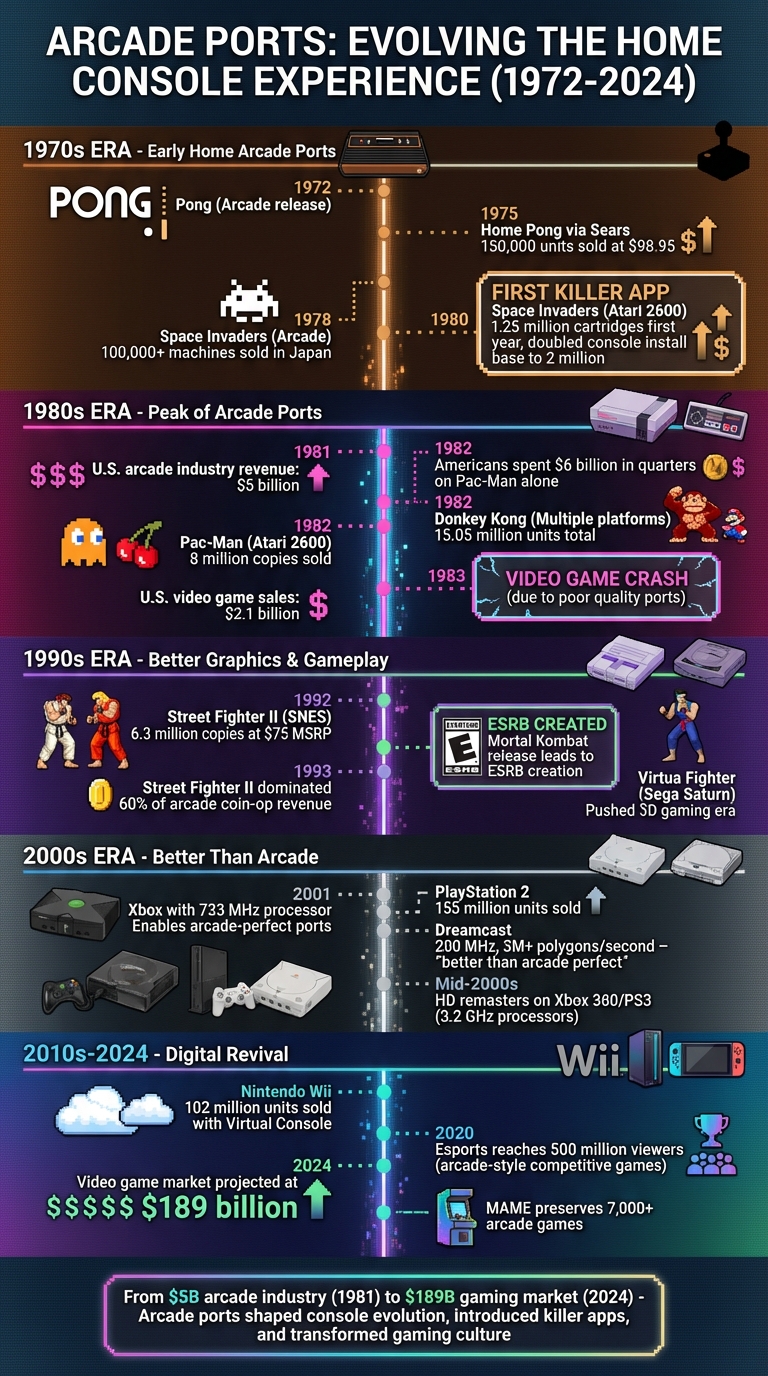
Evolution of Arcade Ports to Home Consoles 1972-2024
What Is The Deal With Arcade-To-Console Ports These Days?
sbb-itb-9a4764e
The 1970s: Early Home Arcade Ports
The 1970s ushered in a new era for gaming, bringing the thrill of arcade games into the comfort of American homes. This period saw pioneers in the industry tackling the challenge of transforming bulky, complex arcade machines into compact, affordable home systems. It was a time of bold engineering and clever business deals that set the stage for home gaming as we know it.
Pong: The First Arcade-to-Console Game
One of the most iconic moments of this era was the adaptation of Pong, which became a blueprint for bringing arcade hits into the home. After its massive success in arcades starting in 1972, Atari engineer Harold Lee managed to condense Pong's large circuit board into a single LSI chip - a feat that made it possible to produce a home version at a reasonable cost. The project, nicknamed "Darlene" during development, was a turning point for home gaming technology.
Atari partnered with Sears to sell the home version of Pong, branded under Sears' "Tele-Games" label instead of Atari's own name. This partnership proved to be a game-changer. During the 1975 holiday season, Sears sold 150,000 units of Home Pong at $98.95 each. Compared to the analog Magnavox Odyssey, which was priced at $100, Home Pong offered a digital experience with features like on-screen scoring and sound, powered by its advanced LSI chip.
"It was a way you could play games, you were sitting shoulder to shoulder, you could talk, you could laugh, you could challenge each other... I met my wife playing Pong." - Nolan Bushnell, Atari co-founder
This success sparked a wave of imitators, with companies like Coleco releasing their own systems, such as the Telstar series, which sold for around $50. The flood of clone systems highlighted the growing appetite for home gaming and the need for more sophisticated, original content. Pong not only set the stage for home gaming but also paved the way for more ambitious titles like Space Invaders.
Space Invaders on the Atari 2600
When Taito's Space Invaders hit arcades in 1978, it became a sensation, selling over 100,000 machines in Japan by the end of the year. Its introduction of persistent high scores created a competitive buzz that kept players coming back. Bringing this arcade hit to the Atari 2600, however, was no small feat.
The Atari 2600's hardware was modest, featuring a 1.19 MHz processor, 128 bytes of RAM, and just five single-color sprites. To overcome these limitations, developers used a technique called "racing the beam", which synchronized the game's code with the television's scanlines to maximize performance. These creative solutions showed that even limited hardware could provide a compelling arcade experience.
The 1980 release of Space Invaders for the Atari 2600 became the first true "killer app" for the console. It sold 1.25 million cartridges in its first year, nearly doubling the console's install base to over 2 million units. This success proved that licensing popular arcade titles could drive console sales and marked the beginning of a new chapter in home gaming.
The technical advancements achieved during these early years - like the integration of LSI chips and innovative coding techniques - set the stage for even more complex arcade-to-home adaptations in the following decade.
The 1980s: The Peak Era of Arcade Ports
The 1980s saw home consoles making huge strides toward replicating the arcade experience. By 1981, the U.S. arcade industry was raking in $5 billion annually, and by 1982, Americans had spent an eye-popping $6 billion in quarters on Pac-Man alone. This arcade craze created a massive demand for home versions, pushing console makers to create systems that could bring the thrilling "arcade-at-home" experience to living rooms.
Popular Ports: Pac-Man, Donkey Kong, and Centipede
As home console technology advanced, developers began tackling arcade hits, though the results were a mixed bag. Some ports became legendary, while others exposed the limits of early hardware.
Atari's Pac-Man for the 2600 was a commercial juggernaut, selling over 7.2 million copies in 1982 and eventually hitting 8 million units. However, the technical compromises were hard to ignore. With only 128 bytes of RAM compared to the arcade system's 4KB, the port struggled to capture the charm of the original. Electronic Games magazine gave it a harsh 4 out of 10, criticizing it as "devoid of what gave the original its charm".
Nintendo's Donkey Kong, on the other hand, enjoyed much better reception across platforms, selling 15.05 million units across systems like the NES and ColecoVision. The NES version, released in 1986 as part of the "Arcade Classics Series", stayed true to the arcade gameplay, though it omitted the "50m" conveyor belt level due to hardware constraints. ColecoVision even bundled Donkey Kong as a pack-in title, promoting its reputation for near-arcade-quality gaming.
Atari's Centipede for the 5200 showcased how improved hardware could deliver faithful ports. The 5200, essentially a gaming-focused version of the Atari 400/800 computer with 16K of memory, allowed for a much closer match to the arcade original. Games magazine praised the port as "splendidly reproduced". The system also introduced specialized controllers like the Trak-ball, designed to mimic arcade-style input for games like Centipede and Missile Command.
Hardware Limits and Developer Workarounds
Adapting arcade games to home consoles in the 1980s came with serious technical hurdles. Arcade systems often used entirely different processors and architectures, meaning developers couldn't simply copy the code. Instead, they had to rebuild games from the ground up, often using assembly language.
For the Atari 2600 version of Pac-Man, programmer Tod Frye had to get creative. The console could only display two player sprites at a time, so Frye developed a technique to alternate ghost sprites frame by frame. He also simplified the maze design, used repetitive patterns, and swapped round dots for rectangular "wafers" that shared the wall color. These changes allowed the game to fit into a 4KB ROM but resulted in visual stuttering that made the port controversial.
The Nintendo VS. System flipped the script entirely. This arcade system used the same hardware as the Famicom (NES), making it much easier to bring arcade hits to home consoles. This hardware alignment was key to the NES's success in North America. Nintendo also introduced the 10NES lockout chip and strict licensing policies in the mid-1980s to prevent the flood of low-quality arcade ports that had contributed to the 1983 video game crash. These innovations not only improved the quality of home gaming but also set the stage for a stronger synergy between arcade and home systems.
The 1990s: Better Graphics and Gameplay at Home
The 1990s marked a turning point for home gaming, as consoles began to rival the quality of arcade machines. With the arrival of 16-bit systems like the Super Nintendo (SNES) and Sega Genesis, arcade ports reached new heights. These consoles could finally handle full-screen sprites and intricate character designs straight from the arcade. The SNES introduced features like shoulder buttons ("L" and "R") and a four-button face layout (X, Y, A, B), which became iconic. Enhanced scrolling capabilities also allowed for expansive game environments that moved smoothly in all directions, along with more advanced physics systems. For the first time, players could enjoy a gaming experience at home that truly felt arcade-worthy.
Street Fighter II and Mortal Kombat: Fighting Games Come Home
In July 1992, Capcom released Street Fighter II: The World Warriors for the SNES, proving that arcade-quality gaming was no longer exclusive to arcades. This port was incredibly faithful to the original, with only minor omissions like the opening cutscene. The game's success was massive - by 1993, Street Fighter II dominated the arcade market, accounting for about 60% of all coin-operated arcade revenue. The SNES version also became the console's best-selling title, moving over 6.3 million copies at a hefty $75 MSRP.
"At the time, an arcade‑faithful port seemed like a pipe dream. Players had become accustomed to arcade machines far outpacing the power of home consoles."
- Steve Watts, GameSpot
Sega followed up with its Genesis version in September 1993, once Nintendo's exclusive deal ended. While the Genesis port featured a reduced color palette and less impressive sound, Sega introduced a six-button controller to make the gameplay smoother.
Mortal Kombat took a different approach, using digitized sprites of real actors to create its distinctive look. Developers used tools like "Chop" to break large images into 8×8 pixel chunks, ensuring the graphics could fit within the consoles' limited memory. On the SNES, the game had better visuals but censored its infamous blood effects, replacing them with "sweat". Meanwhile, the Genesis version included a hidden blood code (ABACABB), making it the fan favorite despite its lower-quality audio.
The rise of fighting games also paved the way for sports titles to shine on 16-bit systems.
NBA Jam and Sports Arcade Ports
Sports arcade games found their stride on these advanced consoles, with NBA Jam leading the charge. The game's exaggerated, two-on-two basketball gameplay translated seamlessly to both the SNES and Genesis. Thanks to faster scrolling, larger character sprites, and improved audio, these ports captured the excitement of arcade-style action in home settings. NBA Jam brought the thrill of high-flying dunks and fast-paced gameplay right into players' living rooms, bridging the gap between arcade and console gaming like never before.
The 2000s and Beyond: Remasters and Updated Ports
As the 2000s rolled in, the world of arcade ports entered uncharted territory. Home consoles were no longer just catching up to arcade machines - they were surpassing them. The Sega Dreamcast led this charge with its 200 MHz processor, capable of pushing over 3 million polygons per second. This leap in hardware meant developers could finally create home versions of arcade games that rivaled - and even exceeded - the originals.
GameCube and Xbox: Raising the Bar for Arcade Ports
The Sega Dreamcast set the stage for what home consoles could achieve, delivering "better than arcade perfect" ports. Launch titles like Soul Calibur, House of the Dead 2, and Hydro Thunder showed what was possible. These games didn't just replicate the arcade experience; they enhanced it, offering sharper visuals and smoother gameplay.
"The Dreamcast was truly the first system to materialize 'better than arcade perfect' ports as evident by launch titles Soul Calibur, House of the Dead 2, and Hydro Thunder." - Long Island Retro Gaming Expo
Microsoft's Xbox, released in 2001, took things further. With a 733 MHz Intel Pentium III processor and 64 MB of DDR SDRAM, it was essentially a PC in console form. This power enabled seamless transitions of arcade hits like Outrun 2006 and House of the Dead 3 to home systems, solidifying the Xbox as a favorite among arcade fans. Meanwhile, the PlayStation 2, which sold an astounding 155 million units, used its DVD-ROM capabilities to handle high-resolution textures and intricate 3D environments once exclusive to arcades.
Even the GameCube, often seen as a family-friendly console, contributed to this era of exceptional ports. Its 486 MHz processor delivered impressive results, and even handheld systems like the Game Boy Advance amazed players with titles like Street Fighter Alpha 3, proving that arcade-quality gaming could fit in your pocket. These advancements laid the groundwork for a revolution in how games were distributed and experienced.
Modern Ports and Remakes: Breathing New Life into Classics
With the arrival of the Xbox 360 and PlayStation 3 in the mid-2000s, gaming entered the era of HD graphics. Both consoles featured multi-core processors running at 3.2 GHz, enabling developers to remaster classic arcade games in high definition. Digital distribution platforms like Xbox Live, PlayStation Network, and the Wii Virtual Console shifted arcade ports from physical media to downloadable libraries, making it easier than ever to revisit old favorites.
The Nintendo Wii, which sold over 102 million units, brought motion controls into the mix, offering arcade-style gameplay in the comfort of your home. Its Virtual Console service became a go-to destination for legally accessing retro games, a trend that Nintendo continued with the Switch and its portable "arcade-on-the-go" concept.
While many remasters added exciting new features, like extra characters and updated soundtracks, not all were hits. Some, like the modernized WWF WrestleFest, struggled to capture the magic of the originals. Still, this digital shift not only revived classic games but also introduced them to new audiences. By 2020, competitive arcade-style franchises helped propel esports to nearly 500 million viewers worldwide, proving that the influence of arcade gaming remains as strong as ever.
For retro gaming fans looking to celebrate this legacy, BJ's Game Vault (https://bjsgamevault.com) offers a treasure trove of retro titles, accessories, and fan-made creations that honor the golden era of arcade gaming.
How Arcade Ports Shaped Console Gaming
Arcade ports didn’t just bring games into our living rooms - they reshaped how consoles were designed, marketed, and sold. The connection between arcade cabinets and home systems drove some of the most important developments in gaming hardware and software.
How Arcade Ports Affected Sales and Gaming Culture
Arcade ports introduced the idea of the "killer app" - a game so popular it could sell a system on its own. A prime example? When Atari released Space Invaders for the Atari 2600 in 1980, it became the first video game to sell over 1 million copies, eventually reaching 2.5 million by 1981. ColecoVision followed suit in 1982, bundling Donkey Kong with its console. This move helped ColecoVision grab 17% of the market in its first year. By the same year, U.S. video game sales had soared to $2.1 billion, fueled by second-generation consoles and their arcade-inspired libraries.
Nintendo took this trend to heart. Masayuki Uemura, the designer of the Famicom, openly admitted the system was built solely for gaming:
"With Famicom, we were the first ones to admit that our computer cannot do anything but play games".
This laser focus on recreating arcade experiences at home helped Nintendo dominate the market. It also pushed developers to constantly innovate, combining arcade excitement with designs more suited for home play.
Arcade ports didn’t just drive sales - they also shaped industry regulations and changed who played games. For instance, the 1993 home release of Mortal Kombat led to U.S. Congressional hearings and the creation of the ESRB rating system. Sega and Sony leaned into this shift by using mature arcade titles to target older audiences. On the flip side, poorly executed ports like the Atari 2600’s Pac-Man in 1982 hurt the industry. Its low quality contributed to the 1983 video game crash, prompting Nintendo to introduce lockout circuits to ensure only licensed, high-quality games could run on its systems.
The demand for arcade-quality experiences at home also pushed hardware development. Console makers used arcade systems as benchmarks, sourcing top-tier components to meet expectations. For example, Nintendo secured advanced 8-bit hardware for the Famicom by guaranteeing Ricoh a purchase of 3 million chips. Later, Sony adopted CD-ROM technology for the PlayStation, allowing for the high data capacity needed to deliver 3D graphics and cinematic experiences that matched evolving arcade standards. To replicate the arcade feel, consoles introduced peripherals like joysticks and light guns. These innovations laid the groundwork for modern gaming, setting trends that still influence the industry.
Timeline of Major Arcade Ports
Here’s a quick look at some of the most significant arcade ports and how they shaped console gaming:
| Major Arcade Port | Original Year | Console Platform | Changes Made | Impact on Gaming |
|---|---|---|---|---|
| Pong | 1972 | Magnavox Odyssey / Atari Home Pong | Simplified controls and graphics | Kicked off the first generation of home consoles |
| Space Invaders | 1980 | Atari 2600 | Lower resolution, color adjustments | First "killer app"; quadrupled hardware sales |
| Pac-Man | 1982 | Atari 2600 | Downgraded graphics, flickering sprites | Huge seller but poor quality contributed to 1983 crash |
| Donkey Kong | 1982 | ColecoVision | Simplified animations, fewer levels | Helped ColecoVision secure 17% market share in its first year |
| Street Fighter II | 1991 | SNES | Added characters, improved sound | Transformed competitive gaming and the fighting genre |
| Mortal Kombat | 1993 | Sega Genesis / SNES | Genesis kept blood code; SNES censored violence | Spurred creation of the ESRB rating system |
| Virtua Fighter | 1993 | Sega Saturn | Reduced polygon count, lower resolution | Pushed home gaming into the 3D era |
For those wanting to relive this golden age, BJ's Game Vault (https://bjsgamevault.com) offers retro titles, custom cartridges, and reproduction games that celebrate the era when arcade ports defined home gaming.
Conclusion: The Lasting Impact of Arcade Ports
Arcade ports changed the landscape of gaming, blending the thrill of arcade classics with the convenience of home entertainment. From Pong in 1972 to today’s remastered versions, these ports introduced the idea of must-have games, drove hardware advancements, and set enduring standards for game design. The hallmark “easy to learn, hard to master” approach, which defined so many arcade classics, continues to shape successful games across platforms.
But their influence wasn’t just technical - it was social. Arcades were more than places to play; they were gathering spots where players competed, shared experiences, and built communities. As Jack Charlesworth put it:
"Arcades were vibrant social hubs where young people congregated, competed and forged communities".
When these experiences transitioned to home consoles, they evolved into new forms of social gaming like couch co-op and local multiplayer. This shift laid the foundation for the way we play together today, whether it’s on a shared screen or online.
Preservation efforts and retro gaming have ensured that the legacy of arcade ports lives on. Tools like MAME keep over 7,000 arcade games accessible for future generations. Meanwhile, mini-consoles and reproduction cartridges allow both nostalgic players and newcomers to experience these classics firsthand. At its peak in 1982, the arcade industry generated $8.9 billion, and its DNA is still visible in today’s video game market, which is projected to hit $189 billion by the end of 2024.
For collectors and fans, BJ's Game Vault (https://bjsgamevault.com) offers authentic reproductions that capture the tactile joy of gaming’s golden era. Whether you’re revisiting Street Fighter II on your SNES or diving into Donkey Kong on a retro console, these reproductions make it easier than ever to bring the magic of arcades into your home.
FAQs
Why were early arcade ports so different from the originals?
In the early days of gaming, arcade ports often looked and played differently from their arcade counterparts. This was because arcade machines were built with cutting-edge hardware that delivered better processing power, sharper graphics, and smoother animations. Home consoles, on the other hand, simply couldn’t keep up. As a result, developers had to make compromises - lowering visual quality, simplifying gameplay mechanics, or even cutting content entirely. These adjustments were necessary to adapt games for the less powerful home systems of the time.
What made an arcade port a “killer app” for a console?
An arcade port earned the title of a "killer app" when it successfully replicated the arcade experience while fully utilizing a console's hardware. This made the console an appealing choice for players. Take Street Fighter II as an example - it captured the smooth animations and authentic gameplay that home consoles of the time often fell short of delivering.
How did arcade ports influence console controllers and hardware?
Arcade ports played a huge role in shaping console controllers and hardware. To bring the arcade experience home, developers introduced features like multiple buttons, joysticks, and ergonomic designs that mimicked arcade-style gameplay.
Arcade games also inspired the creation of specialized accessories, such as fight sticks, which offered the precision needed for fighting games and other input-heavy genres. These innovations helped close the gap between arcade and home gaming, influencing the way modern controllers are designed today.