


Game Boy's Role in Handheld Gaming
The Game Boy, launched by Nintendo in 1989 for $89.99, revolutionized portable gaming. Despite its simple monochrome display and modest specs, it became a global success due to its affordability, long battery life (10–30 hours on 4 AA batteries), and a game library featuring hits like Tetris and Pokémon. Competing devices like the Atari Lynx and Sega Game Gear offered better visuals but fell short in battery efficiency and cost.
Key Takeaways:
- Battery Life: 10–30 hours vs. competitors' 2–5 hours.
- Game Library: Over 1,000 titles, including Tetris (35M sold) and Pokémon (46M combined).
- Impact: Sold 118.69M units globally, appealing to a diverse audience, including nearly 50% female players by 1995.
The Game Boy's design philosophy - prioritizing simplicity and efficiency - set the standard for handheld gaming. Its influence is still felt in modern devices like the Nintendo Switch and Steam Deck, as well as retro-inspired systems like the Analogue Pocket.
1. Game Boy
Technology and Hardware
At first glance, the Game Boy's technical specs didn't seem groundbreaking. It came with a modest 2.5-inch monochrome STN LCD screen, offering a resolution of 160 × 144 pixels and just four shades of grey-green. In comparison, rivals like the Atari Lynx and Sega Game Gear boasted full-color, backlit displays. But what the Game Boy lacked in flashy visuals, it made up for with one key advantage: outstanding battery life. Its custom Sharp SM83 processor - a blend of the Intel 8080 and Zilog Z80 architectures - was optimized for low-power handheld gaming. Paired with its dot-matrix display, this efficient design allowed developers to create games with dynamic graphics and interchangeable cartridges, a major step forward from the fixed-segment LCDs of earlier Game & Watch devices. It also featured a 4-channel sound generator with stereo output through a 3.5mm headphone jack.
Another standout feature was the Game Link Cable, which connected up to four devices for multiplayer gaming and data sharing. This simple yet transformative addition paved the way for the social mechanics of Pokémon, where players could battle and trade with friends. The Game Boy's hardware choices created a perfect balance of simplicity and innovation, laying the groundwork for a vast and varied game library.
Game Library
The Game Boy proved that gameplay quality could outshine raw technical power. With over 1,000 official titles released during its lifespan, the system offered an incredible range of experiences, from addictive puzzle games to sprawling RPGs.
A defining moment came in the late 1990s with the Pokémon phenomenon. Pokémon Red, Blue, and Yellow sold over 46 million copies combined, breathing new life into the aging hardware. Cartridge advancements, like Memory Bank Controllers (MBC), expanded storage capacity from 32 KB to a whopping 1 MB. This allowed developers to create more ambitious games, such as The Legend of Zelda: Link's Awakening. Nintendo's support for third-party developers, through detailed manuals and development kits, encouraged a thriving ecosystem that kept the Game Boy relevant for over a decade.
Impact on Gaming Culture
The Game Boy redefined who played video games and where they played them. By 1995, nearly half (46%) of Game Boy players were female - a stark contrast to the NES (29%) and SNES (14%) demographics. This shift happened because the Game Boy wasn't just a "toy for boys." It became a versatile companion for everyone, from kids to professionals.
Combined sales of the Game Boy and Game Boy Color reached an impressive 118.69 million units worldwide before production ended in 2003. Despite facing technically superior competitors, the Game Boy dominated thanks to its affordable $89.99 price tag, stellar battery life, and expansive game library. As gaming historian Travis Fahs aptly put it:
Nintendo's handheld brand is the Rocky Marciano of gaming, consistently dominating for its entire career and retiring undefeated.
Long-Term Influence
The Game Boy's legacy extends far beyond its initial success. Its design philosophy - prioritizing affordability, battery life, and gameplay over raw technical specs - continues to influence gaming devices today. Greg Maletic, Playdate Project Lead at Panic, reflected on this enduring lesson:
The success of the Game Boy gave us confidence that it was possible to create beautiful games in monochrome.
Backward compatibility with the Game Boy Color and Game Boy Advance kept its library relevant for more than 15 years. The cross-shaped D-pad, refined by Gunpei Yokoi for the Game Boy, became the gold standard for directional input in gaming. Even the chiptune music scene keeps the Game Boy alive, with enthusiasts using tools like Little Sound DJ to create music on original hardware.
In recognition of its impact, the Game Boy was inducted into the U.S. National Toy Hall of Fame in 2009, and a 1989 unit is proudly displayed at the Smithsonian's National Museum of American History. Its influence is undeniable, shaping not just handheld gaming but the broader gaming culture for decades.
The History & Evolution of the Gameboy | Nintendo
2. Modern Handheld Gaming Devices
The Game Boy may have laid the groundwork for portable gaming, but today’s handheld devices have taken that legacy to a whole new level, thanks to leaps in technology and shifts in gaming culture.
Technology and Hardware
Modern handheld gaming devices are equipped with cutting-edge hardware, including multi-core processors and stunning high-resolution IPS or OLED displays. These advancements make the Game Boy’s 8-bit, 160 × 144 pixel monochrome screen seem like a relic of the past. However, one area where the Game Boy still holds its own is battery life - its AA batteries lasted a whopping 15–30 hours, compared to the 3–8 hours of today’s lithium-ion-powered devices.
Control schemes have also grown far more sophisticated. While the Game Boy relied on a simple D-pad and A/B buttons, modern handhelds boast dual analog sticks, touchscreens, and shoulder buttons, offering players a much richer and more versatile gaming experience.
For retro gaming fans, devices like the Analogue Pocket and ModRetro Chromatic combine nostalgia with modern tech. These boutique handhelds use FPGA (Field Programmable Gate Array) technology to replicate the original 8-bit hardware right down to the transistor level, while also adding modern perks like backlit displays. This seamless blend of old and new highlights how the Game Boy continues to inspire hardware innovation and creativity.
Game Library
The variety and depth of games available on modern handhelds are light-years ahead of the simpler, cartridge-based titles of the Game Boy era. Today’s handhelds deliver full console-quality experiences, complete with dynamic updates and downloadable content. Meanwhile, casual gaming - once dominated by the Game Boy’s bundled classic, Tetris - has largely shifted to smartphones.
Interestingly, the Game Boy’s influence still thrives in niche communities. Tools like GB Studio empower enthusiasts to create new Game Boy-compatible games, keeping the spirit of the platform alive well into the 2020s. There’s even a growing market for “tribute” devices that recreate the Game Boy’s iconic monochrome visuals and cartridge-based gameplay.
Impact on Gaming Culture
The evolution of handheld gaming isn’t just about better hardware and bigger game libraries - it’s also reshaped gaming culture. Unlike the Game Boy, which primarily targeted kids, modern handhelds cater to a much broader and more mature audience. Social gaming has also transformed dramatically. What started with local link cables for trading Pokémon has evolved into global online networks and cloud-synced gameplay.
The Game Boy’s rugged, toy-like design reinforced the idea that handheld gaming was “just for kids.” Modern devices, with their sleek, high-performance builds, have worked hard to shed that stigma. As J.C. Fletcher, co-founder of Tiny Cartridge, explains:
It's only natural that something designed to be rugged and toy-like... would attract development of kids' games... But I believe the fact that it is perfect for kids accidentally created the stigma around handheld games.
Today’s handhelds are a far cry from their predecessors, positioning portable gaming as a serious platform for players of all ages. Whether through advanced hardware, a diverse game library, or cultural shifts, these devices have redefined what handheld gaming can be.
sbb-itb-9a4764e
Pros and Cons
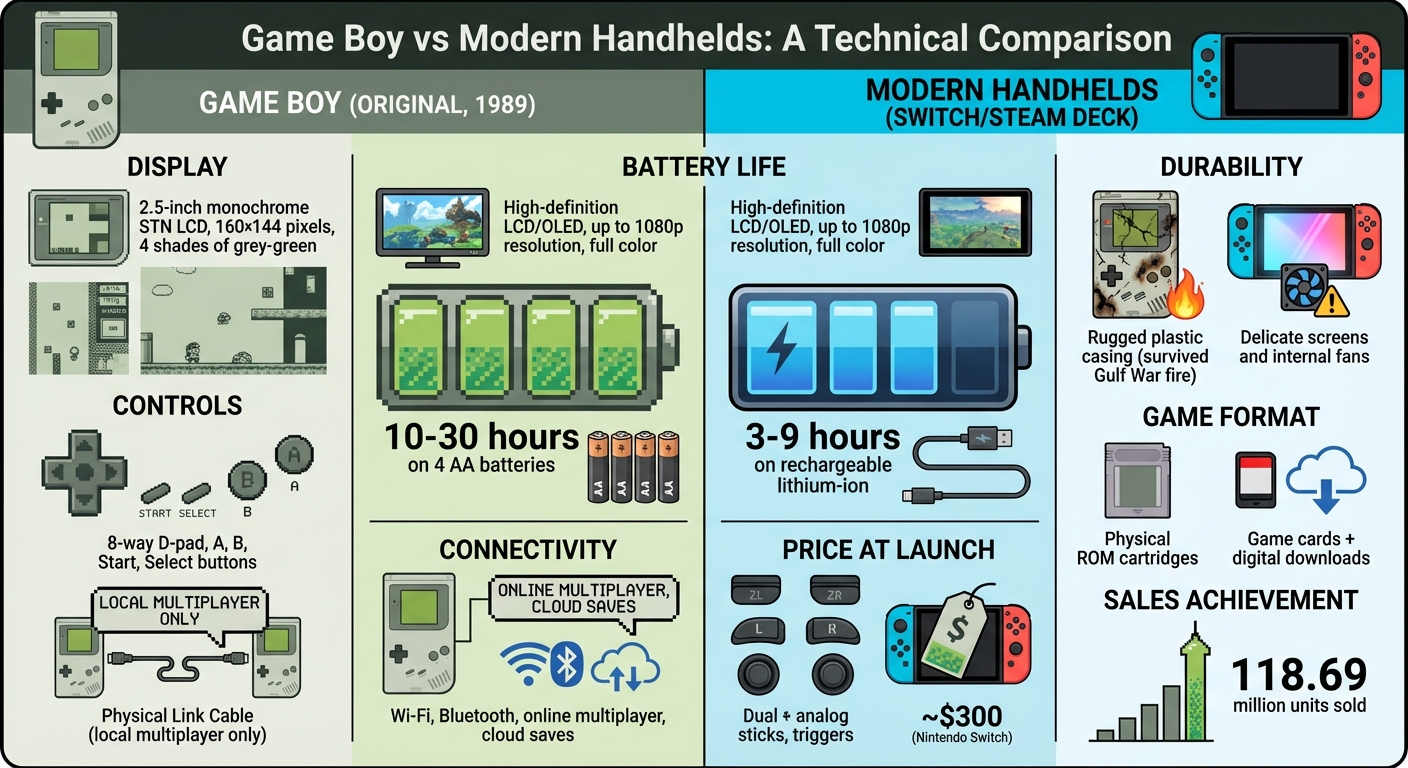
Game Boy vs Modern Handhelds: Battery Life, Display & Features Comparison
The Game Boy and modern handhelds each bring their own set of strengths, shaped by the technology and priorities of their respective eras. Looking at these differences helps explain why the Game Boy ruled portable gaming for over a decade and how today’s devices have evolved to meet new demands.
One of the Game Boy's standout features was its exceptional battery life. It could last up to 30 hours on just four AA batteries - a stark contrast to modern handhelds, which typically run for 3 to 9 hours on rechargeable lithium-ion batteries. Drew Robarge from the Smithsonian's National Museum of American History captured this perfectly:
Game Boy used four AA batteries at 10 to 14 hours of playtime while the Game Gear and Lynx used six batteries each and only lasted a few hours.
Durability was another hallmark of the Game Boy. Its rugged plastic casing was famously tough - one unit even survived a barracks fire during the Gulf War, still functioning despite being charred and melted. Modern handhelds, while packed with advanced features like touchscreens and internal cooling systems, are far more delicate by comparison. But what they lack in toughness, they make up for with stunning visuals and impressive processing power.
Here’s a quick breakdown of how the Game Boy stacks up against modern handhelds like the Nintendo Switch or Steam Deck:
| Feature | Game Boy (Original) | Modern Handhelds (e.g., Switch, Steam Deck) |
|---|---|---|
| Display | 2.5-inch monochrome STN LCD (160×144) | High-definition LCD or OLED screens (up to 1080p) |
| Battery Life | 10–30 hours (4 AA batteries) | 3–9 hours (rechargeable lithium-ion) |
| Controls | 8-way D-pad, A, B, Start, Select | Dual analog sticks, triggers, touchscreens |
| Connectivity | Physical Link Cable (local multiplayer) | Wi-Fi, Bluetooth, online multiplayer, cloud saves |
| Durability | Rugged plastic casing | Delicate screens and internal fans |
| Game Format | Physical ROM cartridges | Game cards and digital downloads |
| Price at Launch | Around $90 | Approximately $300 (e.g., Nintendo Switch) |
The Game Boy’s minimalist design was both a blessing and a limitation. Its simplicity made it easy to pick up and play, but it also meant developers had to work within strict constraints. As Matt Bozon, a developer at WayForward Technologies, noted:
The limitations were severe, and that was its greatest advantage... Every pixel had to fight for its right to be on screen, and as a result games were more likely to fully optimize their limited resources.
Meanwhile, modern handhelds have broadened their horizons with features like internet browsing, media playback, motion controls, and more. But this complexity often sacrifices the straightforward charm that made the Game Boy so appealing.
For those who want to revisit the Game Boy experience with a modern twist, BJ's Game Vault (https://bjsgamevault.com) offers reproduction cartridges and custom Game Boy Advance builds. Whether you’re drawn to the Game Boy’s legendary battery life and durability or the cutting-edge features of today’s handhelds, both eras have left an unforgettable mark on gaming history.
Conclusion
When the Game Boy hit the scene in 1989, it didn’t just join the handheld gaming market - it completely reshaped it. By focusing on battery life, durability, and affordability, Nintendo created a device that became a global sensation. Selling nearly 120 million units worldwide, the Game Boy stayed in production until 2003, leaving behind a legacy that went far beyond its impressive sales figures. Its innovations, like the iconic cross-shaped D-pad, the Game Link Cable for multiplayer gaming, and the decision to bundle Tetris, proved that handheld gaming could appeal to people of all ages - not just kids.
The vision of Gunpei Yokoi and his philosophy of "lateral thinking with withered technology" set the foundation for portable gaming as we know it. As Drew Robarge from the Smithsonian's National Museum of American History aptly said:
Nintendo saw Tetris and realized it was the killer app for the Game Boy. It's perfect for traveling, you can play for five minutes or an hour and still be satisfied.
The Game Boy's influence is still evident in modern handheld devices. Systems like the Nintendo Switch and Steam Deck borrow from its design principles, offering portable libraries, ergonomic controls, and swappable game formats. Even niche devices like the Playdate and Analogue Pocket pay homage to the Game Boy with their retro-inspired aesthetics and layouts. That humble gray brick sparked a shift from living-room consoles to gaming on the go - a shift that continues to shape the industry today.
For those eager to relive this groundbreaking era, BJ's Game Vault (https://bjsgamevault.com) provides reproduction cartridges and custom Game Boy Advance builds, letting fans revisit the classics. Whether you’re nostalgic for the simplicity of the original Game Boy or exploring the advanced features of today’s systems, the Game Boy’s impact is undeniable. It didn’t just make portable gaming possible - it turned it into a global phenomenon that changed the way we play forever.
FAQs
What made the Game Boy so successful despite its simple technology?
The Game Boy became a runaway success by blending affordability, portability, and durability, making it a hit across a broad audience. Its standout feature? Interchangeable cartridges, which let players switch between games effortlessly - perfect for gaming on the go and a game-changer compared to other devices of its era.
What also set the Game Boy apart was its impressive battery life and unforgettable titles like Tetris. These elements didn't just make it popular; they turned it into a cultural icon and a trailblazer in handheld gaming. Even now, its influence is undeniable, as it paved the way for the portable gaming industry as we know it today.
What impact did the Game Boy have on handheld gaming today?
The Game Boy changed the landscape of handheld gaming by blending portability, sturdiness, and an impressive selection of games. It showed the world that gaming on the move could be just as captivating as playing on a home console, laying the groundwork for devices like the Nintendo Switch.
With its focus on extended battery life and an easy-to-use design, the Game Boy opened the door for more people to enjoy gaming. Even today, its legacy lives on in handheld systems that strive to combine convenience with engaging gameplay.
Why was the Game Boy so popular with people of all ages?
The Game Boy captured the hearts of a diverse audience thanks to its low price, sturdy design, and easy portability. Its small size and durable construction made it simple to toss in a bag and take anywhere, making it a hit with both kids and adults who wanted gaming on the go.
One of its standout features was the use of interchangeable cartridges, offering an impressive selection of games across genres like action, puzzles, and sports. This flexibility meant there was something for everyone. And let's not forget Tetris - a game so addictive that it drew in casual players and hardcore gamers alike, solidifying the Game Boy’s appeal.
By combining affordability, a vast game library, and portability, the Game Boy redefined handheld gaming and left a lasting mark on the industry.