


Ultimate Guide to Obscure Consoles
Gaming history is full of consoles that tried bold ideas but couldn’t compete with the likes of Nintendo, Sony, or Microsoft. These systems, often from unexpected companies like Apple or Nokia, introduced groundbreaking features yet failed to resonate with consumers. From the VHS-based Action Max to the $2,500 RDI Halcyon, these consoles were ambitious but met limited commercial success. Today, they’re prized by collectors for their rarity and historical significance.
Key Highlights:
- Action Max (1987): A VHS-based system with limited interactivity, selling for $99. Collectible value: ~$50.
- RDI Halcyon (1985): Laserdisc console with voice recognition; fewer than 10 units exist. Value: $7,000+.
- Pioneer LaserActive (1993): Modular laserdisc system costing up to $2,550. Only 10,000 units sold.
- Nintendo 64DD (1999): Japan-exclusive N64 add-on with internet features. Collectible due to its limited release.
- Vectrex (1982): A vector graphics console with a built-in CRT screen. Modern resale: $450+.
These consoles highlight the risks and creativity of gaming's past. For collectors, they offer a glimpse into the evolution of gaming hardware and ideas that shaped the industry.
Rare and Obscure Console Spotlights
Action Max (1987)
Released by Worlds of Wonder for $99, the Action Max is one of the quirkiest consoles in gaming history. Instead of generating its own graphics, it relied on a VCR to play VHS tapes while players used a light gun to interact with light pulses on the screen. Sensors on both the TV and the gun tracked these pulses. The system’s library consisted of just five titles, including Sonic Fury, .38 Ambush Alley, and Blue Thunder.
What set the Action Max apart - though not necessarily in a good way - was its lack of real interactivity. The VHS tapes played on a loop, regardless of how well players performed. All you could do was rack up points, making the gameplay feel static. Unsurprisingly, it earned a lowly 1/10 rating for "Gamer Value." These days, complete systems can be found for around $50, making them an affordable oddity for collectors intrigued by gaming’s more unconventional experiments. Up next, we dive into a console renowned for its extreme rarity.
RDI Halcyon (1985)
The RDI Halcyon is a true gem in the world of rare gaming hardware. Launched at a rumored price of $2,500, this laserdisc-based console boasted some impressive features for its time, including voice recognition capable of understanding 1,000 words and speech synthesis that could even greet users by name. Only two games were ever released: Thayer's Quest and NFL Football: Chargers vs. Raiders.
"The Halcyon was intended to seem like a living, thinking member of your family." – 98PaceCar, Video Game Console Library
With fewer than 10 units ever produced, the Halcyon has achieved legendary status among collectors, earning a perfect 10/10 "Collector Value" rating. For serious enthusiasts, it’s nothing short of a holy grail.
Pioneer LaserActive (1993)
Pioneer’s LaserActive took a bold, modular approach to gaming. The base unit, which doubled as a laserdisc player, retailed for $970. Add-on modules, priced at $600 each, expanded its functionality, bringing the total cost for a fully equipped setup to about $2,550 back in 1993.
The system used LD-ROMs, a format that combined analog video and audio with digital data, delivering impressive graphical fidelity. Despite its technical capabilities, only about 10,000 units were sold before it was discontinued in 1996. Collectors value the LaserActive for its high-quality ports of laserdisc arcade games, though its PAC modules are notorious for leaky capacitors that can damage the hardware. Let’s now turn to one of Nintendo’s most intriguing experiments.
Nintendo 64DD (1999)
The Nintendo 64DD was an ambitious magnetic disk drive expansion for the N64, released exclusively in Japan. It brought with it 64MB of rewritable storage, an internal real-time clock, and online functionality via the Randnet service. The system introduced features like downloadable content and internet connectivity, with standout titles such as Mario Artist and the F-Zero X Expansion Kit.
Despite its forward-thinking features, the 64DD struggled commercially. Its limited release, combined with its late arrival in the N64’s lifecycle, sealed its fate as a commercial failure. However, its Japan-only status and role as an add-on rather than a standalone console have made it a prized collectible. It stands as a testament to Nintendo’s bold - but ultimately unsuccessful - attempt to push the boundaries of the N64.
Vectrex (1982)
The Vectrex holds a unique place in gaming history as the only home console with a built-in vector CRT display. Priced at $199 at launch (about $650 today), it used vector graphics - sharp, glowing lines of light instead of pixels - to deliver arcade-quality visuals on its 9-inch monochrome screen. The console came preloaded with Mine Storm and was the first to feature a 3D peripheral, the 3-D Imager. This device spun color-filtered disks to create the illusion of color and depth.
"Vector graphics really do make a difference, and the strong line-up of games helps immensely." – David H. Ahl, Creative Computing Video & Arcade Games
The Vectrex earned a 10/10 "User Experience" rating and continues to thrive in the retro gaming scene, with homebrew developers adding dozens of new games since the mid-1990s. Working units usually sell for $75 to $125, but original 3D Imagers can fetch hundreds or even thousands of dollars. The system’s enduring appeal was highlighted by a 2025 Kickstarter for the Vectrex Mini, which raised $1,301,353 from 5,583 backers. It’s clear that this console still holds a special place in the hearts of gaming enthusiasts.
17 Gaming Consoles You Probably Never Heard Of
Collectibility and Value
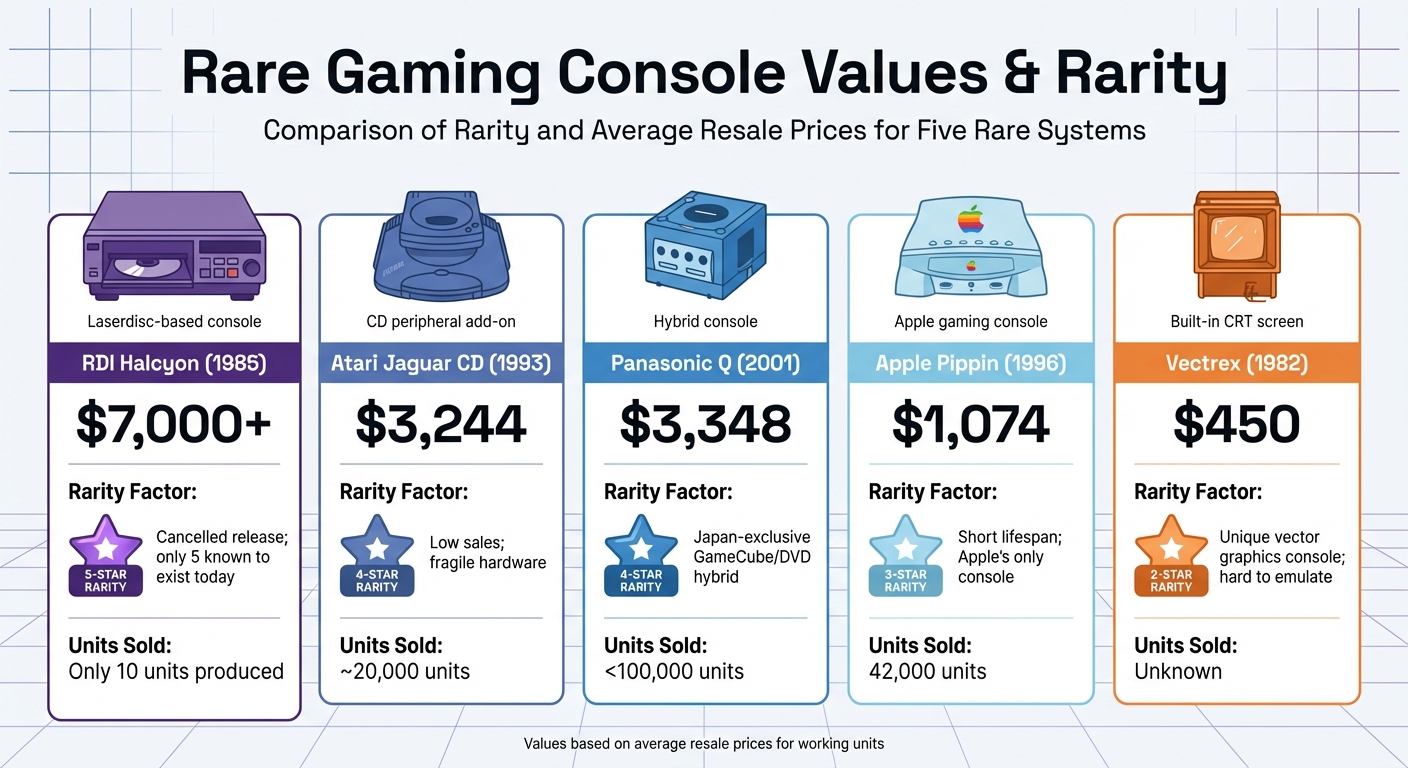
Rare Gaming Console Values and Rarity Comparison Chart
Value and Rarity Comparison
The market for rare gaming consoles is shaped by factors like production numbers, durability, and their place in gaming history. Take the RDI Halcyon, for instance - only 10 units were ever made, with just 5 confirmed to exist today. This extreme rarity places its value at around $7,000. On the other hand, the Vectrex, though uncommon, is priced at a more modest $450 when sold loose, thanks to its higher production numbers and durable design.
| Console | Units Sold (Approx.) | Avg. Resale Value (USD) | Scarcity Factors |
|---|---|---|---|
| RDI Halcyon | 10 | $7,000+ | Cancelled release; only 5 known to exist |
| Atari Jaguar CD | 20,000 | $3,244 | Low sales; fragile hardware |
| Panasonic Q | <100,000 | $3,348 | Japan-exclusive GameCube/DVD hybrid |
| Apple Pippin | 42,000 | $1,074 | Short lifespan; Apple's only console |
| Vectrex | Unknown | $450 | Unique vector graphics console; hard to emulate |
Other consoles, like the Bally Astrocade, are rare due to hardware issues such as overheating, which impacted their longevity.
Investment Potential
Collectors often examine rarity alongside condition and market trends to gauge a console's investment potential. For obscure systems, historical importance often outweighs nostalgia in driving value. For example, the Panasonic Q, a Japan-only GameCube/DVD hybrid, can fetch over $3,300 in graded condition, while a standard GameCube typically sells for just $45 to $180.
Condition plays a massive role in pricing. A loose NES might sell for $74, but a sealed version can command prices exceeding $2,000. As Racketboy puts it:
"Cardboard is quickly becoming the currency of the retro world"
Original packaging, manuals, and boxes have become must-haves for serious collectors.
Certain systems offer unique quirks that influence their value. The Zeebo, released mainly in Brazil and Mexico, is worth more when opened if it has pre-installed digital games, as its servers are no longer operational. Similarly, the Atari Jaguar CD's peripheral alone is valued at $3,244, far surpassing the $250 price of the base unit. Ultimately, the investment potential of these consoles depends heavily on survival rates. In cases like the RDI Halcyon, its extreme rarity means its value is dictated by the few collectors who own it.
sbb-itb-9a4764e
Where to Find Obscure Consoles
BJ's Game Vault
If you're looking to dive into the world of rare gaming history, BJ's Game Vault is a treasure trove worth exploring. While finding obscure consoles in working condition can feel like searching for a needle in a haystack, this store offers a creative workaround: rare ROM hacks and custom cartridges for vintage systems like the NES, SNES, Sega Genesis, N64, and Game Boy. These fan-made recreations bring to life lost or modified titles, with prices typically falling between $35 and $50. Examples include Smash Remix v2.0 for the N64 and Super Mario Bros. 2-Player Hack for the NES.
Every cartridge is tested on original hardware to ensure functionality and includes free shipping. Plus, their "Collector's Guarantee" provides added peace of mind. For collectors who want a steady flow of rare finds, subscription boxes are available: $45 gets you 2 ROM hack cartridges and a collectible, while $85 includes 3 cartridges and 3 collectibles. Each box also comes with fun extras like stickers and a monthly discount card. Need help? Their "Vault Support" team - staffed by experienced gamers - offers quick and knowledgeable assistance.
If you're planning to expand your collection, make sure to follow safe collecting practices to avoid counterfeits and ensure quality.
Safe Collecting Practices
When you're on the hunt for genuine obscure consoles and games, authentication is key. Start by verifying regional releases. For instance, Earthbound was never released in PAL regions, so any PAL-formatted cartridge claiming to be Earthbound is a fake. A reliable way to confirm authenticity is by opening the cartridge or console to inspect the PCB (Printed Circuit Board) for official manufacturer logos, serial numbers, and high-quality soldering.
Physical inspection can also help you spot counterfeits. Genuine cartridges typically use "Gamebit" security screws, which have external notches. If a cartridge opens with a standard screwdriver, it’s likely not authentic. Pay attention to the labels as well - authentic ones feature vibrant colors, glossy finishes, and clear text. Additionally, keep in mind that older SNES and Game Boy games used the "K-A" (Kids to Adult) rating instead of the "E" rating we see today.
"If the price is too good to be true then either avoid or be extra vigilant"
If a deal seems suspiciously cheap, proceed cautiously. A Gamebit screwdriver set - which costs under $10 - can be a handy tool for inspecting high-value purchases. Always use credit cards or PayPal for added buyer protection. When dealing with obscure systems like the Bally Astrocade or Entex Adventurevision, be sure to check for common issues such as overheating or degradation of mirrors and LEDs, as these systems are notoriously fragile. Also, match the console's serial numbers with its original box and confirm that it displays official startup screens. Unresponsive or unfamiliar interfaces are often red flags for counterfeit products.
Conclusion
Rare gaming consoles are far more than just quirky footnotes in gaming history - they're milestones that highlight the ingenuity of an era when bold ideas often triumphed over limited resources. Between 1972 and 1983, these systems pushed boundaries, introducing groundbreaking features like the first touchscreen (Bandai Design Master Denshi Manga Juku), the first internet-enabled console (Tiger Game.com), and the first 32-bit CD-based system (FM Towns Marty). Preserving these consoles is crucial to fully appreciating how modern gaming evolved.
But this isn't just about nostalgia. Many of these obscure consoles offer experiences that can't be recreated through emulation. Take the Vectrex, for instance - its vector monitor creates a distinct visual style that fans say is "impossible to emulate exactly on a standard TV". Additionally, systems like the RDI Halcyon host games that only exist on their original hardware, meaning their stories risk disappearing entirely if the devices aren't preserved. These unique qualities not only cement their historical value but also make them highly sought-after collectibles. As Faisal N from Retro vGames puts it:
"These consoles weren't just pieces of hardware; they were unique artifacts that inspire innovation."
Each of these rare systems tells a story of creativity and experimentation, whether it's the pioneering RDI Halcyon or the one-of-a-kind Vectrex. By collecting and preserving these consoles, you're not just holding onto physical devices - you’re safeguarding the innovative spirit that laid the foundation for today’s gaming landscape.
FAQs
Why is the RDI Halcyon considered a rare and valuable gaming console?
The RDI Halcyon holds a special place in the hearts of gaming collectors, thanks to its cutting-edge features and incredible scarcity. As the very first home laser disc gaming system, it brought forward-thinking technologies to the table in the 1980s, including voice recognition, AI capabilities, and full-motion video - features that were way ahead of their time.
Despite its potential, the Halcyon never made it to mass production. Only about 11 units were ever created, making it one of the rarest gaming systems in history. Its blend of technological ambition and extreme rarity offers a unique window into the early days of gaming innovation, cementing its status as a prized artifact for enthusiasts.
Why did the Nintendo 64DD struggle to succeed despite its innovative features?
The Nintendo 64DD faced a tough road in the market, and several issues contributed to its commercial failure. For starters, its small game library, delayed launch, and steep price tag made it hard to win over a broad audience. On top of that, the device was exclusively released in Japan, which severely limited its potential reach. Features that were meant to set it apart - like expanded storage and online connectivity - didn’t quite live up to expectations.
In the end, a combination of weak developer support and low consumer demand sealed its fate. With only around 15,000 units sold before it was discontinued, the 64DD didn’t make much of a splash. That said, it has carved out a unique spot in gaming history and remains a sought-after collectible for dedicated fans.
How can I verify the authenticity of rare gaming consoles?
To determine if a rare gaming console is genuine, start by thoroughly examining its physical features. Look for quality construction details like professional soldering, the correct circuit board dimensions, and original chips. Packaging and branding are also telling - authentic consoles typically have sharp printing, accurate logos, and official barcodes. If the item is sealed, check that the packaging and seals look legitimate.
Seasoned collectors often suggest opening the console (when feasible) to inspect its internal components. Be on the lookout for signs of tampering, such as missing parts, unusual wiring, or hardware inconsistencies. Buying from reputable sellers and testing the console before purchase are also smart ways to avoid counterfeits. Staying up to date and consulting trusted collector guides can be invaluable in spotting authentic pieces.