


Hex Editing vs. Script Editing in ROM Hacks
Hex editing and script editing are two key methods used in ROM hacking, each serving distinct purposes and offering unique advantages. Hex editing involves modifying raw binary data, providing precise control over game mechanics, graphics, and text. Script editing, on the other hand, focuses on altering in-game events, dialogue, and logic using readable commands through specialized tools.
Key Takeaways:
- Hex Editing: Best for low-level changes like tweaking stats, palettes, or game physics. Requires technical knowledge of hexadecimal and memory structures.
- Script Editing: Ideal for creating new storylines, NPC interactions, and events. Easier to learn, with tools handling technical complexities.
Quick Comparison Table:
| Feature | Hex Editing | Script Editing |
|---|---|---|
| Purpose | Modify mechanics, graphics, data | Create events, dialogue, logic |
| Control Level | Byte-level precision | High-level commands |
| Tools | Universal (e.g., HxD) | Game-specific (e.g., XSE) |
| Learning Curve | Steep, technical | Moderate, user-friendly |
| Best For | Mechanics, graphics, cheats | Story, events, gameplay flow |
Both methods are essential for ROM hacking, often used together to achieve technical and narrative goals.
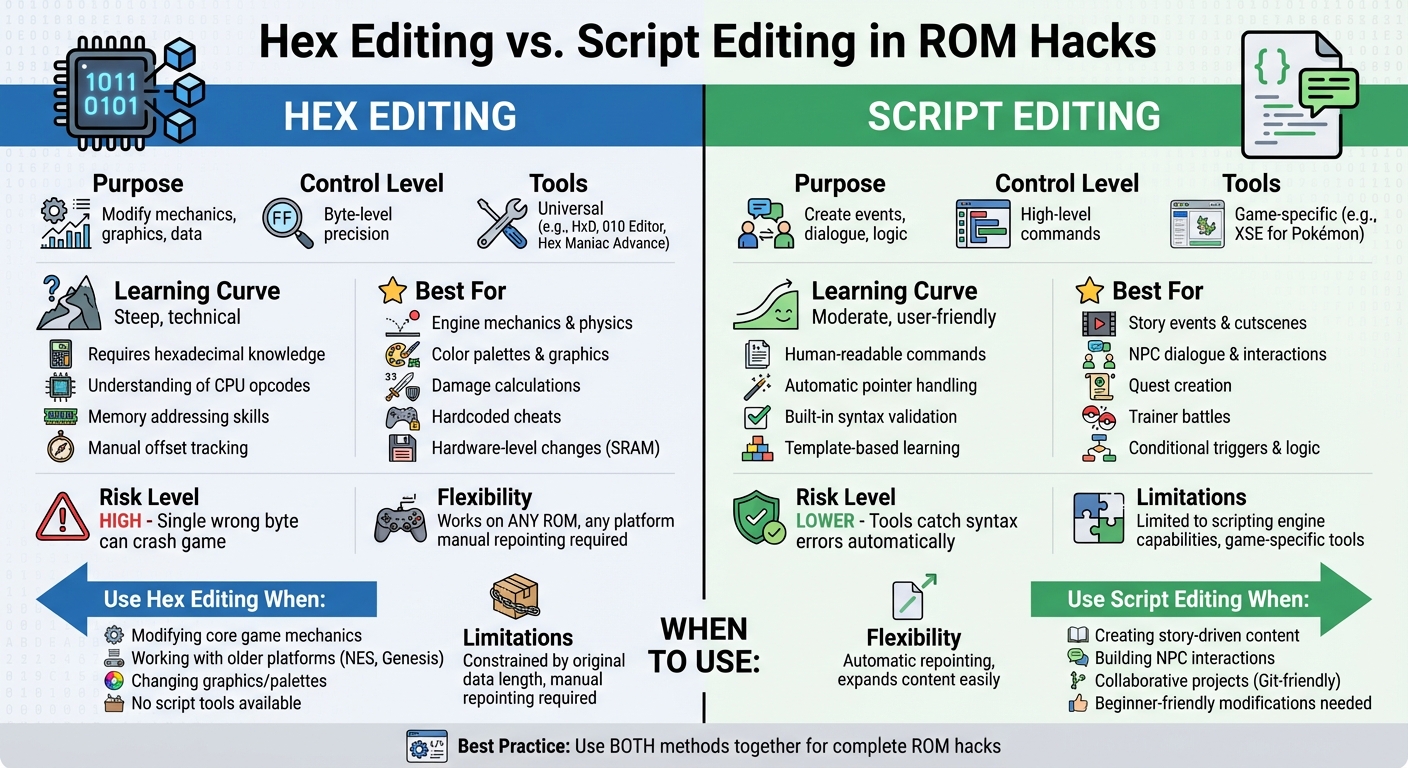
Hex Editing vs Script Editing in ROM Hacking: Complete Comparison Guide
Pokémon Generation III ROM Hacking: Tutorial 26: Hexadecimal Palette Manipulation
What is Hex Editing?
Hex editing involves directly altering a ROM's binary data, displayed in hexadecimal (base-16) format. This process allows you to tweak the raw bytes that control everything in a game - from its visuals and text to its mechanics and logic. As Sliver X aptly puts it in A Beginner's Guide to NES ROM Hacking:
"The Hex Editor: Your new best friend".
Hexadecimal uses 16 symbols (0–9 and A–F) to represent data, making it more compact and readable than binary. Each hex digit corresponds to four bits, so a single byte (00 to FF) can be represented by just two hex digits. This format is particularly useful for ROM hackers, as it simplifies the process of interpreting and modifying game data.
Now, let’s break down how hex editing works and explore some practical examples.
How Hex Editing Works
To start hex editing, you’ll need a ROM file and a hex editor like HxD. When you open the ROM in the editor, you’ll see rows of hexadecimal values, each representing a byte in the game. These bytes are arranged in a specific order, with each one located at a unique offset in the file. To make changes, navigate to the desired offset and overwrite the existing bytes with new values.
When editing, use the "Paste Write" function (Ctrl+B in HxD) to ensure you don’t accidentally corrupt the file. It’s also crucial to back up your ROM before making changes. Many tools, including HxD, automatically create a ".bak" file, which can save you from headaches if your edits cause the game to crash.
Examples of Hex Editing in ROM Hacking
Hex editing allows for precise modifications, as shown in these examples:
- Super Mario Bros. (NES): To change Mario’s color palette, hackers search for the hex string "22 16 27 18", which defines his light blue, red, rust, and brown colors. By altering specific bytes - like changing "16" to "0C" - you can adjust the colors of his uniform.
- Sonic the Hedgehog 2 (Sega Genesis): At offset 011FE0, replacing the opcode "52 78" (Add 1) with "54 78" (Add 2) makes Sonic collect double rings for every ring he touches.
- Metroid Zero Mission (GBA): To disable the game’s low energy alarm, hackers locate offset 0x52888 and replace the bytes "1D 2F" with "14 E0".
Text editing often requires table files (.tbl) since many retro games use custom encoding rather than standard ASCII. These files map hex bytes to specific characters, enabling you to read and edit in-game dialogue. For instance, using a table file makes it possible to rewrite text in older games without breaking the encoding.
These examples highlight how hex editing gives hackers precise control over game data, paving the way for a comparison with script editing.
What is Script Editing?
Script editing takes a different approach from hex editing by using specialized tools to modify game dialogue, events, and behaviors. Instead of working directly with raw bytes, you use commands like faceplayer, msgbox, or giveitem, which the game engine executes in sequence to create gameplay moments. As Avara, a ROM hacking expert, puts it:
"Scripting is, in my humble opinion, THE most important thing to learn in manipulating Pokémon games. It's what you use to create your dialog, your events, your quests, to make stuff happen, to literally create your gameplay."
The main advantage of script editing lies in its abstraction. While hex editing requires manually altering raw data, script editing allows you to write commands that are compiled into hex by the tool itself. This means you don't need to calculate pointers or worry about overwriting nearby data - the scripting tool automatically handles those technical details by using dynamic offsets to find free space in the ROM. This makes script editing much more user-friendly compared to the hands-on byte manipulation required in hex editing.
How Script Editing Works
Tools like XSE (eXtreme Script Editor) and Hex Maniac Advance, often used alongside map editors like Advance Map, make script editing straightforward. For example, you can edit an NPC's script by simply double-clicking on them. The scripting syntax is simple: commands like lock stop player movement during an event, while release allows it again.
Dynamic offsets are a key feature of script editing. When you start a script with #dynamic 0x800000 in XSE, the tool automatically finds free space in the ROM to compile your code. This eliminates the need for manual tracking of data locations, a common issue in hex editing where exceeding the original data length can corrupt the ROM. Script editing also supports advanced logic using flags, variables, and conditional statements - tasks that would be painstakingly slow and error-prone with manual hex editing.
Examples of Script Editing in ROM Hacking
Script editing shines when it comes to creating custom gameplay. For instance, you can use the trainerbattle command to initiate battles with specific trainers or the giveitem command to add items to the player's inventory. To modify dialogue, the msgbox command displays text in various formats, whether it's a conversation with an NPC or a signpost message.
You can even build multi-step quests with conditional triggers. For example, you might script a legendary Pokémon to appear only after the player collects certain items and defeats specific trainers. Tools like Atlas and Cartographer complement script editors by handling text insertion, automatically updating pointers when text length changes. This makes translating games or rewriting entire storylines far more efficient than relying on hex editing alone.
Key Differences Between Hex Editing and Script Editing
Control and Capabilities
Hex editing provides direct, low-level access to every byte in a ROM. This means you can tweak virtually anything - graphics, text, music, or even the underlying code. However, there's a catch: you're constrained by the original data's length. If you need to add longer content, you'll have to manually repoint data to unused sections of the ROM, which can be tricky.
Script editing, on the other hand, works at a higher level, focusing on game logic and story events. Instead of dealing with raw bytes, you use readable commands that the game engine understands. This lets you create new sequences - like custom Gym Leader battles or elaborate cutscenes - by reusing the game's existing code. The downside? You're limited to what the scripting engine supports, like NPC interactions, dialogue, triggers, and conditional logic. It’s not a tool for altering graphics or the physics engine.
These differences in control highlight the distinct strengths and limitations of each approach.
Learning Curve and Ease of Use
Hex editing may offer unmatched control, but it comes with a steep learning curve compared to the more beginner-friendly script editing.
To use hex editing effectively, you need a solid understanding of hexadecimal systems, byte structures, CPU opcodes, and memory addressing. Tasks like manually tracking offsets or editing long strings of dialogue byte by byte can be especially tedious. It’s a method that demands precision and technical know-how.
Script editing, however, is much easier to pick up. Tools like XSE (eXtreme Script Editor) use scripting languages that are almost as easy to read as plain English. These tools handle complex tasks for you - like finding free space in the ROM and updating pointers automatically. Beginners can often jump right in by using templates for common tasks, such as NPC dialogue or signposts, making it possible to see results without needing extensive technical expertise.
The contrast in accessibility and complexity plays a key role in determining which approach a developer might choose.
Strengths and Use Cases: Hex Editing vs. Script Editing
Now that we've covered the technical basics, let's dive into when to use hex editing versus script editing. Each method has its own strengths, and knowing when to use which can save you time and effort.
When Hex Editing Shines
Hex editing is your go-to tool for tweaking core game mechanics like damage calculations, acceleration rates, or multipliers for collecting items like rings in a game. It's also the method of choice for changing color palettes, such as altering sprite colors or background schemes by directly editing hex values.
One major advantage of hex editing is its universality. Unlike script editors, which are tailored to specific games (like XSE for Pokémon), hex editors work on any ROM. This flexibility allows you to modify graphics, text, and even machine code. Advanced users can go further, inserting JMP commands to redirect the game's execution flow to new routines coded in unused ROM space. This opens the door to custom features like unique XP systems or SRAM saving.
"Hex Editing... will quickly become one of your most useful skills to have." - Sliver X
However, hex editing requires precision. It's ideal for mechanical tweaks but less suited for creative storytelling or event scripting.
When Script Editing Takes the Lead
Script editing excels when you're focused on storytelling and event-driven changes. Tasks like creating NPCs, writing dialogue, setting up battles with Gym Leaders, or scripting legendary Pokémon encounters are where script editors shine. These tools handle the heavy lifting, such as locating free space in the ROM and updating pointers automatically, so you don’t have to.
Another advantage is the readable syntax. Script editors make large-scale text modifications much easier compared to hex editors. Translating an entire game or rewriting lengthy dialogue through hex editing can be a nightmare - one wrong byte could corrupt the entire ROM. Tools like XSE simplify the process with commands that resemble plain English and built-in syntax validation to catch errors before they cause problems.
"Through scripting, your story and plot come to life. Basically, anything more than a basic person talking script or a signpost script is referred to as an 'event'." - Deokishisu, Mr. Magius
While script editing is less risky and more intuitive for narrative changes, it doesn’t offer the same low-level control as hex editing.
Comparison Table: Hex Editing vs. Script Editing
Here’s a quick side-by-side look at how hex editing and script editing stack up:
| Feature | Hex Editing | Script Editing |
|---|---|---|
| Best For | Engine mechanics, physics, palettes, graphics | Story events, NPC dialogue, triggers, cutscenes |
| Control Level | Byte-level precision across entire ROM | Logic-level control over game flow |
| Flexibility | Modifies any byte; limited by original data length | Expands content through automatic repointing |
| Learning Difficulty | Steep; requires ASM/hex knowledge | Moderate; readable syntax with tool validation |
| Risk Factor | High; a single wrong byte can crash the game | Lower; tools catch syntax errors automatically |
| Tool Specificity | Universal (works on any ROM) | Game-specific (e.g., XSE for GBA Pokémon) |
Each method has its strengths, making them better suited for different kinds of tasks. Whether you’re diving into mechanics or crafting a compelling story, understanding these tools will help you make the most of your ROM hacking projects.
sbb-itb-9a4764e
Tools for Hex Editing and Script Editing
When it comes to advanced ROM hacking, having the right tools can make all the difference. Whether you're diving into low-level hex editing or tackling high-level script work, the tools you choose will shape your workflow and outcomes.
Popular Hex Editing Tools
HxD is a compact yet powerful hex editor weighing in at just 900kB. It’s perfect for tasks like editing disks, RAM, and file images. Known for its speed and reliability, it’s a go-to choice for quick edits and file comparisons without unnecessary bulk.
For more intricate projects, 010 Editor offers advanced features like "Binary Templates", which transform raw hex into neatly organized, color-coded sections. While it’s a paid tool, it’s worth the cost if you’re working with complex ROM structures.
Hex Maniac Advance (HMA) is a standout for Pokémon ROM hacking. It converts raw hex data into editable tables for stats, trainers, and moves, while also including a built-in script editor with automatic repointing to simplify your work.
Other noteworthy options include ImHex, an open-source editor with pattern-based highlighting, and Windhex32, which is particularly useful for translations thanks to its Japanese table support and relative search functionality.
Popular Script Editing Tools
XSE (eXtreme Script Editor) is a staple for scripting in GBA Pokémon ROMs. It takes human-readable commands and compiles them into executable binary data. The unofficial version 1.1.1 addresses common bugs, making it even more reliable.
Hex Maniac Advance serves double duty as both a hex and script editor. It simplifies text insertion and repointing, reducing the risk of pointer corruption - a problem that can render a ROM unusable. For English GBA Pokémon games like Ruby, Sapphire, FireRed, LeafGreen, and Emerald, HMA is an all-in-one solution that streamlines the editing process.
Comparison Table: Hex and Script Editing Tools
Here’s a quick comparison of the top tools to help you decide which fits your needs best:
| Tool | Type | Key Features | Compatibility | Cost |
|---|---|---|---|---|
| HxD | Hex Editor | Lightweight (900kB), RAM/disk editing, checksums | Universal | Free |
| 010 Editor | Hex Editor | Binary templates, histograms, wildcard search | Universal | Paid |
| Hex Maniac Advance | Hybrid | Table editing, auto-repointing, script/map editor | GBA Pokémon | Free |
| XSE | Script Editor | Human-readable syntax, auto-freespace finder | GBA Pokémon | Free |
| ImHex | Hex Editor | Pattern language for parsing, cross-platform | Universal | Free |
| Windhex32 | Hex Editor | Relative search, Japanese table support | Universal | Free |
"A hex editor is possibly the most multi-purpose and general tool used in ROM hacking. It displays the ROM data as a hexadecimal string, which allows one to examine it, provided they have knowledge of the game's internals." - The Cutting Room Floor
When to Choose Hex Editing Over Script Editing
Hex editing comes into play when you need to dive deep into a game's core mechanics - like tweaking damage formulas, adjusting physics, or altering AI behavior - tasks where script editing simply doesn't cut it. For example, if you want to modify how damage is calculated or change the way a character interacts with the environment, you'll need to work directly with the hex data of the game.
Hardware-level changes are another area where hex editing is essential. Take adding SRAM (battery-backed saving) to games that originally lacked it, such as Shinobi III on the Sega Genesis. This process involves modifying the ROM header at offset 01B0 and writing custom save routines directly in hex. Unlike script editing, which operates within predefined boundaries, hex editing provides the system-level control needed for such modifications.
Older platforms like the NES and Sega Genesis often require hex editing because they lack the advanced script editing tools available for systems like the GBA. A great example is from December 2024, when developer BillyTime! Games used a hex hack on Sonic the Hedgehog 2. By implementing a JMP hijack at offset 012152, they altered the ring loss logic so Sonic would only lose 20 rings per hit instead of all of them. This showcases how hex editing is sometimes the only option for making these deeper changes on older systems.
Hex editing also allows you to modify graphical data directly. Whether you're tweaking color palettes or altering sprite appearances, this level of precision isn't something script editors can achieve.
Moreover, hex editing lets you implement hardcoded cheats or bypass game logic entirely. For instance, inserting instructions like NOP (4E71) in 68k Assembly can disable certain game behaviors. This byte-level control gives you unparalleled access to customize any aspect of the game, even when no specialized tools exist for your target platform.
When to Choose Script Editing Over Hex Editing
Script editing is the go-to choice when your ROM hack emphasizes storytelling. If your project involves crafting new NPC dialogues, deepening character interactions, or designing intricate, plot-focused events, scripting tools provide the flexibility you need to bring those ideas to life.
A ROM hacking expert puts it this way:
"Through scripting, your story and plot come to life. Basically, anything more than a basic person talking script or a signpost script is referred to as an 'event'." - Deokishisu, PokéCommunity
For beginners, script editing is particularly appealing because it uses human-readable commands. Tools like XSE (eXtreme Script Editor) for Pokémon hacks let you write commands like msgbox or applymovement while handling the technical intricacies behind the scenes.
Script editing also shines in collaborative projects. Since the scripts are text-based, they can be easily managed with version control systems like Git. This allows multiple contributors to work on different aspects of the game simultaneously without stepping on each other's toes.
When your project pushes the boundaries of the original game's limitations, scripting becomes indispensable. Modern compilers and linkers take care of memory allocation automatically, eliminating the need to manually track free space or calculate offsets. This makes it much easier to incorporate extended dialogue, custom cutscenes, or event-heavy features like Gym Leader battles. While hex editing is great for fine-tuning core mechanics, script editing is the key to unlocking creative, narrative-driven enhancements. Together, they form a powerful combination for ROM hacking projects focused on storytelling.
Conclusion
Pick the tool that aligns with your project's goals. Hex editing gives you precise control over raw data adjustments, while script editing allows you to craft engaging narratives with dialogue, events, and triggers.
Many successful ROM hacks blend these approaches - using hex editing to tweak the game engine and script editing to build a rich world and story around those technical changes. Hex editing requires a solid grasp of hexadecimal, binary, and often assembly code, whereas script editing leans on more user-friendly, human-readable commands. As Deokishisu, Mr. Magius, puts it:
"Hacking is a hobby, but none of us can pretend that it isn't work. And sometimes that work is hard and tedious".
Before diving into core game data, always back up your ROM. A single misplaced byte can corrupt your entire project. Embrace experimentation - trial and error is where progress happens.
FAQs
What are the key benefits of hex editing compared to script editing in ROM hacking?
Hex editing gives ROM hackers a direct way to modify game data at the binary level. Unlike script editing, which often demands familiarity with a game’s scripting language or engine, hex editing lets you tweak any byte of data - whether it’s character stats, item properties, or hidden settings - using just a hex editor. This makes it a handy option, especially for games that don’t have dedicated editing tools.
One of the best parts? Hex editing is approachable, even for beginners. You don’t need to be a programmer to dive in - just find the data you want to adjust, change the values, and save. It also offers precise control, making it ideal for tasks like fine-tuning details or restoring data that script editing might struggle to handle. For ROM hackers seeking maximum control and flexibility, hex editing is a must-have skill.
What’s the best way for beginners to start learning hex editing for ROM hacking?
Hex editing is an excellent entry point into ROM hacking, and getting started is easier than you might think. To begin, you'll need a user-friendly hex editor. Tools like Hex Workshop or Windhex are perfect for beginners, as they allow you to view and edit the raw byte data of a ROM file. Alongside this, set up an emulator with debugging capabilities so you can test your changes as you go. For NES games, NESticle is a solid choice, while BGB works well for Game Boy titles.
Before making any edits, it’s important to familiarize yourself with hexadecimal notation. Hex uses a base-16 system, which includes digits 0-9 and the letters A-F. For instance, the hex value 0x1A translates to 26 in decimal. When you're ready, open your ROM file in the hex editor, locate the specific data you want to modify - whether it’s text, colors, or sprites - and make small adjustments. Always save your edited file under a new name to keep the original ROM intact.
Once you’ve made your changes, load the edited ROM into your emulator to see the results. Starting with simple tasks, like altering text or tweaking palette colors, is a great way to build your skills and confidence. If you're looking for clean ROMs or additional tools for retro hacking, BJ's Game Vault is a helpful resource to explore.
What is the best tool for editing scripts in Pokémon ROM hacks?
For creating and editing scripts in Pokémon ROM hacks, PKSV – the Pokémon Script Editor stands out as a go-to tool. It offers an intuitive graphical interface that simplifies the process of writing and testing event scripts. With features like syntax highlighting for the Pokémon scripting language and the ability to compile scripts directly into the ROM, it’s a must-have for working on Gen 3 and later hacks.
Some developers also rely on hex editors for more detailed, low-level adjustments. Popular options include HxD for Windows, iHex for macOS, and Bless for Linux. While these tools are useful for specific tweaks, PKSV remains the primary choice for scripting and debugging, providing everything needed for smooth and efficient script development.