


How ROM Hacks Help Preserve Games
Classic video games are disappearing due to aging hardware, regional restrictions, and compatibility issues with modern devices. ROM hacks - modifications made by fans - address these problems by fixing bugs, translating games, and updating old titles for new hardware. These efforts ensure retro games remain playable and accessible.
Key Points:
- Bug Fixes: ROM hacks correct glitches and improve gameplay (e.g., adding save systems to older games).
- Translations: Fan-made translations make region-locked games available to global audiences.
- Modern Compatibility: Updates allow older games to work on modern screens and devices.
- Community Efforts: Platforms like ROMhacking.net have archived thousands of projects, even as legal and logistical challenges persist.
- Pre-Loaded Cartridges: Services like BJ's Game Vault simplify retro gaming by offering plug-and-play cartridges with popular ROM hacks.
ROM hacks are helping preserve gaming history while making retro games more enjoyable for today's players.
The Hidden Battle to Save Gaming History
Problems Facing Retro Game Preservation
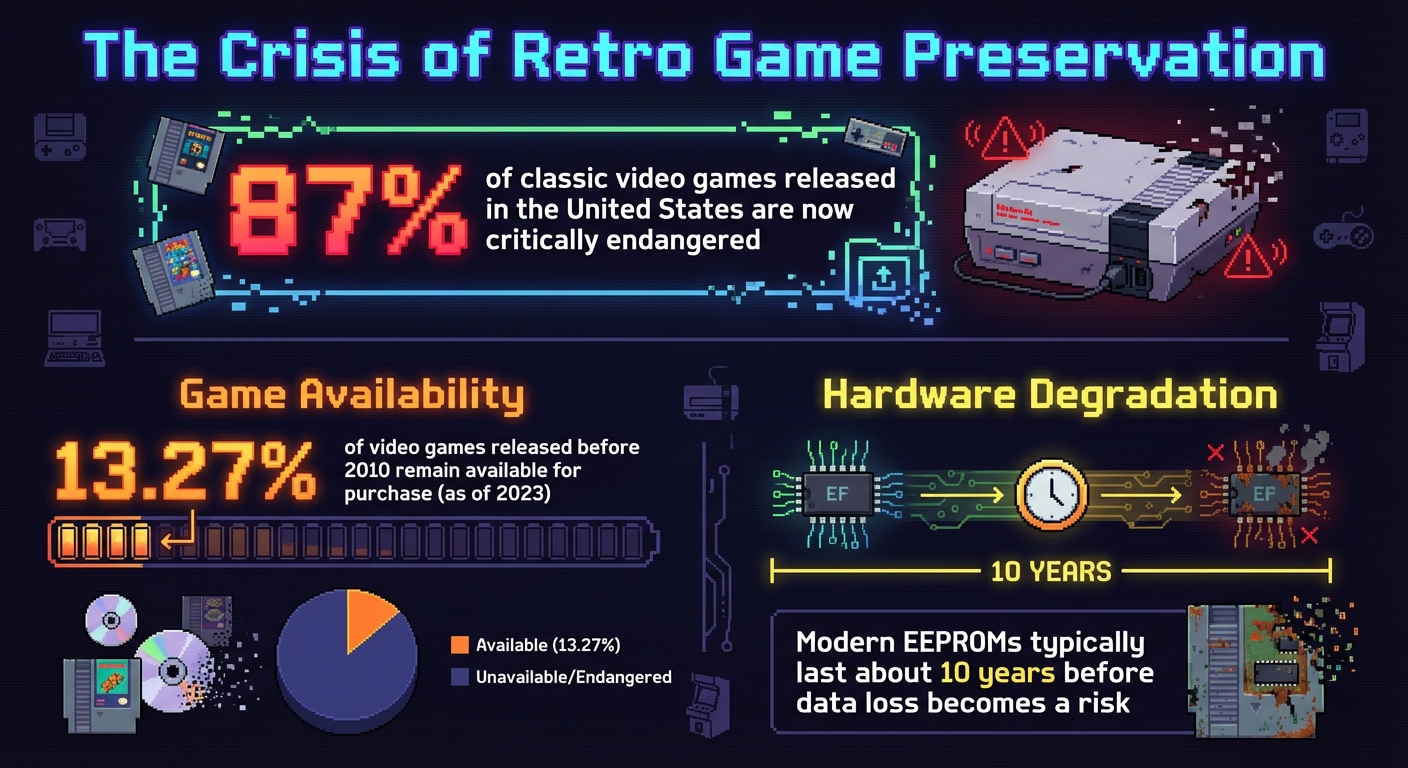
The State of Retro Game Preservation: Critical Statistics
Failing Hardware and Outdated Technology
The physical components of retro games are deteriorating at an alarming rate. Game cartridges and consoles from decades past are falling victim to "bit rot", where the electrical charges stored in memory chips leak over time. For instance, modern EEPROMs typically last about 10 years before data loss becomes a risk. Optical media like CD-ROMs and DVDs are also fragile - oxidation of their reflective layers or separation of bonded layers can make these discs unreadable. On top of that, aging processors and other hardware components are succumbing to wear and tear, leading to circuit failures. Problems like leaking capacitors and dead internal batteries further accelerate damage, often corroding circuit boards. With these challenges, a staggering 87% of classic video games released in the United States are now labeled as "critically endangered".
Missing Translations and Regional Restrictions
Hardware failures aren’t the only obstacle. Language barriers and regional limitations also stand in the way of preserving classic games. Many titles were region-locked, such as those exclusive to Japan, like the Nintendo Satellaview releases. Even if a game’s code survives, it can remain inaccessible to global audiences if it’s only available in Japanese. Licensing complications add another layer of difficulty, as publishers often cannot legally translate or re-release these games. This leaves entire collections of games out of reach for many players.
Compatibility Issues with Modern Devices
Retro games weren’t designed with modern hardware in mind, making compatibility a serious issue. Most of these classics exist only on physical cartridges built for consoles that have long since ceased production. Games originally optimized for CRT televisions often look overly sharp or lose their characteristic glow when displayed on modern screens. Emulators, while helpful, can distort the original aspect ratios and fail to replicate the authentic experience.
Digital platforms haven’t completely solved these problems either. The closure of the Nintendo 3DS and Wii U eShops, for example, has erased access to many digital-only titles that never had physical releases. As of 2023, only 13.27% of video games released before 2010 remain available for purchase in any form. Frank Cifaldi, founder of the Video Game History Foundation, compares the situation to the early days of film preservation:
Imagine if movies were only released on, like, VHS, ever. You want to watch Back to the Future? All right, you have to go on eBay, and you have to find an antique VHS copy that's degraded a bit from use. You have to find a VCR that works, a TV that it plugs into... this is the state of the industry.
These challenges highlight the pressing need for creative and effective ways to preserve gaming history.
How ROM Hacks Solve Preservation Problems
With aging hardware and limited accessibility threatening the legacy of classic games, ROM hacks have stepped in as a creative and practical solution. By modifying game code, these hacks fix bugs, add translations, and update compatibility, ensuring that older titles remain playable and relevant.
Bug Fixes and Gameplay Enhancements
ROM hackers dive into a game's code using assembly (ASM) programming to address glitches and oversights that were left unresolved by the original developers. These fixes can range from correcting bugs to tweaking gameplay elements like enemy AI and graphics. For instance, some hacks introduce modern conveniences, such as replacing outdated password systems with SRAM save functionality. This has been done for games like Super Mario Bros. 3 and Mega Man, making them more user-friendly for today’s players.
A standout example is the Phantasy Star 2 Improvement hack by FlamePurge. This project tackled issues like harsh screen flashing during combat - an annoyance on modern high-contrast displays - while also improving the original localization and addressing various technical flaws. These changes not only make the game more polished but also set the stage for better language localization and accessibility.
Fan-Created Translations
Fan translations have become a crucial tool in breaking down language barriers for games that were never officially localized. Many titles, particularly those exclusive to Japan, have found new audiences thanks to these efforts.
Take Nintendo's Satellaview games, for example. These Japan-only titles were broadcast via satellite and lacked physical releases, leading many to believe they were lost forever. Fans, however, managed to compile the broadcast data, creating playable and translated versions. Chris Avellone, a Lead Designer and Writer, aptly summed up the importance of such work:
There are many games that resound with people... and it's their appreciation that makes all the difference - fans want to preserve games they love.
In March 2025, a fan project brought Castlevania: Harmony of Dissonance to Brazilian players with a full Portuguese translation. This included edited graphics and accented characters to improve the original script. Fan translations often go beyond just language; they can restore content censored or altered during international releases, preserving the original vision of the games.
Adapting Games for Modern Hardware
ROM hacks also tackle the challenge of making retro games compatible with today’s hardware. For example, "DX" hacks transform monochrome Game Boy titles into full-color versions, addressing the visual limitations of older technology on modern screens.
Some hacks focus on emulator-specific updates to improve performance. In January 2026, developer sics released an update for Sonic the Hedgehog Vol. 2 (NES Hack), adding EPSM audio support for the Mesen 2 emulator. Around the same time, mattw77777 updated Mega Man: The Wily Wars - Mega Hack to version 2.0, ensuring it could run smoothly on Retro-bit and Genesis Mini consoles.
Modern control schemes have also been integrated into older games. For instance, Tetris hacks now feature hard drops and hold functions, which align with today’s gameplay standards. Even platforms like Steam have embraced ROM hacks, offering official support through the Sega Genesis Classics Hub. This allows fan-enhanced versions of classic games to run effortlessly on modern PCs via Steam Workshop.
sbb-itb-9a4764e
Community Efforts in Game Preservation
Creating and Sharing ROM Hack Archives
ROM hacking communities have been instrumental in safeguarding gaming history by creating extensive archives. A prime example is ROMhacking.net, which served as a central hub for nearly two decades. Even after transitioning to a read-only state, its archive remains accessible through the Internet Archive for long-term preservation. Nightcrawler, the site’s administrator, shared his thoughts on this milestone:
"The site achieved almost everything it set out to do... We brought ROM hacking from niche and fragmented to global and centralized."
Today, collaboration in the ROM hacking world thrives across multiple platforms. Discord servers and Reddit communities, such as r/RomHacks, provide real-time spaces for troubleshooting and project coordination. Meanwhile, GitHub repositories host large-scale decompilation projects, like the Pokémon Generation 3 decompilation, which make these games more accessible for modification and preservation. To maintain the integrity of these efforts, communities rely on standardized verification methods like CRC32, MD5, and SHA-1 hashes to ensure ROM files remain authentic. Despite these strides, the preservation of ROM hack collections faces significant legal and logistical challenges.
Obstacles in Preserving ROM Hack Collections
While collaboration has yielded impressive results, legal issues and internal conflicts continue to hinder progress. The legal landscape is particularly challenging. Modifying games for personal use often falls under fair use, but distributing modified ROM files can breach copyright laws. To navigate this tricky territory, communities distribute patch files - commonly in IPS, UPS, or BPS formats - which users must apply to their own legally obtained game copies.
Nintendo’s aggressive stance on copyright enforcement has further complicated matters. The company frequently issues cease-and-desist orders against fan projects, leading to frustration among creators. Developer celadonk, known for the fan-made Pokémon Fool's Gold, voiced their concerns:
"The people making fan content are generally some of their closest fans, and it really sucks that Nintendo often goes out of their way to stomp on them."
Beyond legal challenges, large-scale archives face internal struggles. Issues like doxxing, staff disputes, and escalating hosting costs threaten their sustainability. As these archives evolve from niche repositories to globally recognized resources, the financial demands of hosting and moderation grow significantly. Additionally, the move to decentralized platforms has fragmented the preservation landscape, making it harder to maintain cohesive archives. Emerging platforms, such as Romhack.ing (RHDI), are stepping in as spiritual successors. Despite these obstacles, ROM hack collections remain a vital part of preserving gaming history, underscoring their importance in keeping the legacy of video games alive.
Custom Cartridges for Easy Access
Pre-Installed ROM Hacks for Simplicity
Hacking ROMs manually can be a daunting task. It involves hex editing, tile editors, and ensuring checksums are correct. A single misstep can render the patch useless - or worse, cause the game to crash.
Pre-loaded cartridges offer a simple solution to this challenge. They provide plug-and-play functionality for original consoles, delivering an experience that emulators often struggle to replicate. As Justin Pot from Popular Science explains:
No emulator feels quite as good as the real thing. I can't overstate how much better titles like Super Mario World feel on actual hardware.
He also highlighted the difference in responsiveness:
There's an immediacy - pressing a button instantly has an action - that I haven't experienced in decades of emulating this same game.
These cartridges eliminate the need for flash carts, which are not only expensive but also require constant SD card management. RetroRGB captured the appeal of these pre-loaded solutions perfectly:
A lot of us in retro gaming are adults with finite time to actually enjoy games, and many of our favourite titles benefit greatly from quality of life improvements that simply weren't common in the 8 or 16-bit eras.
This approach creates a seamless way to enjoy retro gaming while preserving the authenticity of the original hardware.
BJ's Game Vault: Custom Retro Gaming Products

For those seeking an even easier way to enjoy retro games, custom cartridges blend game preservation with convenience.
BJ's Game Vault specializes in creating tested ROM hack cartridges for systems like the NES, SNES, Sega Genesis, N64, and GBA. Priced between $35 and $50, these cartridges eliminate the need for expensive flash carts or the hassle of patching ROMs yourself. They come pre-loaded with popular hacks, including fan translations of Japanese-exclusive games, uncensored versions of localized titles, and updates like save features and performance tweaks.
For collectors or enthusiasts looking for regular access to rare ROM hacks and collectibles, BJ's Game Vault offers subscription boxes. The basic tier, priced at $45, includes two ROM hack cartridges and a collectible, while the premium tier, at $85, features three cartridges and three collectibles. Both options also include stickers and a discount card for future purchases. This service spares players the effort of manually tracking community releases on platforms like SMW Central or ROMhacking.net. By curating these offerings, BJ's Game Vault makes retro gaming more accessible while ensuring the integrity of classic games is preserved for modern audiences.
Conclusion
ROM hacks play a key role in preserving gaming history. By fixing long-standing bugs, translating games that never left Japan, and adding modern conveniences like save support, the community tackles issues that game developers left unresolved decades ago. Some experts liken this effort to preserving old film formats, emphasizing the critical need to safeguard these digital treasures.
The numbers tell a stark story - archivists estimate that nearly 90% of classic video games released in the U.S. before 2010 are now classified as "critically endangered". ROM hacks offer a practical solution, addressing both the technical wear and tear of aging games and the barriers created by regional exclusivity.
Take BJ's Game Vault, for example. Their pre-loaded cartridges eliminate the hassle of complex patching, offering a plug-and-play experience that appeals to both hardcore fans and casual players. This blend of community-driven preservation and user-friendly products ensures that the magic of classic gaming will remain accessible for years to come. Future generations won't have to deal with degraded cartridges or intimidating patching processes - they'll simply get to enjoy the games as they were meant to be played.
FAQs
How do ROM hacks make region-locked games accessible?
ROM hacks have become a gateway for gamers to explore titles that were once locked behind regional restrictions. By modifying game files, these hacks bypass region-locking, enabling players to enjoy games that were originally exclusive to specific markets - like Japan-only releases or European versions - on their devices of choice. Beyond just breaking restrictions, many ROM hacks also include translations, making these games accessible to players who don’t speak the original language.
In the past, manufacturers used region-locking as a way to control where and how games were distributed, often requiring players to own region-specific consoles or cartridges. ROM hacks have changed the game, offering fans a way to experience these titles without needing to track down official regional hardware or software. While the legal status of ROM hacks varies depending on local laws, they’ve become a beloved tool for preserving and sharing games that might otherwise remain out of reach for many players worldwide.
What legal issues do ROM hacking communities face?
ROM hacking communities often find themselves navigating tricky waters when it comes to copyright laws and intellectual property rights. Altering or sharing game files without the explicit consent of the original creators can cross into copyright infringement territory, especially when modified ROMs or patches are made publicly available.
Some companies, like Nintendo, are known for strictly enforcing their copyrights, treating ROM hacking as an unauthorized use of their intellectual property. This enforcement can result in lawsuits, takedown notices, or other legal measures, creating a challenging environment for hobbyists to operate freely. Even with these legal hurdles, ROM hacks serve a valuable purpose - preserving classic games by fixing glitches, translating content for broader audiences, and updating older titles to work on modern systems.
How do pre-loaded game cartridges enhance retro gaming?
Pre-loaded game cartridges bring back the magic of retro gaming in a way that feels genuinely connected to the past. Unlike digital downloads or emulators, they offer a tangible link to the experience, letting players enjoy the original hardware's look and feel. Plus, there's no need to worry about compatibility issues or tricky modifications - just plug in and play, hassle-free.
What makes these cartridges even more appealing are the custom ROM hacks often included. These can range from translations and bug fixes to tweaks that improve gameplay, making classic titles more approachable for today’s players. By offering these updated versions in a physical format, pre-loaded cartridges help preserve the legacy of retro gaming while ensuring it remains enjoyable for future generations.