


Localized Console Branding: Lessons from the 90s
In the early 90s, Sega and Nintendo went head-to-head to dominate the U.S. gaming market. Their strategies weren't just about games or hardware - they were about understanding what American gamers wanted. Sega leaned into bold, edgy marketing for teens and young adults. Nintendo focused on family-friendly branding for younger kids. This clash of styles reshaped the industry.
Key Takeaways:
- Sega Genesis: Rebranded from "Mega Drive" with darker designs and aggressive slogans like "Genesis Does What Nintendon't." Targeted older gamers with edgier content and uncensored games like Mortal Kombat.
- Nintendo SNES: Redesigned consoles for a boxier, subdued look. Strict content rules ensured family-safe games but earned a "kiddy" reputation.
- Sonic vs. Mario: Sonic was Sega's answer to Mario, emphasizing speed and attitude. Bundling Sonic the Hedgehog with Genesis consoles boosted sales.
- Market Shift: By 1992, Sega claimed 65% of the U.S. 16-bit market, dethroning Nintendo. However, Nintendo's long-term strategy helped it outsell the Genesis globally.
The 90s console wars show how branding, design, and marketing can shape consumer preferences - and still serve as lessons for today’s companies.
The Console Wars Christmas 1990 News Report
How Nintendo and Sega Adapted Console Names for the US Market
When Japanese gaming consoles made their way to the U.S., their names often needed a makeover. Both Nintendo and Sega realized that original Japanese names might not connect with American audiences, so they made deliberate branding changes to appeal to the new market. Here’s a look at how each company approached this challenge.
Mega Drive vs. Sega Genesis: The Reason Behind the Name Change
Sega’s decision to rename the Mega Drive as the "Genesis" in North America was driven by co-founder David Rosen. He explained:
I insisted on the name [Genesis] and wanted to represent 'a new beginning' for Sega.
The Genesis hit the U.S. market in 1989 with a price tag of $189, compared to its Japanese launch price of ¥21,000 (around $163 in 1988). The rebranding wasn’t just about the name - it extended to the console’s design. Sega adopted a bold black and red color scheme, a stark contrast to Nintendo’s light gray and purple aesthetic. This shift reinforced Sega’s edgier, more rebellious image. By January 1992, Sega had captured 65% of the U.S. 16-bit console market, marking the first time Nintendo wasn’t leading the pack.
Famicom vs. Super Nintendo Entertainment System (SNES)
Nintendo took a different route, leaning on the success of its original Nintendo Entertainment System (NES) to rebrand the Super Famicom as the Super Nintendo Entertainment System (SNES) in the U.S. The name kept the "Entertainment System" phrasing, which helped distance video games from the negative reputation they gained after the 1983 market crash.
To better suit American tastes, designer Lance Barr gave the SNES a new look. Unlike the Japanese Super Famicom, which had rounded edges and colorful buttons (red, yellow, blue, and green), the U.S. version featured a boxier design with purple and lavender accents, mimicking the style of high-end electronics. The curved top was a practical touch - it discouraged people from placing drinks on the console, protecting it from spills. Released in 1991 at $199, the SNES went on to sell 23.35 million units in North America, ultimately surpassing the Genesis by about 3.35 million units.
Nintendo's Localization Rules: Managing Content and Cultural Differences
Nintendo of America didn't just tweak console names and designs - they went a step further by altering game content to align with American family standards. In 1988, they introduced strict "Video Game Content Guidelines" to ensure all games adhered to what they considered "acceptable norms of society" and remained suitable for families. Since Nintendo controlled the licensing and manufacturing of every cartridge, developers had no choice but to comply if they wanted their games published. These rules laid the groundwork for significant regional adjustments in game content.
Content Changes and Cultural Adjustments
Nintendo's guidelines were particularly strict about religious symbols and violent imagery. For instance, they banned the use of religious symbols and sensitive terms, as well as graphic depictions of death. Developers had to tone down their language - characters were described as being "defeated" or "destroyed" instead of "killed" or "dead".
One of the most famous examples was the SNES version of Mortal Kombat. Nintendo replaced the game's red blood with white "sweat", a decision spearheaded by Chairman Howard Lincoln. He later explained:
We had some pretty strict standards... in part because we were selling games to kids and we just didn't like the violence. So we had long discussions at Nintendo about whether we should allow the blood in and I ultimately decided that we would not.
This move, however, backfired. Sega's Genesis version, which retained the arcade's original gore through a cheat code, outsold Nintendo's sanitized version by a staggering 5-to-1 ratio.
Other games underwent equally dramatic changes. Bionic Commando and Wolfenstein 3D saw major renaming and imagery edits to comply with the guidelines. Publishers, eager to avoid delays in the review process, often went above and beyond these standards. For example, Square renamed the "Holy" spell to "Pearl" in Final Fantasy VI, reimagined bars as "cafes", and toned down an opium smuggling subplot into something less controversial. Even Bowser’s champagne-drinking animation in Super Mario Kart was removed for the U.S. release.
Original Japanese vs. Localized US Versions: A Comparison
The differences between the original Japanese versions and the localized U.S. versions highlight the impact of these guidelines:
| Category | Japanese Version | US Version | Example Game |
|---|---|---|---|
| Religion | Crosses on tombstones/shields | Changed to "RIP" or removed | DuckTales, Zelda |
| Violence | Red blood spray | White "sweat" or removed | Mortal Kombat |
| Language | "Kill" or "Die" | "Defeat" or "Destroy" | Mega Man 2 |
| Alcohol | Bars and beer mugs | Cafes and coffee/soda | Final Fantasy VI |
| Politics | Nazi swastikas | Germanic eagles | Bionic Commando |
| Sexuality | Playboy bunny outfits | Conservative dresses | Lufia II |
These changes helped Nintendo maintain a strong family-friendly image, reassuring parents that their games were safe for kids. However, this approach also earned them a reputation for being overly "kiddy", a perception Sega exploited in its marketing campaigns. By 1994, the introduction of the ESRB rating system allowed Nintendo to ease up on some of its internal censorship practices, though the company still refuses to license games rated "Adults Only".
Sega's Aggressive US Marketing: Building an Edgier Brand
While Nintendo leaned into family-friendly localization, Sega took a completely different route with bold and daring marketing. By 1990, Nintendo had a firm grip on the gaming market, but Sega of America saw an opportunity where Nintendo was falling short: teenagers and college students who had outgrown the "kiddie" vibe of Mario.
Sega's approach was straightforward yet game-changing for the industry. They pitched the Genesis as the console for those ready to "graduate" from Nintendo. Backing this vision, Sega ramped up its advertising budget from $10 million in 1991 to $95 million by 1993, shifting its focus from Saturday morning cartoons to MTV, a move that directly targeted older audiences.
The results? Sega's market share skyrocketed, proving that gaming wasn't just for kids anymore. Older gamers wanted something more daring, and Sega gave it to them.
Slogans and Campaigns: 'Genesis Does What Nintendon't'
In September 1990, Sega launched a campaign that would go down in gaming history. The slogan "Genesis Does What Nintendon't", crafted by ad agency Bozell, directly called out their competitor - a bold move for the time. Al Nilsen, Sega's Global Head of Marketing, later reflected on the impact:
Genesis does what Nintendon't... seeing 'Nintendo' with the misplaced apostrophe underscored our intent to differentiate, creating a memorable visual impact.
This campaign was a game-changer. It was direct, daring, and unforgettable, and it worked. Within six months, Sega sold 500,000 Genesis consoles. The commercials highlighted the Genesis's 7.67MHz processor, emphasizing its speed advantage over the SNES's 3.58MHz. Sega even coined the term "Blast Processing" to hammer home this technical edge, making it a core part of the Genesis's identity.
By 1992, Sega handed its $65 million advertising account to Goodby, Berlin & Silverstein. The agency produced 35 commercials in just four months, including the iconic "Sega Scream" campaign, which debuted during the 1993 MTV Video Music Awards. Each ad ended with someone yelling "SEGA!" directly at the camera - a quirky touch that became a cultural sensation. The Sega Scream was so popular that even rappers started shouting it during concerts.
Sega's boldness extended to retail strategies as well. At the 1991 Summer Consumer Electronics Show, Al Nilsen set up side-by-side monitors showcasing Sonic the Hedgehog and Super Mario World. Despite the SNES boasting a larger color palette (32,768 colors vs. 512), Nilsen steered the conversation toward Sonic's speed and vibrant gameplay, successfully diverting attention from Nintendo's specs.
The Sonic the Hedgehog Strategy
Sega didn't stop at marketing - they used Sonic the Hedgehog to completely redefine their brand.
Sonic wasn't just a mascot; he was a strategic weapon in Sega's battle against Mario. When Tom Kalinske became CEO of Sega of America in 1990, he made a bold move: bundle Sonic the Hedgehog with every Genesis console and cut the price to $149. Sega of Japan was furious, arguing this would lose money on both hardware and their top game. But Kalinske had a bigger plan - he banked on software sales making up the difference.
The gamble paid off. The Sonic bundle sold 15 million units. More importantly, it reshaped how consumers viewed the Genesis. In secret playtests, even die-hard Mario fans overwhelmingly preferred Sonic - 80% to 90% chose Sonic over Mario after playing both games. At his peak, Sonic was so popular that his "Q score", a measure of familiarity and appeal, was higher than Mickey Mouse's.
Sonic was designed to be everything Mario wasn't. While Mario was a cheerful plumber, Sonic had attitude - he tapped his foot impatiently and crossed his arms if players stopped moving. His speed wasn't just a character trait; it showcased the Genesis's processing power in a way players could immediately experience. Tom Kalinske summed up the strategy:
Nintendo was clearly the preference of the child gamer. To me, it seemed logical to really hammer the older audience.
Sonic's success peaked with "Sonic 2sday", the first synchronized global launch in gaming history, held on Tuesday, November 24, 1992. Sega went all out, setting up "Sonic boutiques" in Toys 'R' Us stores and hosting mall tours where players could compare Sonic and Mario side by side. Even in Seattle - just miles from Nintendo's headquarters - 85-88% of players favored Sonic. By November 1994, Sega controlled 63% of the 16-bit console market in the US.
Sega's edgy image extended to its game library, too. When Mortal Kombat launched, Sega included a cheat code to unlock the arcade's original red blood and gore, while Nintendo sanitized it to white "sweat." The result? The Genesis version outsold the SNES version three to one. This decision cemented Sega's reputation for understanding its audience better than Nintendo - and today, those uncensored Genesis versions remain collector's items for their historical significance.
sbb-itb-9a4764e
Third-Party Publishers: How They Adapted Japanese Games for US Audiences
While Nintendo and Sega were locked in fierce competition for market dominance, third-party publishers faced a different kind of struggle: navigating Nintendo of America's strict content policies. These guidelines could make or break a game's release schedule. If a game didn’t meet the requirements, publishers risked expensive delays and missing critical shipping deadlines. Ted Woolsey, a translator and localizer at Square, described the high stakes:
Any time you submitted a game to Nintendo you had to take the entire screen text... If you had something like that, that stopped the submission you were in trouble. It was very expensive and you could miss your deadline to ship.
To avoid rejection, companies like Square, Tecmo, and Capcom often took a cautious approach, altering or cutting content before submission. Woolsey noted that many publishers opted to "err on the safe side... just to strip out as much as they could in advance just to reduce the time to market." These constraints often led to significant changes in the games.
Renovation Products and Name Changes
To meet Nintendo's stringent review process and appeal to American audiences, third-party publishers overhauled their games during localization. This process included rewriting storylines, renaming characters, and replacing references that might not resonate with or could offend U.S. players. Examples like Final Fantasy VI and Bionic Commando illustrate just how much games were altered to align with these guidelines.
Cultural differences often required creative solutions. For instance, in Final Fantasy Legend II, a storyline about opium smugglers was completely rewritten to involve banana smugglers instead. Similarly, Secret of the Stars swapped out "Drunkards" for "Sleepers" and turned bars into coffee shops. These changes weren’t just cosmetic; they reflected a broader effort to sanitize content for a more family-friendly image.
Even themes and tones were adjusted to soften potentially sensitive material. In Final Fantasy VI, Celes’s attempted suicide was reworked so that she simply "perked up" after a moment of despair. Violent imagery across games was also toned down to fit a more wholesome narrative. As a result, the U.S. versions often felt noticeably different from their Japanese originals.
For retro gaming enthusiasts, these changes offer a window into the challenges of localization in the 1990s. Places like BJ's Game Vault allow fans to explore original Japanese cartridges and uncensored versions, preserving a piece of gaming history that shows just how much was altered - or lost - during the adaptation process.
Market Performance: How Branding Affected Console Sales
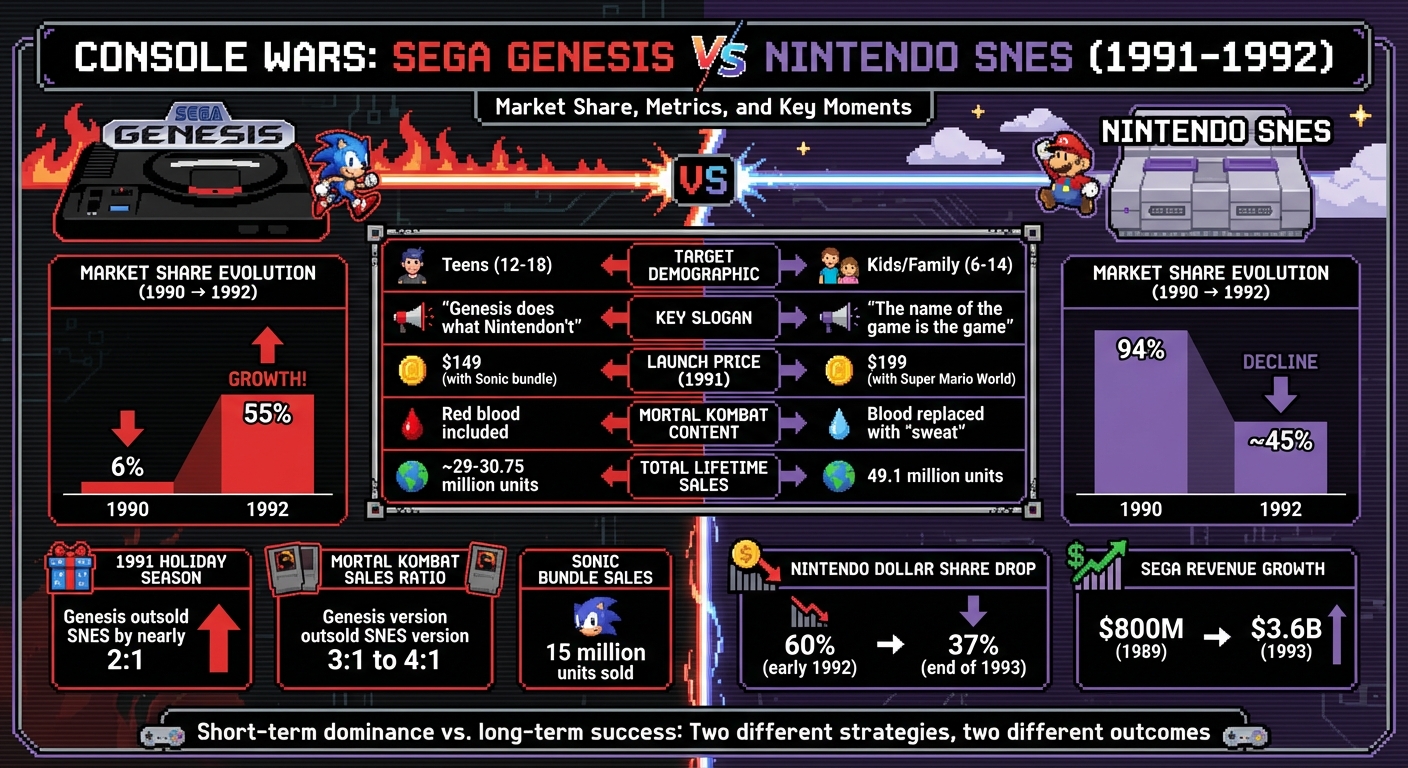
Sega Genesis vs Nintendo SNES: 1991-1992 Console Wars Comparison
In the early 1990s, branding strategies played a pivotal role in reshaping the console market. At the start of the decade, Nintendo held a commanding lead, while Sega struggled to gain traction. However, Sega’s bold marketing and localization efforts turned the tide. By 1992, Sega had claimed 55% of the 16-bit market, a remarkable shift in just two years.
One of Sega’s most effective moves was bundling Sonic the Hedgehog with the Genesis in 1991, pricing the package at $149 - significantly undercutting the SNES launch price of $199. This aggressive pricing strategy spurred widespread adoption, with the Sonic bundle selling an impressive 15 million units. Sega’s revenue soared from $800 million in 1989 to $3.6 billion by 1993. During the 1991 holiday season, Genesis sales outpaced the SNES by nearly 2:1, marking a significant victory for Sega.
Nintendo, however, stayed true to its family-friendly brand identity. Its emphasis on high-quality first-party titles like Super Mario World and The Legend of Zelda helped the SNES achieve long-term success, ultimately selling 49.1 million units worldwide. In contrast, the Genesis sold approximately 29–30.75 million units. While Sega’s short-term dominance was impressive, Nintendo’s strategy ensured sustained success over the console generation.
1991–1992 US Sales Data: Comparing Two Different Approaches
Sales data from 1991 to 1992 highlights the impact of Sega and Nintendo’s contrasting branding strategies. By January 1992, Sega controlled 65% of the 16-bit console market. Meanwhile, Nintendo’s dollar share fell sharply, dropping from 60% at the start of 1992 to just 37% by the end of 1993.
The 1992 release of Mortal Kombat further demonstrated the influence of content decisions on sales. Sega’s version retained the game’s red blood, while Nintendo replaced it with "sweat." This change led to the Genesis version outselling the SNES version by a ratio of 3:1 or even 4:1. This move reinforced Sega’s edgier brand image, a vision championed by CEO Tom Kalinske. For modern retro gaming enthusiasts, BJ's Game Vault offers both original and reproduction cartridges of these uncensored versions, allowing collectors to experience the games as they were originally intended.
| Metric | Sega Genesis (1991–1992) | Nintendo SNES (1991–1992) |
|---|---|---|
| Market Share (1990) | 6% | 94% |
| Market Share (1992) | 55% | ~45% |
| Target Demographic | Teens (12–18) | Kids/Family (6–14) |
| Key Marketing Slogan | "Genesis does what Nintendon't" | "The name of the game is the game" |
| Launch Price (1991) | $149 (with Sonic bundle) | $199 (with Super Mario World) |
| Mortal Kombat Content | Included red blood | Replaced blood with "sweat" |
| Total Lifetime Sales | ~29–30.75 million units | 49.1 million units |
These figures underscore how branding choices shaped consumer preferences and defined the console wars of the early 1990s. For retro gaming enthusiasts and collectors, these moments offer a fascinating glimpse into the strategies that influenced an entire generation of gamers.
Conclusion: What Retro Gaming Collectors Can Learn from 90s Branding
The console wars of the 1990s offer insight into why certain games, hardware variants, and promotional items have become prized collectibles today. Nintendo's strategy of prioritizing gameplay quality over sheer quantity stood in stark contrast to Sega's bold, youth-driven marketing approach, which helped broaden gaming's appeal beyond children.
Promotional materials from that era - like Nintendo Power magazines, VHS tapes such as Donkey Kong Country Exposed, and event merchandise from campaigns like Sonic 2sday - have become sought-after artifacts. These items capture the creativity and competitive energy of the marketing battles that defined the decade .
Regional branding differences also played a significant role, adding layers of historical context to collections. These variations, as previously discussed, highlight how tailored strategies shaped the gaming landscape in different parts of the world .
For collectors today, the legacy of these branding efforts lives on. At BJ's Game Vault, enthusiasts can find original and reproduction cartridges, rare ROM hacks, and gaming accessories for systems like the NES, SNES, and Sega Genesis. These offerings allow fans to experience the authentic charm of retro gaming hardware.
The branding strategies of the 90s left a lasting mark. Sega's edgy campaigns might have given it a temporary edge, but Nintendo's focus on quality ensured its enduring success. For collectors, these artifacts are more than just physical items - they're pieces of history that showcase how branding shaped an entire era of gaming.
FAQs
Why was the Sega Mega Drive renamed to Genesis in the United States?
When Sega introduced the Mega Drive to the U.S., they rebranded it as the Genesis. This decision wasn’t just about creativity - it was practical too. A storage-device company already owned the trademark for "Mega Drive" in the U.S., forcing Sega to find a new name. They landed on "Genesis" because it captured the idea of a fresh start, symbolizing Sega's ambitious entry into the American gaming market. The new name also set the console apart from personal computers, emphasizing its identity as a thrilling gaming system.
How did Nintendo's content policies in the 1990s influence U.S. game releases?
In the 1990s, Nintendo took a firm stance on content guidelines in the U.S., requiring game developers to censor or alter their titles to remove elements like graphic violence, sexual content, religious imagery, and explicit depictions of death. A well-known example is Mortal Kombat, where red blood was changed to white, and the iconic fatality moves were completely removed.
These strict policies often caused delays, censorship headaches, or even led to some games being banned outright. This sometimes hurt sales, especially when less-restricted versions of the same games were available in other regions. While the goal was to uphold a family-friendly image, these rules sparked debates about creative freedom and opened the door for competing consoles that offered fewer restrictions.
How did Sega's 'Genesis Does What Nintendon't' campaign influence its market share in the 1990s?
Back in the early 1990s, Sega shook up the gaming world with its bold "Genesis Does What Nintendon't" campaign. This clever marketing move positioned the Sega Genesis as the cooler, more advanced option compared to its rival, Nintendo. The message? Sega was here to break the mold and appeal to a younger, edgier crowd.
And it worked. Sega's U.S. console market share skyrocketed from a modest 6% in the early '90s to a commanding 65% by the middle of the decade. With the help of iconic games like Sonic the Hedgehog and a sharp focus on innovative branding, Sega firmly established itself as a powerhouse during the heated 16-bit console wars.