


Sega vs. Nintendo: Marketing Wars
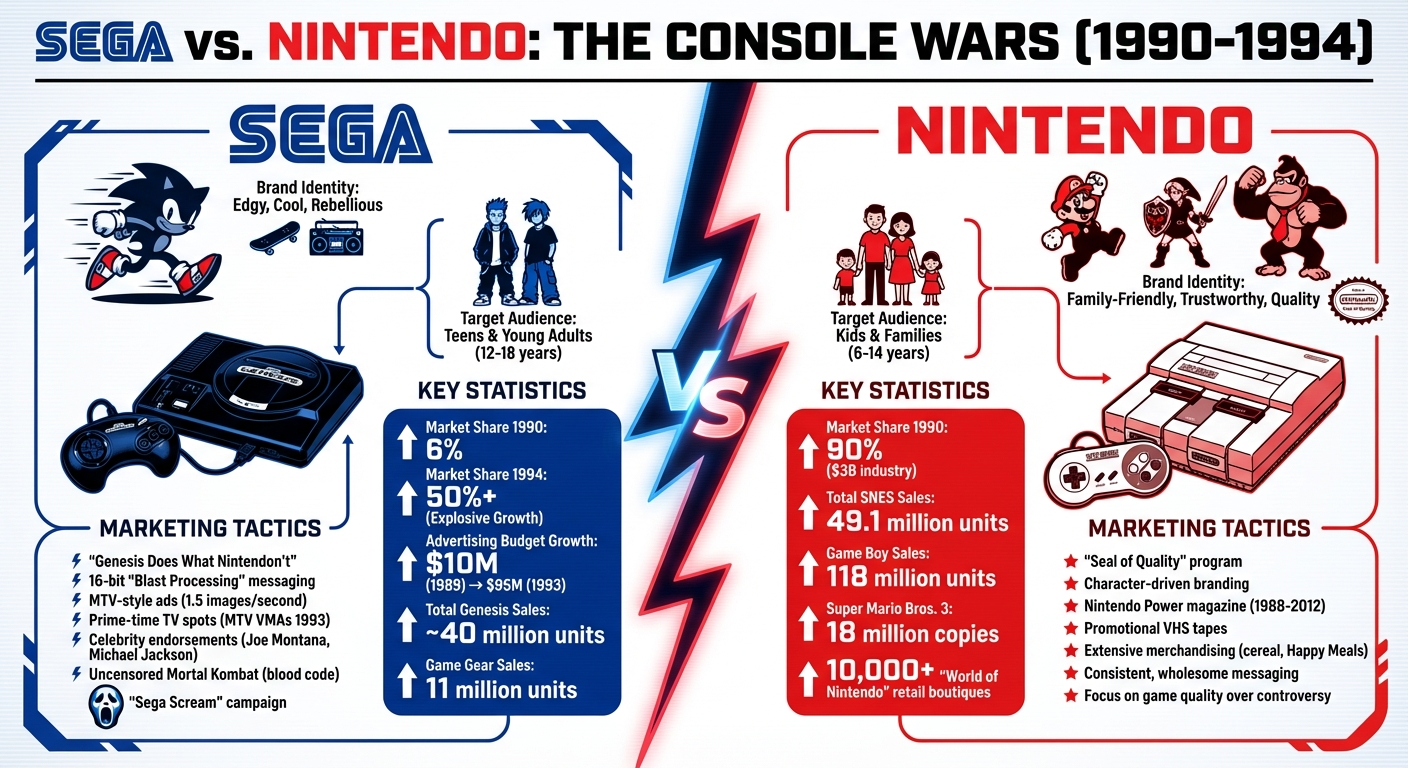
The battle between Sega and Nintendo in the 1990s wasn’t just about gaming consoles - it was a clash of identities and marketing strategies that reshaped the gaming industry. By 1990, Nintendo dominated the U.S. market with a 90% share, catering to kids and families with its wholesome image and iconic characters like Mario. Sega, however, disrupted the scene by targeting teens and young adults with bold, edgy campaigns like "Genesis Does What Nintendon’t." This rivalry pushed both companies to innovate in marketing, content, and cross-media efforts, leaving a lasting impact on gaming culture.
Key takeaways:
- Nintendo's strategy: Family-friendly branding, iconic characters, and consistent quality. Dominated early with the NES and SNES, selling 49.1M SNES units globally.
- Sega's approach: Aggressive marketing, targeting older audiences with campaigns like "Genesis Does What Nintendon’t." By 1994, Sega captured over 50% of the U.S. market.
- Cultural influence: Sega’s edginess vs. Nintendo’s trustworthiness defined the "console wars", influencing how games were marketed and perceived.
- Legacy: Both brands now collaborate, offering their classic games via platforms like Nintendo Switch Online, blending nostalgia with modern gaming.
This rivalry wasn’t just about sales - it shaped how gaming brands connect with audiences, from bold advertising to cross-media storytelling.
Sega vs Nintendo Marketing Strategies and Market Performance 1990-1994
Sega vs Nintendo: The Most Brutal Console War with Al Nilsen - The Retro Hour EP
Sega's Aggressive Marketing Strategy
When Tom Kalinske took over as Sega's CEO, he made a bold move: he shifted the company's focus from young children to teenagers and college students. Between 1989 and 1993, Sega ramped up its advertising budget significantly, growing it from $10 million to a whopping $95 million. This massive investment helped establish Sega as the edgier, cooler alternative in the gaming world.
"Nintendo was clearly the preference of the child gamer. To me, it seemed logical to target the older audience, and to do that with more aggressive marketing."
– Tom Kalinske, former CEO, Sega of America
This strategy paid off. By rebranding the Genesis as the console for kids who had outgrown Nintendo's family-friendly vibe, Sega created a whole new identity. They weren’t just selling a gaming system - they were selling a lifestyle that appealed to the MTV generation. This shift set the stage for some of Sega's most iconic campaigns.
The "Genesis Does What Nintendon't" Campaign
"Genesis Does What Nintendon't" is one of the most unforgettable slogans in gaming history. Created by the ad agency Bozell, this campaign broke the mold by directly calling out Nintendo, something rarely done in Japanese business culture but perfect for the competitive U.S. market.
"I remember when our ad agency went and promoted that for the first time to us... just seeing 'Nintendo' with the apostrophe and letter T on the end was just so visually exciting."
– Al Nilsen, former Head of Global Marketing, Sega
The campaign leaned heavily on the Genesis’s 16-bit "Blast Processing" technology, portraying it as faster and more advanced than Nintendo’s 8-bit NES. The commercials were fast-paced and visually intense, mirroring MTV's rapid-cut editing style, with an average of 1.5 images per second. They were loud, in-your-face, and impossible to ignore - exactly what Sega wanted to grab the attention of teenagers.
Sega also made daring creative decisions. For instance, when Mortal Kombat launched in 1993, Nintendo censored the game’s blood, replacing it with "grey sweat." Sega, on the other hand, included a code that unlocked all the gore, positioning the Genesis as the console for "real" gamers. These bold moves helped Sega stand out even more.
Celebrity Endorsements and Pop Culture Connections
Sega understood the power of star power. In October 1989, Sega of America President Michael Katz brought in big names like Joe Montana for Joe Montana Football and Michael Jackson for Moonwalker. These endorsements gave the Genesis a serious boost in pop culture relevance.
Sega also took a fresh approach to advertising, opting for prime-time TV spots during events like the 1993 MTV Video Music Awards. This strategy helped Sega connect with teens and young adults who saw gaming as part of their identity.
In April 1993, Sega took its branding to the next level by sponsoring the European Grand Prix at Donington Park. Sonic the Hedgehog was everywhere, and when racing legend Ayrton Senna won and lifted a Sonic-themed trophy, Sega's connection to high-speed excitement was cemented. The "Sega Scream" campaign, which featured explosive visuals and ended with a dramatic "SEGA!" yell, became so popular that even rappers started using it as a backstage greeting.
Nintendo's Family-Friendly Brand and Consistent Messaging
Nintendo built its reputation by focusing on a family-friendly approach, delivering games that parents could trust and kids would adore. Instead of relying on flashy or aggressive marketing, the company emphasized quality and consistency. While Sega stirred up controversy with its bold and edgy tactics, Nintendo stuck to its wholesome messaging, earning long-term loyalty from families.
By 1990, Nintendo dominated the U.S. video game market, holding a staggering 90% share of the $3 billion industry. Their strategy targeted kids aged 6 to 14 and their parents. Even when the industry faced backlash over controversial content, Nintendo maintained its clean-cut image. They also launched over 10,000 "World of Nintendo" boutiques in major retail stores, reinforcing their presence and trustworthiness. The company’s strict "Seal of Quality" program ensured that third-party games met high standards, further cementing Nintendo as the go-to choice for families.
"Nintendo has surpassed Sega in unit sales already. 3rd party licensees are flocking to us. Sega isn't a question."
– Howard Lincoln, Chairman, Nintendo of America
While Sega’s edgy branding resonated with the trends of the 1990s, it didn’t have the staying power of Nintendo’s family-first approach. Nintendo’s ability to grow alongside its audience helped the brand stay relevant across generations. This strategy paid off: the SNES outsold the Sega Genesis, with 49.1 million units sold compared to Sega’s estimated 40 million. By prioritizing reliability and family appeal, Nintendo laid the groundwork for a legacy built on beloved characters and widespread merchandising.
Mario and Other Popular Characters
Nintendo’s focus on iconic characters like Mario, Link, and Donkey Kong played a huge role in its success. These characters weren’t just mascots - they became symbols of trust and nostalgia, helping Nintendo connect with players of all ages.
The numbers back this up. Super Mario Bros. and The Legend of Zelda sold a combined 46 million units on the NES, and Super Mario Bros. 3 alone moved 18 million copies, making it the best-selling stand-alone game of its time. This character-driven strategy created lasting loyalty, something Sega struggled to replicate with its edgier mascot, Sonic. Designed to appeal to rebellious teens, Sonic’s "split-personality" branding couldn’t match the universal appeal of Nintendo’s characters.
Nintendo Power magazine, which ran from 1988 to 2012, became a cornerstone of Nintendo’s community-building efforts. It offered game tips, industry news, and a direct connection between the company and its fans, fostering deep loyalty in the pre-internet era. Nintendo even mailed out promotional VHS tapes like "Donkey Kong Country Exposed", giving fans a behind-the-scenes look at their favorite games and adding a personal touch to their marketing.
Merchandising and Licensing Programs
Nintendo didn’t stop at games - it turned its characters into household names through extensive merchandising. Mario and his friends showed up everywhere, from cereal boxes to Happy Meals, making them impossible to miss. This constant visibility created a cycle of nostalgia, with parents introducing their childhood favorites to their kids.
The Game Boy, often bundled with the puzzle game Tetris, was another massive win for Nintendo. It sold an incredible 118 million units worldwide, far outpacing Sega’s more advanced Game Gear, which managed only 11 million units. While Sega diluted its focus by supporting up to eight different hardware systems and add-ons simultaneously, Nintendo kept its message simple and clear. By centering its brand around cherished characters and family-friendly values, Nintendo made it easy for families to understand - and trust - what the company stood for.
Cross-Media Marketing Strategies
Sega and Nintendo recognized early on that video games couldn't just stay on consoles. To create enduring brands, they ventured into movies, TV shows, and mobile platforms. While their strategies differed, these moves not only shaped their identities but also allowed them to evolve alongside the gaming industry. This shift set the foundation for their unique ways of leveraging media beyond traditional gaming systems.
Sonic the Hedgehog in Movies and TV
Sega designed Sonic with cross-media appeal in mind. His look was inspired by Western cartoon icons like Mickey Mouse and Fritz the Cat, making him a natural fit for animation and film.
This vision first materialized in the 1990s with several animated series. Later, after the Dreamcast's disappointing sales - 9 million units compared to the PlayStation 2's staggering 157 million - Sega exited the hardware business and transformed into a third-party publisher. This shift allowed Sega to bring franchises like Sonic, Yakuza, and Persona to competing consoles, keeping them alive and relevant. The recent success of the Sonic the Hedgehog movies highlights how Sega's original focus on multimedia appeal continues to pay off.
Sega also explored celebrity partnerships early on, with games like Michael Jackson's Moonwalker and Joe Montana Football, embedding its brand into pop culture. The "Sega Scream", introduced during the 1993 MTV Video Music Awards, became so iconic that music artists even used it in live performances.
Nintendo's Games and Merchandise Integration
Nintendo, on the other hand, took a different route. Instead of leaning on celebrity endorsements, it focused on blending physical and digital experiences. Products like Amiibo connected collectible toys directly to gameplay, reinforcing Nintendo's family-friendly image while offering fans tangible extras for their games.
Mobile gaming became another key piece of Nintendo's strategy. Titles like Super Mario Run introduced iconic characters to smartphone users who might not own a console. By 2014, Shigeru Miyamoto noted that mobile games' widespread appeal meant Nintendo no longer needed to convince everyone to embrace gaming, allowing the company to focus on its core console audience. By 2021, this approach, coupled with the hybrid success of the Nintendo Switch, helped drive global net sales to nearly $16 billion.
Nintendo also embraced digital platforms to connect with fans. By late 2019, the company had over 10.3 million Twitter followers and 6.2 million YouTube subscribers. On TikTok, the #nintendo hashtag has racked up more than 20 billion views, showcasing how effectively Nintendo adapted its family-friendly image to modern social media. Meanwhile, Nintendo Switch Online doubled its subscriber base between January 2020 and September 2021, offering features like cloud storage and long-distance play while monetizing nostalgia.
Interestingly, the rivalry between Sega and Nintendo eventually evolved into collaboration. Nintendo Switch Online now includes classic Sega Genesis games alongside NES, SNES, and N64 titles. Meanwhile, Sega operates as a platform-independent content provider, distributing its legacy games across Nintendo, Sony, and Microsoft systems. What began as a fierce competition turned into a partnership built on mutual respect and a shared understanding that expanding cross-media reach matters more than hardware exclusivity.
sbb-itb-9a4764e
Modern Nostalgia Marketing
Building on their earlier cross-media campaigns, Sega and Nintendo have found new ways to keep their brands relevant by tapping into nostalgia.
Although both companies lean on their storied pasts, they do so in unique ways. Sega embraces an edgy, "Rock & Roll" identity, while Nintendo presents a polished, family-friendly "Pop Music" vibe.
Sega's Revival of Classic Franchises and Transmedia Expansion
Sega is making bold moves to revive its legacy. At The Game Awards in December 2023, Sega President Shuji Utsumi announced plans to bring back five iconic franchises - Jet Set Radio, Shinobi, Golden Axe, Streets of Rage, and Crazy Taxi. This announcement came in the form of a 90-second trailer that aimed to signal Sega's return to its roots. Utsumi was clear about the message:
"I wanted to send a message saying 'Sega is coming back'."
But Sega isn’t just reviving games; it’s reimagining itself as an entertainment powerhouse, taking cues from Disney. The company is leveraging its gaming history while expanding into toys, clothing, and other merchandise - a strategy that now generates nearly $1 billion annually in retail sales. In November 2024, Justin Scarpone, Sega's Global Head of Transmedia, described the vision:
"We want to be in the position where it's OK if there are people who love some of our IP who have never played a game, but have seen all of our films, been to our live shows, been to our attractions, or bought our merchandise."
This strategy targets nostalgic fans in their 40s and 50s while introducing these classic franchises as fresh content to younger audiences. Sega's efforts have paid off, with the company climbing 107 spots on License Global's Top Global Licensors list to No. 39, surpassing Sony Pictures. To further cement its presence, Sega plans to open flagship retail stores in Tokyo and Shanghai in 2025.
Nintendo Switch Online and Its Legacy Game Library
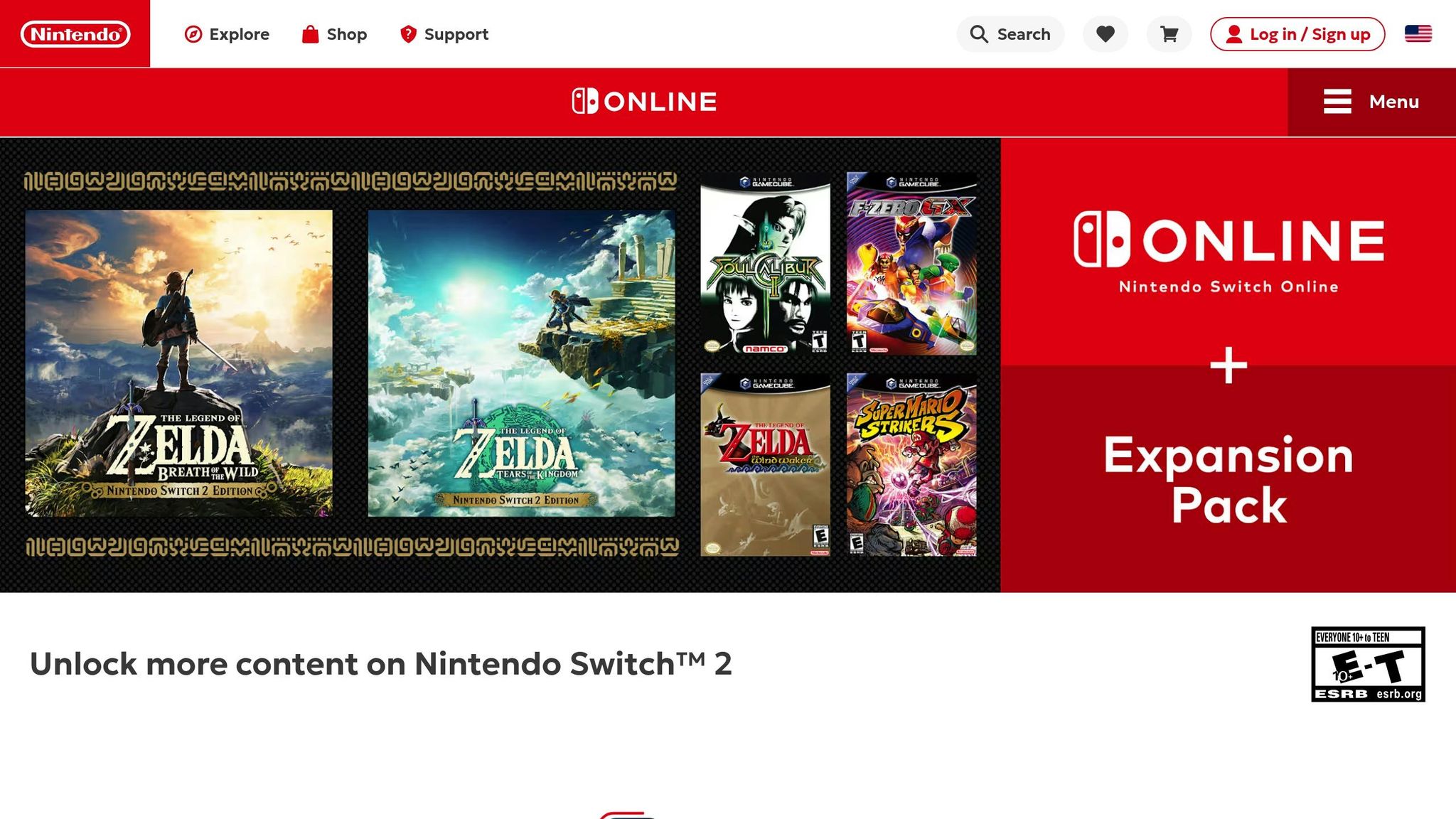
Nintendo, on the other hand, has taken a more measured approach. Instead of reviving dormant franchises with new games, the company uses Nintendo Switch Online (NSO) to give players access to its extensive back catalog. In October 2021, Nintendo introduced the Expansion Pack tier for $50 per year, offering subscribers access to a curated collection of NES, SNES, N64, and even Sega Genesis games. Titles like The Legend of Zelda: Ocarina of Time and Sonic the Hedgehog 2 have become part of this subscription model.
This strategy allows Nintendo to deliver its legacy content on modern hardware without the need for significant new development. It keeps longtime fans engaged while also attracting new players. And it’s working: as of March 2025, the Nintendo Switch has sold over 152 million units, thanks in part to its focus on retro gaming and its appeal to older audiences.
Interestingly, what was once a heated rivalry between Sega and Nintendo has evolved into a shared nostalgia experience. Since Sega exited the console market in 2001, it has become a third-party publisher, bringing its classic titles to platforms like the Nintendo Switch. Meanwhile, Nintendo benefits from offering Sega’s games alongside its own, creating a unified retro gaming library that appeals to fans of both brands. This collaboration highlights how both companies have found ways to blend their rich histories with modern gaming platforms.
BJ's Game Vault Retro Picks for Sega and Nintendo Fans
For those passionate about preserving gaming history, BJ's Game Vault offers custom cartridges and reproduction titles that highlight the fierce rivalry of the early 1990s console wars. These carefully crafted products not only bring back fond memories but also showcase the contrasting strategies of Sega and Nintendo during that iconic era.
Custom Sega Genesis and SNES cartridges reflect the unique identities of the two gaming giants. Sega leaned into its "Blast Processing" speed and edgy appeal, targeting teens aged 12–18, while Nintendo focused on polished, family-friendly gameplay for kids aged 6–14. Reproduction titles like Mortal Kombat even restore the stark differences between Sega's uncensored, gore-filled version and Nintendo's more subdued take.
Rare ROM hacks at BJ's Game Vault further highlight the technical competition between the two. Back in the early '90s, even die-hard Mario fans were intrigued by Sonic's "attitude" - his lightning speed, iconic red sneakers, and impatient personality. Custom cartridges featuring both Sonic and Mario capture the essence of Sega's "Mario killer" strategy, which helped the company skyrocket from a 6% market share in 1990 to over 50% by 1994.
To round out the collection, plush collectibles inspired by Sonic and Mario embody the "cool" versus "family-friendly" branding divide that defined this legendary rivalry. These items celebrate how targeted demographics and storytelling across multiple media shaped the gaming landscape. Whether you're a Sega fan or a Nintendo enthusiast, these retro treasures keep the spirit of the console wars alive.
Conclusion: The Lasting Impact of Sega vs. Nintendo
The rivalry between Sega and Nintendo didn’t just sell consoles - it reshaped the way video games were marketed in the U.S. It introduced a competitive edge that continues to influence the industry today. This "console war" mindset not only fueled intense brand loyalty but also laid the groundwork for how gaming communities still interact and identify themselves.
The competition between these two giants led to tangible changes in the industry. From the introduction of age-rating systems to the coordination of global release dates, their battle pushed the boundaries of what gaming could be. Sega’s ability to attract a broader audience forced its rivals to rethink their strategies, ultimately changing how gaming brands present themselves.
Blake Harris, author of Console Wars, summed it up well:
"Nintendo and Sega were enemies... I've always compared it to the childhood equivalent of political parties".
This sense of tribalism didn’t just define the era - it continues to shape gaming culture today, from the way fans rally around their favorite brands to the growing market for retro game collecting.
Even now, the legacy of this rivalry lives on in the retro gaming scene. Companies like BJ's Game Vault honor this history with products that bring the Sega vs. Nintendo era back to life. Their custom cartridges, reproduction titles, and rare ROM hacks celebrate everything that made these two brands distinct - from Sega’s bold "Blast Processing" to Nintendo’s polished, family-friendly gameplay. While the rivalry itself may have ended, its influence on gaming culture - and the nostalgia it sparks - remains as powerful as ever.
FAQs
How did Sega’s marketing approach in the 1990s differ from Nintendo’s?
In the 1990s, Sega’s marketing was all about being bold, edgy, and appealing to older teens and young adults. Campaigns like “Genesis Does What Nintendon’t” and “Now There Are No Limits” highlighted speed, attitude, and the rebellious vibe of their new mascot, Sonic the Hedgehog. Sega wasn’t shy about pushing boundaries either, proudly showcasing games like Mortal Kombat with all the blood and gore intact. The goal? To position themselves as the "cool" and daring choice, standing in stark contrast to their main competitor.
Nintendo, meanwhile, leaned into its reputation for being family-friendly. Their ads focused on the universal appeal of beloved characters like Mario, emphasizing fun for everyone, regardless of age. By sticking to a consistent, safe message and maintaining tight control over licensing, Nintendo managed to hold onto its strong market presence by catering to families and younger players.
This approach created a clear divide: Sega aimed to win over older, image-conscious gamers, while Nintendo stayed focused on delivering games that appealed to a wider, family-oriented audience.
How did Sega's 'Genesis Does What Nintendon't' campaign impact its market share?
Sega's Genesis Does What Nintendon't campaign shook up the gaming world in the early 1990s. These bold, head-to-head ads struck a chord with gamers, portraying the Genesis as a sleeker, edgier alternative to Nintendo's consoles. This clever strategy paid off, helping Sega claim a major share of the U.S. console market by 1991 and briefly dethroning Nintendo as the industry leader.
During its height, the Genesis earned the title of the best-selling toy in America, outselling Nintendo's systems and cementing Sega's legacy in gaming history. The campaign proved how impactful aggressive marketing and sharp messaging could be in transforming the competitive landscape.
How did the rivalry between Sega and Nintendo shape modern gaming culture?
The rivalry between Sega and Nintendo in the late 1980s and early 1990s didn’t just change gaming - it reshaped how we think about it. By turning their consoles into distinct brands, they introduced competition that pushed gaming beyond its "just for kids" image. Sega took a daring leap with more mature titles like Mortal Kombat, prompting Nintendo to adjust its strategy. This clash even led to the development of the first age-rating system, opening the door for gaming to attract a wider audience, including adults.
This era also gave rise to mascot-driven marketing, with Sonic and Mario becoming household names. These characters weren’t just in games - they were everywhere, from cereal boxes to massive parades. Fans picked sides, forming “Team Sega” and “Team Nintendo,” a rivalry that still echoes in gaming communities today. The impact of this competition is still felt, influencing how games are marketed and celebrated. It’s also a big reason why retro gaming products, like those at BJ’s Game Vault, remain so popular with fans chasing a bit of nostalgia.