


US vs. Japan: Console Box Art Differences
When it comes to video game box art, the US and Japan have taken very different approaches, reflecting the preferences of their respective audiences. US designs focus on bold, action-packed visuals meant to grab attention, while Japanese covers emphasize detailed, character-driven artwork inspired by anime and manga. These differences highlight how publishers tailored their strategies for each market, shaping how players first experienced games.
Key takeaways:
- US box art: Bold characters, action scenes, and high-contrast colors. Designed to stand out on store shelves.
- Japanese box art: Detailed illustrations, emotional character art, and vibrant or subdued palettes. Prioritized artistic expression.
- Examples: Games like Chrono Trigger, Final Fantasy, and The Legend of Zelda show striking contrasts between the two styles.
Here’s a quick comparison of their design elements:
| Design Element | US Box Art | Japanese Box Art |
|---|---|---|
| Focus | Action-packed, bold visuals | Detailed, character-driven artwork |
| Colors | High-contrast, dark tones | Vibrant or hand-drawn palettes |
| Typography | Large logos, marketing taglines | Integrated, subtle text placement |
| Characters | Gritty, "toughened-up" designs | Faithful to in-game art styles |
These differences not only shaped gaming's visual identity but also offer a nostalgic glimpse into the gaming history of both regions.
US vs Japan Video Game Box Art Design Differences Comparison
American VS Japanese Video Game Box Art
sbb-itb-9a4764e
How Culture and Design Shape Console Box Art
The differences between U.S. and Japanese console box art go far beyond surface visuals - they reveal distinct regional perspectives. In the U.S., game packaging often serves as a direct marketing tool. Publishers focus on bold branding, prominent logos, and action-packed imagery to promise excitement and adventure. Meanwhile, Japanese designs lean into the idea of games as playful experiences, often showcasing detailed character art and drawing heavily from the country’s deep-rooted manga and anime traditions. These contrasting approaches have shaped the way millions of gamers first perceive their favorite titles and highlight the unique priorities of each region.
U.S. Box Art: Bold and Market-Driven
In the U.S., publishers have historically used bold, action-focused visuals to appeal to a predominantly male audience. George Harrison, former Director of Marketing at Nintendo of America, once explained:
"We tend to do what most publishers do - follow our nose to where the business is. It has been less of an exclusion of women than it has been following our nose to where the business is."
This marketing-centric strategy led to box art designed to grab attention on crowded store shelves. Covers often featured strong, isolated characters in dramatic poses, emphasizing action and intensity. Take games like Kirby or Chrono Trigger - while the U.S. versions reimagined these characters with a tougher, edgier look, their Japanese counterparts retained a softer, more communal style. The U.S. approach prioritized simplicity and boldness, aiming to sell the game as an experience packed with excitement.
Japanese Box Art: Artistic and Character-Driven
In Japan, where manga and anime influence nearly every aspect of visual culture - from advertisements to public signage - it’s no surprise that game box art reflects this aesthetic. Japanese designs often feature intricate, character-focused artwork that highlights emotion and personality. For example, the Japanese version of Chrono Trigger includes detailed sprite-based illustrations that capture expressions like happiness through subtle touches, such as "arched eyes", staying true to anime traditions.
Rather than focusing on polished marketing, Japanese publishers often prioritize artistic expression, even if it means embracing a hand-drawn, less commercialized style. Journalist Will Freeman noted:
"In Japan, there appears to be a greater eagerness to sell games as playthings, and a degree more devotion in the West to sell experiences by leaning into the gritty and realistic."
This approach results in busier, more detailed compositions. Japanese covers often feature smiling characters, dynamic perspectives, and elaborate collages that feel more playful and inviting. A great example is the Final Fantasy series. In Japan, the boxes typically showcase Yoshitaka Amano’s sophisticated artwork against simple white backgrounds. By contrast, U.S. versions include large character illustrations and prominent logos, catering to a more action-oriented audience.
Console Box Art Comparisons: US vs. Japan
Super Nintendo Entertainment System (SNES)
The SNES era showcased some striking differences in box art styles between regions. Japanese Super Famicom boxes had a vertical, portrait-style layout, resembling VHS tapes or books, while US SNES boxes were horizontal and much larger to fit the bulkier cartridge designs. As David Law pointed out:
"The vertical design of Super Famicom game boxes, reminiscent of VHS tapes or books, was truly ingenious. When these boxes were lined up on a shelf, they looked like a 'playable novels' collection."
Take The Legend of Zelda: A Link to the Past, for example. In Japan, the cover depicted Link in a forest setting with the Master Sword, surrounded by vibrant, full-coverage colors. In contrast, the US version opted for a gold-colored background with a bold red "ZELDA" logo, prioritizing brand recognition over intricate artwork.
Another notable case is Final Fantasy VI (released as Final Fantasy III in the US). The Japanese version featured Yoshitaka Amano's detailed, sci-fi-inspired artwork, while the US cover went with a minimalist design showing a Moogle holding a sword. This shift reflected the belief among US publishers that American audiences preferred simpler, more direct marketing. Interestingly, despite the artistic disparity, the game sold 1,440,000 copies in Japan alone.
Then there’s Phalanx. The Japanese version showcased a sleek spaceship, fitting its futuristic theme. But the US release took a completely different route: it featured an old man playing a banjo. This bizarre choice was meant to grab attention on crowded store shelves. Beyond imagery, color schemes also varied. Japanese covers leaned into vibrant, saturated palettes that matched the games’ themes, while US designs often relied on stark black or purple borders. These early differences laid the groundwork for the evolving strategies seen in later console generations.
PlayStation 2 (PS2)
By the PS2 era, these regional contrasts became more refined. A standout example is ICO. The Japanese cover, designed by Director Fumito Ueda, had a minimalist, painting-like aesthetic inspired by architecture, with small characters to evoke a sense of scale and artistry. The US version, however, replaced it with a close-up of the horned protagonist, aiming for a more immediate and bold appeal. As Joseph Parziale observed:
"Companies knew that each audience was very different in what appealed to them, and would tweak cover art accordingly to increase sales for that region."
Resident Evil 4 followed a similar pattern. The Japanese artwork emphasized atmosphere and stylized character portraits, while the US version leaned into action-packed scenes with weapons drawn. This shift reflected a broader strategy: Western publishers often avoided anime-style designs, considering them too niche for American audiences. Instead, they favored "Westernized" visuals inspired by action movies, which tested better with local markets. While these changes often boosted sales, they frequently came at the expense of the original artistic vision.
Nintendo Switch
Even in the modern era, regional preferences remain evident on the Nintendo Switch. Japanese covers often include more intricate details, atmospheric backgrounds, and contextual elements, while Western versions favor brighter colors and tighter character framing.
For instance, The Legend of Zelda: Breath of the Wild highlights these differences. Critics have praised the Japanese version for its atmospheric depth, while the US version, though striking, was noted for being slightly less detailed. Similarly, Super Metroid offers a clear comparison. The Japanese cover included background characters like Kraid, adding layers of environmental storytelling through accurate color palettes. Meanwhile, the US and PAL versions zoomed in on Samus and Ridley, stripping away much of the surrounding context.
These examples show that while gaming has become a more global industry, regional preferences still shape box art. Japanese designs tend to embrace "playful" and "hand-drawn" aesthetics, while Western covers stick with "hero-centric" action shots and bold logos, even as global releases become the norm.
US vs. Japan Design Elements Comparison
When it comes to box art for video games, the design principles in the US and Japan have historically followed very different paths. These differences reflect not just artistic choices but also cultural preferences and marketing strategies.
In the US, publishers leaned toward bold, attention-grabbing visuals designed to stand out on crowded store shelves. Meanwhile, Japanese designers often prioritized artistry and storytelling, frequently collaborating with iconic illustrators like Yoshitaka Amano, Ayami Kojima, and Yoji Shinkawa.
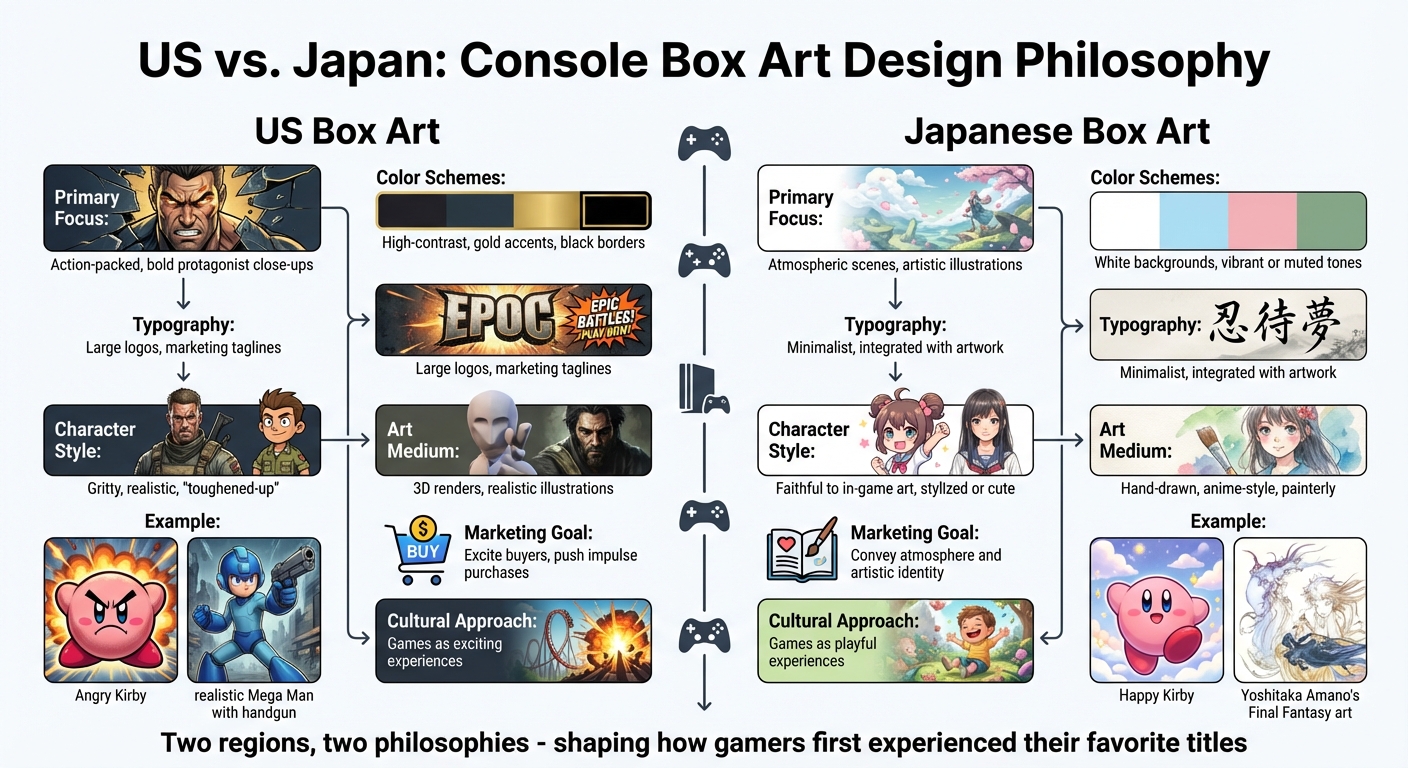
One striking difference is how characters are portrayed. US covers tend to "toughen up" characters to appeal to local tastes. A well-known example is the "Angry Kirby" phenomenon. As Lucas M. Thomas of IGN explains:
"The running gag here is that Kirby is always altered to look pissed off when he comes to the USA, but he's allowed to retain his happy-go-lucky personality elsewhere".
This approach wasn’t limited to Kirby. Even Mega Man underwent a dramatic transformation for US audiences, trading his iconic blue robotic look for a more realistic depiction - a man in a jumpsuit holding a handgun.
Typography and layout also highlight these differences. US box art often features large, prominent logos and marketing taglines like "From the creators of…" to encourage impulse buys. On the other hand, Japanese covers tend to integrate logos seamlessly into the artwork or place them against simple backgrounds, allowing the art to take center stage. The color palettes differ as well: US designs often use high-contrast tones, gold accents (especially for The Legend of Zelda series), or stark black borders. Japanese covers, by contrast, lean toward white backgrounds, vibrant colors, or more subdued, painterly styles.
Here’s a quick comparison of the two styles:
| Design Element | US Box Art | Japanese Box Art |
|---|---|---|
| Primary Focus | Action-packed, bold protagonist close-ups | Atmospheric scenes, artistic illustrations |
| Color Schemes | High-contrast, gold accents, black borders | White backgrounds, vibrant or muted tones |
| Typography | Large logos, marketing taglines | Minimalist, integrated with the artwork |
| Character Style | Gritty, realistic, "toughened-up" | Faithful to in-game art, stylized or cute |
| Art Medium | 3D renders, realistic illustrations | Hand-drawn, anime-style, painterly |
| Marketing Goal | Excite buyers, push impulse purchases | Convey atmosphere and artistic identity |
Interestingly, modern US Collector's Editions have started to adopt some of the minimalist and artistic elements traditionally seen in Japanese designs. This shift reflects a growing appreciation for the artistry that was once overlooked.
Conclusion
The contrasting design philosophies of US and Japanese console box art reveal much about their respective cultural and marketing approaches. Historically, American publishers leaned toward bold, action-filled visuals featuring tough characters and striking contrasts, designed to grab attention on crowded retail shelves. On the other hand, Japanese designers often prioritized atmosphere and artistic expression, frequently collaborating with renowned illustrators to create covers that felt like pieces of art.
For many, US box art evokes a deep nostalgia, harking back to a time when game covers were the primary way to entice players - long before online reviews and gameplay videos existed. As Joseph Parziale from Video Game Guardian puts it:
"There is something bittersweet and charming thinking back to this simple time, when all we really had was the box art".
At the same time, Japanese box art is often seen as offering a truer representation of a game's artistic vision, resonating with collectors who value authenticity.
Retro gamers cherish these designs as cultural artifacts. The exaggerated, sometimes altered characters on US covers (like the infamous American Mega Man) and the understated elegance of Japanese covers (such as Final Fantasy) together tell a story of how marketing and cultural values shaped gaming history. Each box was more than just packaging - it was an invitation into a unique gaming adventure.
For those looking to relive this legacy, BJ's Game Vault keeps the spirit alive with retro-tested games and custom cartridges for systems like NES, SNES, Sega Genesis, N64, and GBA - bridging the gap between collectors and the original artistry of each region.
FAQs
Why do US and Japanese video game box arts look so different?
The differences between US and Japanese video game box art boil down to distinct preferences and marketing strategies shaped by each region's culture. In the US, covers often lean toward clean, straightforward designs. They typically feature bold titles and a central, eye-catching image - like a heroic pose or a prominent logo. This style resonates with American audiences, who tend to favor simple, information-driven visuals.
On the other hand, Japanese box art is often more vibrant and packed with detail, reflecting the country's strong ties to anime and illustration. These covers frequently showcase colorful characters, expressive artwork, and intricate scenes that hint at the game's mood or story. This approach aligns with Japanese gamers' appreciation for hand-drawn designs that bring out a game's unique personality.
When games are localized, publishers often redesign the box art to align with the tastes and expectations of each market. This process explains the stark contrasts collectors and fans notice between the two regions. Stores like BJ’s Game Vault, which specialize in retro games, often stock both US and Japanese versions, giving fans a chance to explore and compare these artistic differences firsthand.
How do cultural differences influence video game box art design?
Cultural differences have a significant impact on video game box art, as designers adapt their visuals to resonate with regional audiences. In Japan, box art often leans into vibrant, hand-drawn illustrations with a distinct anime-inspired flair. These designs typically feature expressive characters, bold color palettes, and intricate details, reflecting the deep influence of Japanese pop culture and its focus on storytelling and group dynamics.
In contrast, U.S. box art tends to embrace bold, action-packed imagery, often emphasizing simplicity and intensity. American designs frequently spotlight individual heroes or dramatic, high-stakes scenes, aiming to evoke a sense of excitement and urgency. This approach aligns with marketing strategies in the U.S. that prioritize action and spectacle.
At BJ’s Game Vault, collectors have the chance to dive into these intriguing regional differences, offering a glimpse into how cultural preferences have shaped the visual identity of video games over the years.
How do differences in box art between the U.S. and Japan affect game sales?
Box art plays a huge part in how video games are marketed and sold. In Japan, covers often showcase vibrant, intricate artwork that appeals to fans of anime-inspired designs and collectors who appreciate detailed visuals. Meanwhile, U.S. box art tends to lean on simpler designs, usually with bold logos, aiming to grab the attention of a wider audience.
These design choices can have a noticeable effect on sales. Eye-catching Japanese box art not only drives initial purchases but also sparks interest among collectors, often leading to higher resale values. On the flip side, less appealing U.S. designs can sometimes hurt demand. A well-known example is Ico, where the North American cover was partly blamed for underwhelming sales. For retro gaming fans, stores like BJ’s Game Vault have stepped in, offering original Japanese packaging that has become a prized find for collectors.