


N64 vs. PlayStation: 3D Gaming Pioneers
The Nintendo 64 and Sony PlayStation marked a turning point in gaming history by bringing 3D worlds into players’ homes. Each console offered distinct advantages and faced unique challenges:
- Nintendo 64: Focused on performance with a faster CPU, hardware-accelerated graphics (anti-aliasing and Z-buffering), and near-instant game loading thanks to cartridges. However, limited storage (max 64 MB) and complex development tools made it harder for third-party developers to create games.
- PlayStation: Prioritized ease of development and cinematic experiences using CD-ROMs, which provided 10x more storage (650 MB). It had a larger game library, but lacked advanced features like Z-buffering, leading to visual quirks like texture warping.
Key Takeaway: The N64 excelled in multiplayer and technical precision, while the PlayStation dominated with its vast game library and storytelling capabilities.
Quick Comparison
| Feature | Nintendo 64 | PlayStation |
|---|---|---|
| CPU Speed | 93.75 MHz (64-bit) | 33.8 MHz (32-bit) |
| Storage | Cartridge (4–64 MB) | CD-ROM (650 MB) |
| Game Library | 388 titles | 1,100+ (NA) / 4,000+ (Global) |
| Best-Selling Game | Super Mario 64 (11.62M units) | Gran Turismo |
| Multiplayer Ports | 4 (built-in) | 2 (multitap required for more) |
| Loading Times | Near-instant | Noticeable |
Both consoles shaped modern gaming, with the N64 revolutionizing controls and local multiplayer, and the PlayStation pushing the boundaries of cinematic storytelling.
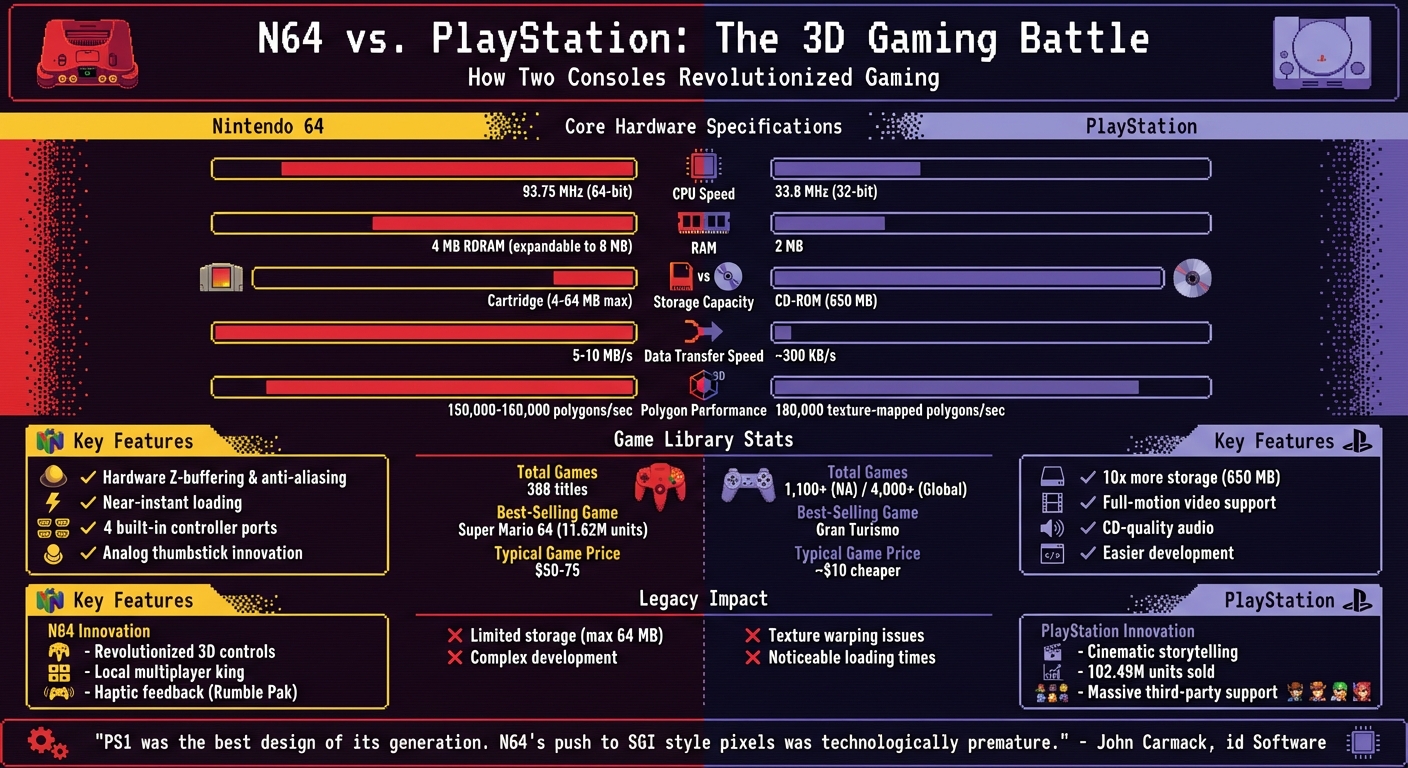
Nintendo 64 vs PlayStation Hardware and Performance Comparison
Nintendo 64: Hardware and Capabilities
N64 Technical Strengths
The Nintendo 64 packed some serious power for its time. At its core was the NEC VR4300 CPU, clocked at 93.75 MHz, capable of processing 125 million instructions per second - nearly tripling the performance of the PlayStation's 33.9 MHz CPU. But the real game-changer was the Reality Coprocessor (RCP). This custom 62.5 MHz chip, developed with Silicon Graphics, handled graphics and audio independently, freeing up the CPU for other tasks.
One standout feature was the N64's unified memory architecture. Unlike the PlayStation, which divided memory into separate pools, the N64 used a single 4 MB RDRAM (expandable to 8 MB with the Expansion Pak) shared across the CPU, audio, and video systems. This approach delivered a whopping 562.5 MB/s bandwidth, which was crucial for handling the demands of 3D rendering. It also included hardware Z-buffering, a technique that managed 3D depth calculations efficiently, ensuring smooth and detailed visuals.
Another innovation was the analog thumbstick, which allowed precise 360-degree movement - a first for home consoles. Combined with four controller ports built directly into the system, the N64 became a local multiplayer favorite. On the technical side, the system could render around 150,000 to 160,000 polygons per second, supported resolutions up to 640×480, and offered a color palette of 16.8 million colors.
Cartridge Storage Limitations
Despite its technical strengths, the N64 faced significant challenges due to its reliance on cartridges. These cartridges had their advantages, like near-instant load times and data transfer speeds of 5–10 MB/s. However, their maximum capacity of 64 MB was a major drawback, especially compared to the 650 MB storage offered by standard CD-ROMs. This forced developers to get creative with compression techniques and other workarounds.
"The big strength was the N64 cartridge. We use the cartridge almost like normal RAM and are streaming all level data, textures, animations, music, sound and even program code while the game is running." - Factor 5, Developer of Indiana Jones and the Infernal Machine
The limitations of cartridge storage had a noticeable impact on the system's audio and visuals. The RCP's modest 4 KB texture cache often forced developers to use smaller, stretched textures or rely on techniques like Gouraud shading, which gave many N64 games their characteristic "blurry" look. While the system supported 16-bit, 44.1 kHz stereo sound, developers frequently used compressed audio or MIDI-based music instead of high-quality Red Book audio. Additionally, full-motion video cutscenes - common on PlayStation games - were nearly impossible to implement on the N64.
From a financial perspective, cartridges were a double-edged sword. They cost $10 more to produce than PlayStation CDs, with retail prices typically ranging between $50 and $75. On top of that, manufacturing lead times of two weeks or more added risk for third-party publishers, making the N64 a less attractive platform for some developers.
sbb-itb-9a4764e
PlayStation: Hardware and Capabilities
PlayStation Technical Strengths
The PlayStation's hardware decisions not only defined its capabilities but also influenced the direction of 3D game development, leaving a lasting mark on the industry.
At its core, the PlayStation featured a 32-bit MIPS R3000A-compatible CPU (R3051) clocked at 33.86 MHz - a slower processor compared to the N64's 93.75 MHz. However, Sony's focus wasn't on raw speed. Instead, the system's architecture was designed to make 3D game development more straightforward for developers.
One standout feature was the Geometry Transformation Engine (GTE), a specialized coprocessor that handled tasks like vector math, lighting, and coordinate transformations. This allowed the system to render up to 360,000 flat-shaded polygons or 180,000 texture-mapped polygons per second, giving developers the tools to create visually impressive 3D worlds.
The use of CD-ROM storage was a pivotal choice. With a capacity of 660 MB per disc, the PlayStation offered over ten times the storage of even the largest N64 cartridges. This enabled developers to include features like full-motion video (FMV) cutscenes, CD-quality audio, and expansive game environments. To complement this, the console included a dedicated Motion Decoder (MDEC), which efficiently decompressed video and images, allowing cinematic sequences to run smoothly without taxing the system's other resources.
The PlayStation's memory was divided into segments: 2 MB of main RAM, 1 MB of VRAM (around 700 KB for textures), and 512 KB of sound RAM. While not unified, this setup allowed for detailed textures and efficient resource management.
Another key advantage was its developer-friendly approach. Sony provided robust development tools and C language support, making it easier to create games compared to the more complex architectures of rival systems. The PlayStation's reliance on triangle-based polygons also set a standard for 3D rendering efficiency, a design choice praised by industry figures like John Carmack.
PlayStation Hardware Weaknesses
Despite its strengths, the PlayStation had its share of technical limitations that affected visual fidelity. One of the most notable drawbacks was the absence of hardware Z-buffering, which forced developers to rely on the "painter's algorithm" for rendering. This often led to sorting issues, where objects appeared out of order. Additionally, the use of fixed-point math introduced polygon jitter and texture warping. Combined with the lack of perspective correction for textures, these issues resulted in visuals where straight lines could appear to bend or distort as the camera moved - particularly noticeable on flat surfaces like floors or racetracks.
Developers found creative ways to work around these challenges. For example, Crash Bandicoot relied on extensive pre-computation performed on SGI workstations, while Metal Gear Solid used advanced framebuffer effects to mask some of these visual shortcomings.
The PlayStation's 2× CD-ROM drive also posed challenges, with a transfer rate of roughly 300 KB/s and slow seek times. This often resulted in frequent loading screens, a sharp contrast to the near-instant access provided by the N64's cartridges. Despite this drawback, the trade-off was generally seen as worthwhile due to the CD's massive storage capacity. For instance, Final Fantasy VII was moved from the N64 to the PlayStation specifically because the cartridge format couldn't handle the game's extensive FMV sequences and pre-rendered backgrounds.
The affordability of CD-ROMs compared to cartridges further reinforced this decision, with launch pricing and subsequent price cuts highlighting the cost advantages.
Game Library Comparison
Nintendo 64 Exclusives
The Nintendo 64's library of 388 titles was all about quality over quantity, with a strong focus on exclusive games developed by Nintendo and its close partner, Rare. The limitations of the cartridge format pushed developers to create highly optimized games that played to the system's strengths.
Super Mario 64 was the console's crown jewel, selling 11.62 million copies and setting the standard for 3D platforming. The Legend of Zelda: Ocarina of Time took adventure gaming to new heights with its groundbreaking lock-on targeting system and immersive gameplay. Rare played a crucial role in filling out the N64's lineup, delivering hits like GoldenEye 007, Banjo-Kazooie, Perfect Dark, and Conker's Bad Fur Day. With four built-in controller ports, the N64 became the go-to console for local multiplayer, with games like Mario Kart 64 and GoldenEye 007 becoming staples of group gaming sessions.
Meanwhile, the PlayStation took a different approach, using CD-ROM technology to build a much larger and more cinematic game library.
PlayStation's Game Library
The PlayStation's library dwarfed the N64's, featuring over 1,100 titles in North America and more than 4,000 worldwide. Thanks to its CD-ROM format, Sony's console offered cheaper production costs and faster development times, which attracted a wide range of third-party developers, including industry giants like Square, Enix, Konami, and Namco.
The PlayStation became the ultimate destination for RPG fans when Square decided to move Final Fantasy VII from the N64 to the PlayStation. The decision was driven by the N64's cartridge limitations, which couldn't handle the game's expansive full-motion videos and pre-rendered backgrounds. Other standout exclusives like Crash Bandicoot, Metal Gear Solid, Tekken, and Resident Evil showcased the PlayStation's ability to deliver cinematic gaming experiences with rich audio and video. On top of that, PlayStation games were typically priced about $10 lower than N64 titles, making them more affordable for gamers.
Game Library Comparison Table
Here's a side-by-side look at how the two consoles' hardware choices shaped their game libraries:
| Feature | Nintendo 64 | PlayStation |
|---|---|---|
| Library Size | 388 games | 1,100+ (NA) / 4,000+ (Global) |
| Storage Media | ROM Cartridge (4–64 MB) | CD-ROM (650 MB) |
| Best-Selling Game | Super Mario 64 (11.62M units) | Gran Turismo |
| Key Exclusives | Zelda: Ocarina of Time, GoldenEye 007, Star Fox 64 | Final Fantasy VII, Crash Bandicoot, Metal Gear Solid |
| Dominant Genres | 3D Platformers, FPS, Local Multiplayer | RPGs, Survival Horror, Cinematic Action |
| Controller Ports | 4 (Built-in) | 2 (Multitap required for more) |
| Load Times | Near-instant | Noticeable (CD-based) |
The N64 stood out for its polished first-party titles, instant loading times, and multiplayer-friendly design. On the other hand, the PlayStation offered an expansive library with cinematic experiences and a broader variety of genres, thanks to its CD-ROM format and strong third-party support.
Hardware and Performance Comparison
Hardware Specifications Table
This section dives into how the Nintendo 64 (N64) and Sony PlayStation approached 3D gaming hardware, highlighting their key specifications and performance differences.
| Feature | Nintendo 64 | Sony PlayStation |
|---|---|---|
| CPU Speed | 93.75 MHz (64-bit) | 33.8 MHz (32-bit) |
| RAM | 4 MB RDRAM (up to 8 MB) | 2 MB |
| GPU Clock | 62.5 MHz | 53 MHz |
| Storage Method | ROM Cartridge (max 64 MB) | CD-ROM (max 650 MB) |
| Data Transfer Rate | 5–10 MB/s | ~300 KB/s |
| 3D Rendering | Anti-aliasing, Z-buffering | No native AA or Z-buffering |
| Texture Cache | 4 KB [2,5] | ~700 KB usable [2,13] |
| Ease of Development | "Horrendously complex" | Generally considered easier |
The N64's hardware featured the SGI Reality Coprocessor, which independently handled graphics and audio at a clock speed of 62.5 MHz. However, the table reveals stark differences in processing power and architecture. The N64's higher CPU speed and advanced features like anti-aliasing and Z-buffering gave it a technical edge in some areas, but its 4 KB texture cache required heavy compression, often leading to blurry visuals. On the other hand, the PlayStation's larger texture cache and VRAM made it easier to use higher-resolution textures.
Storage methods also played a major role. The N64's cartridges offered faster data transfer speeds (5–10 MB/s) but were limited to 64 MB of storage. In contrast, the PlayStation's CD-ROMs had significantly more capacity (up to 650 MB), allowing for full-motion video and CD-quality audio - features the N64 couldn't match.
These hardware differences directly influenced how the consoles performed in rendering 3D environments.
3D Gaming Performance
Technical specs only tell part of the story. When it came to actual gameplay, each console had its strengths and weaknesses. The N64's hardware Z-buffering and anti-aliasing eliminated polygon jitter and texture warping, which were common on the PlayStation [2,13]. Games like Super Mario 64 showcased smooth 3D movement with techniques like Gouraud shading, while titles such as Star Wars: Rogue Squadron used custom microcode to push the hardware, achieving extended draw distances and higher polygon counts.
Meanwhile, the PlayStation leveraged its larger storage and simpler architecture to deliver visually impressive games. For example, Gran Turismo 2 used high-detail textures and realistic lighting to create a polished experience, even if texture jitter occasionally appeared. Similarly, Tekken 3 achieved a steady 60 FPS by optimizing visuals. In terms of polygon performance, the PlayStation could handle up to 180,000 texture-mapped polygons per second under ideal conditions, while the N64 typically maxed out at around 100,000 polygons per second with standard microcode [5,13].
"PS1 was the best design of its generation. Saturn was nuts, and N64's push to SGI style pixels was technologically premature."
– John Carmack, Lead Developer, id Software
Even Nintendo's hardware chief, Genyo Takeda, admitted the challenges of the N64's design:
"When we made Nintendo 64, we thought it was logical that if you want to make advanced games, it becomes technically more difficult. We were wrong."
The N64's unified memory system, though innovative, sometimes created bottlenecks. Combined with its overall complexity, this led many developers to prefer the PlayStation, which was easier to work with and offered more flexibility for ambitious projects.
The Legacy of N64 and PlayStation
N64's Contributions to 3D Design
The Nintendo 64 brought a wave of innovation to 3D game design, thanks to its cutting-edge hardware. At the heart of this transformation was its precise analog stick, which allowed for smooth 360° movement. This feature became a blueprint for modern controllers, shaping how players interact with games today.
In June 1996, Super Mario 64 reimagined platform gaming by introducing open, fully explorable 3D worlds. Similarly, The Legend of Zelda: Ocarina of Time set a new benchmark with its Z-targeting system, which made dynamic camera control a seamless part of gameplay.
The N64 also carved out a niche in local multiplayer gaming. Titles like GoldenEye 007 and Mario Kart 64 turned living rooms into lively social spaces, redefining how people experienced gaming together. And with the Rumble Pak, Nintendo introduced haptic feedback to the mainstream, adding a physical layer of immersion that players had never felt before.
These contributions cemented Nintendo's reputation for innovation, but Sony's PlayStation took a different route, focusing on market reach and cinematic depth.
PlayStation's Market Success
Sony's PlayStation made waves in the gaming world, selling an impressive 102.49 million units globally. One of its most pivotal moments came at E3 in May 1995, when Sony announced a $299 launch price - $100 less than the Sega Saturn. This bold pricing strategy gave Sony a competitive edge and helped solidify its place in the market.
The PlayStation's CD-ROM technology was a game-changer. It allowed for larger game worlds, richer audio, and full-motion video, all of which elevated the storytelling experience. Games like Metal Gear Solid and Final Fantasy VII showcased this cinematic approach, setting new standards for narrative depth in gaming.
Sony also embraced developers with open arms, resulting in a massive library of over 2,400 games worldwide. In comparison, the N64 offered only 387 titles. On top of that, PlayStation games were cheaper to produce, with CD-ROMs costing less than N64 cartridges. This often translated to a $10 price difference, making PlayStation games more accessible to players.
While the N64 is remembered for its unforgettable first-party games and multiplayer focus, the PlayStation's extensive game library and cinematic storytelling expanded the boundaries of what gaming could achieve.
Why the limitations of the N64 and PS1 mattered
Conclusion
Both the N64 and PlayStation carved out unforgettable legacies in the world of 3D gaming, each excelling in unique ways. The N64 revolutionized how players interacted with 3D environments, thanks to its groundbreaking analog stick, and turned local multiplayer into a staple of social gaming. On the other hand, the PlayStation raised the bar for storytelling, using CD-ROM technology to deliver expansive narratives and immersive audio, proving that games could rival films in emotional depth.
These consoles' technical innovations still resonate in modern game design. As John Carmack, Lead Developer at id Software, famously said:
"PS1 was the best design of its generation. Saturn was nuts, and N64's push to SGI style pixels was technologically premature."
Their contrasting hardware choices led to game libraries that reflected distinct design philosophies, giving players a variety of memorable experiences.
For retro gaming fans, BJ's Game Vault offers a chance to relive this golden era with authentic N64 and PlayStation products, including custom cartridges, reproduction titles, and accessories. Whether you gravitate toward the N64’s easy-to-pick-up gameplay or the PlayStation’s cinematic adventures, both systems represent a turning point in gaming history.
Nintendo reimagined how we play in 3D, while Sony showed us the storytelling potential of games. Together, they shaped the medium into what it is today.
FAQs
Why did Nintendo stick with cartridges for the N64?
Nintendo chose cartridges for the N64 because they provided faster load times and were more durable than CDs. This decision helped deliver smooth gameplay and protected the games from damage. On the flip side, cartridges came with some challenges: they were costlier to produce and had limited storage capacity, which meant games couldn't be as large or complex as those on CD-based systems. Even with these downsides, the choice aligned with the N64's emphasis on real-time 3D rendering and dependable performance for its time.
What caused PlayStation’s texture warping in 3D games?
PlayStation's texture warping happened because of affine texture mapping. This method skipped out on perspective correction during 3D rendering, leading to noticeable texture distortions. These distortions became especially obvious when textures were viewed at sharp angles or applied to irregular shapes.
How did storage format shape each console’s game library?
The Nintendo 64 relied on cartridges, which had their strengths and weaknesses. On the plus side, they provided fast load times and were durable, making them less prone to damage compared to discs. However, their storage capacity was limited to around 64 MB, which restricted the complexity and size of games. Developers often had to focus on creating more streamlined and efficient titles to work within these limitations.
Meanwhile, the PlayStation used CD-ROMs, which could hold up to 700 MB of data. This allowed for more detailed graphics, full-motion video, and larger, more immersive game worlds. As a result, the PlayStation boasted a broader and more varied game library. In contrast, the N64 prioritized speed and reliability but sacrificed storage capacity, shaping its game development approach.