


Best RGB SCART Cables for SNES
If you're still using composite cables with your SNES, you're missing out on sharper visuals and better color accuracy. RGB SCART cables separate red, green, and blue signals, delivering a cleaner, more vibrant picture. They work great with CRT monitors or modern TVs when paired with upscalers like the OSSC or RetroTINK.
Here are the top RGB SCART cables for SNES, designed for different needs and budgets:
- Insurrection Industries RGB SCART Cable ($27.99): Affordable, with solid shielding and TTL C-sync for NTSC consoles.
- Stone Age Gamer RGB SCART Cable ($29.99): Similar build to Insurrection Industries, with high user ratings for sharp visuals.
- RetroTINK SNES RGB SCART Cable: Great for NTSC and PAL consoles, but pricier.
- Retro Access Fortraflex Cable ($44.99): Premium option with advanced shielding and durable build.
- Custom Modified PAL SCART Cables ($20–$33): Risky for NTSC systems due to voltage issues; better to avoid.
Quick Tip: Always check your SNES model and region before buying. Some models, like the SNES Mini, require RGB modding services for RGB output. High-quality cables with proper shielding prevent interference and ensure the best gaming experience.
Quick Comparison:
| Cable Model | Price Range | Shielding Type | Sync Method | NTSC Compatible | Required Mods (Mini/1CHIP-03) |
|---|---|---|---|---|---|
| Insurrection Industries | $27.99–$29.99 | Outer + Sync/Audio Shielding | TTL C-Sync | Yes | Yes |
| Stone Age Gamer | $29.99 | Double External Shielding | TTL C-Sync | Yes | Yes |
| RetroTINK SNES RGB SCART | Varies | Fully Shielded | Various | Yes | Yes |
| Retro Access Fortraflex | $44.99 | Individual Copper Shielding | C-Sync | Yes | Yes |
| Custom Modified PAL Cables | $20–$33 | Varies | Varies | No | Not Recommended |
Choose the right cable for your setup to enjoy crisp, interference-free visuals.
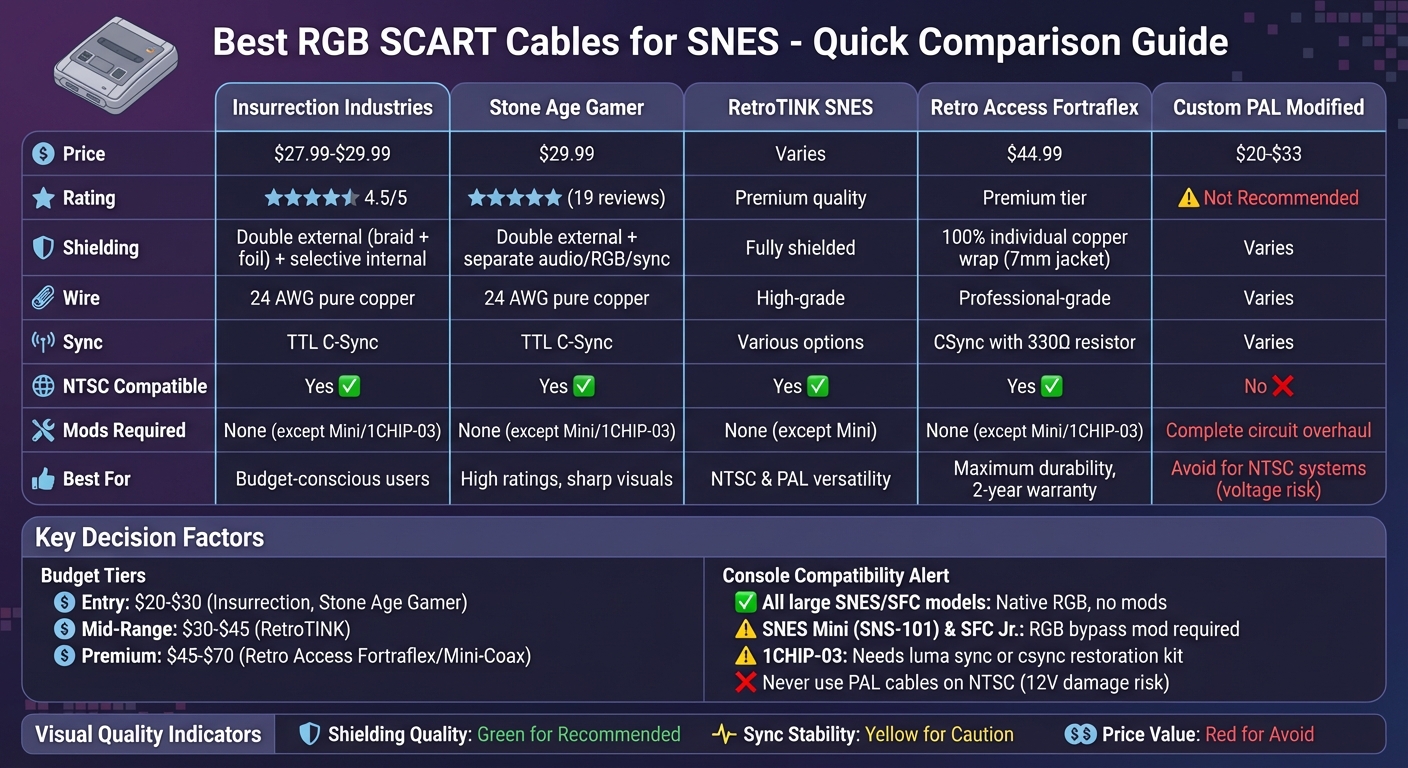
SNES RGB SCART Cable Comparison: Features, Pricing, and Compatibility Guide
Insurrection Industries SNES RGB SCART Cable Review
sbb-itb-9a4764e
Why Use RGB SCART Cables for SNES
The SNES offers three video output options: composite (the familiar yellow cable), S-Video (which separates brightness and color), and RGB. RGB SCART cables take things up a notch by using separate channels for red, green, and blue signals. This setup eliminates the color bleeding and smearing often seen with composite connections and even outperforms S-Video in terms of clarity and color accuracy.
When you compare them side by side, the difference is striking. RGB SCART delivers sharper pixel details - think smoother gradients in skies and more defined textures in backgrounds. Colors appear more vibrant, and the contrast is noticeably improved, even in darker scenes. High-quality cables achieve this by using 24 AWG pure copper and 75-ohm mini-coaxial conductors to preserve signal integrity from the console to the display.
Premium RGB SCART cables go a step further with advanced shielding. Each signal line (RGB, audio, and sync) is individually shielded, and there's an additional layer of external shielding using braid and foil. This design prevents "crosstalk", which can cause visual artifacts like vertical "jailbars" on the screen or annoying audio interference. On the flip side, cheaper unshielded cables often introduce these exact problems.
For modern retro gaming setups, RGB SCART cables are a game-changer. Upscalers like the OSSC (Open Source Scan Converter) and RetroTINK work best when they receive a clean RGB signal. This clean input ensures sharper, more precise upscaled images on modern flat-screen TVs. The better the input signal, the better the output quality - simple as that. But to enjoy these benefits, you need to ensure your setup is region-compatible.
Regional differences can be tricky. For instance, PAL SNES consoles output 12 volts on the csync pin, while NTSC systems do not. Using the wrong cable for your console's region - like an NTSC cable on a PAL console - can damage your equipment due to mismatched pin voltages. To avoid this, look for cables specifically designed for csync (clean sync), which offer better stability compared to those relying on composite video for synchronization - provided your display or upscaler supports it.
1. Insurrection Industries RGB SCART Cable with C-Sync
This cable is specifically designed for NTSC-region SNES and Super Famicom systems, offering a clean signal without requiring any console modifications. It's priced at $27.99 directly from the manufacturer or $29.99 at retail, with a solid 4.5-star rating. Let’s dive into the technical details that make it stand out.
Shielding Type
The cable's shielding is engineered to reduce interference and maintain signal clarity. It features double external shielding (braid and foil) alongside selective internal shielding for key signal lines. As Bob from RetroRGB notes:
"This cable has a layer of shielding on the outside, but not all signal lines are individually shielded on the inside."
This approach strikes a balance between performance and cost, effectively minimizing video noise and audio hum. Users report "strong, sharp and clear" signals when paired with upscalers like the OSSC.
Wire Gauge and Sync Method
The cable uses 24 AWG pure copper wires, ensuring strong signal integrity. This contributes to the crisp and stable visuals users appreciate. It's configured for TTL C-sync on SNES pin 3, which provides a more stable image compared to composite sync methods. However, your display or upscaler must support TTL C-sync for proper functionality. Devices like the RetroTINK-5X and OSSC are fully compatible.
NTSC Compatibility and Console Requirements
This cable is designed exclusively for unmodified NTSC consoles. Using it with PAL systems could cause damage due to voltage differences. By sticking to NTSC systems, you’ll unlock the full potential of RGB SCART technology by optimizing your setup for modern displays. The latest versions of this cable also feature a dual ground connection, enhancing compatibility with certain console modifications.
2. Stone Age Gamer RGB SCART Cable with C-Sync
The Stone Age Gamer version of the Insurrection Industries RGB SCART cable is priced at $29.99 and boasts a flawless 5/5 star rating from 19 reviews. Users praise its ability to deliver much sharper visuals compared to composite connections. Manufactured by the same company as the previous model, this cable carries over the same dependable build quality. Let’s take a closer look at its shielding and sync features.
Shielding Type and Wire Gauge
This cable is equipped with double external shielding, combining both braid and foil layers, while also providing separate shielding for stereo audio, RGB video, and sync signals. This design minimizes noise and interference effectively. It uses 24 AWG multi-stranded pure copper wires and incorporates Nichicon UHV capacitors, ensuring a stable and clean signal for optimal performance.
Sync Method and NTSC Compatibility
For those prioritizing image clarity, this cable includes a dedicated C-Sync output to achieve the sharpest picture possible. However, you’ll need to confirm that your display or upscaler supports TTL C-sync. Devices like the OSSC, RetroTINK-5X, and Morph 4K are all compatible.
This cable is specifically designed for NTSC consoles - such as the North American SNES and Japanese Super Famicom. Standard "fat" NTSC models work seamlessly, but systems like the SNES Mini (Super Famicom Jr.) or the rare 1CHIP-03 variant might require internal modifications to enable proper C-sync functionality.
3. RetroTINK SNES RGB SCART Cable

The RetroTINK SNES RGB SCART cable is a versatile option for both NTSC and PAL SNES consoles. Created by Mike Chi, this cable is known for delivering outstanding video performance. Here’s what sets it apart.
Shielding Type and Signal Quality
The cable features high-grade shielding, which ensures the signal remains intact and free from interference. This shielding helps maintain a clean RGB signal, resulting in sharp, artifact-free visuals - perfect for retro gaming enthusiasts who value picture clarity.
NTSC Compatibility
This cable is designed for plug-and-play use with standard NTSC SNES and Super Famicom consoles that support native RGB output. However, if you own a SNES Mini (also called the New-Style SNES) or a Famicom Jr., you’ll need to perform an internal RGB modification before using this cable. Without this mod, these compact models won’t output an RGB signal, as is the case with similar cables discussed earlier.
Price Range in USD
RetroTINK cables come at a premium compared to budget unshielded options, which start as low as US$6. While cheaper alternatives often suffer from poor image quality and interference, investing in a well-shielded cable like this one is a smart choice for serious gamers who want the best visual experience from their SNES setup.
4. Retro Access SNES to SCART Fortraflex Cable (CSync)
The Retro Access SNES to SCART Fortraflex Cable is designed for retro gaming enthusiasts who prioritize high-quality output. With its professional-grade construction and flexible Fortraflex design, this cable is priced at $44.99 and comes with a 2-year warranty, offering a reliable and durable option for your gaming setup.
Shielding Type and Build Quality
This cable boasts a 7mm-thick jacket, similar to those used in professional audio and controller cables. Each signal line is individually wrapped in copper shielding, effectively eliminating issues like video jailbars and audio interference.
"Fortraflex is a premium-grade, ultra flexible, and highly durable cable manufactured exclusively for Retro Access. Each signal line is 100% shielded with robust copper wrap to prevent signal degradation and crosstalk." – Retro Access
To further enhance performance, the cable includes 220 uF tantalum capacitors on the RGB lines, mounted on a PCB inside the console connector. Additionally, the CSync line is equipped with a 330-ohm resistor, ensuring safe and stable signal levels for your display.
NTSC Compatibility and Required Console Mods
This cable is specifically designed for NTSC-U (USA) and NTSC-J (Japan) SNES and Super Famicom consoles. However, certain models like the 1CHIP-03 units, New-Style SNES, or Nintendo 64 require an internal modification to enable CSync output. Thanks to its superior shielding and precise CSync implementation, the cable ensures clean, artifact-free RGB visuals, delivering the high-quality performance retro gamers seek.
Each cable is made to order, with an estimated production time of 4 to 5 weeks.
5. Custom Modified PAL SNES SCART Cables for NTSC
Using cables with the wrong regional specifications can spell trouble for your console, and custom-modified PAL cables are no exception. These cables might seem like a bargain, priced between $20 and $33 USD, but for NTSC console owners, they carry a high risk of causing serious damage to your equipment.
NTSC Compatibility and Console Modifications
The main issue stems from the differences in pin configurations between PAL and NTSC systems. For example, a standard PAL cable outputs 12V on Pin 3, which is fine for PAL consoles but can harm NTSC hardware. On NTSC systems, that same pin is used for CSync, and feeding it 12V can lead to problems.
Additionally, NTSC consoles require specific components, such as 220 uF tantalum capacitors on RGB lines and a 330-ohm resistor on CSync, to function correctly. Without these, the picture quality will be noticeably dim.
Sync Method and Pricing
Modifying a PAL cable to work with NTSC systems isn't a simple fix. It requires a complete overhaul of the internal circuitry, including addressing the 12V line to protect your hardware. Given the complexity and potential for error, it's far safer to invest in a dedicated NTSC cable designed for CSync from the outset.
For those who need compatibility with both PAL and NTSC systems, Universal SNES RGB SCART cables are a much safer option. These cables are built to handle the voltage differences and include the necessary components for both regions. While premium NTSC-specific cables range from $44.99 to $69.99 USD, the slight savings from modifying a $20 PAL cable simply aren’t worth risking your vintage gaming setup.
SNES RGB SCART Cable Comparison Table
This table highlights the essential specifications discussed earlier, making it easier to align your console setup and budget with the right cable choice.
| Cable Model | Shielding Type | Wire Gauge | Sync Method | NTSC Compatible | Required Console Mods | Price Range |
|---|---|---|---|---|---|---|
| Insurrection Industries | Outer layer + Sync/Audio shielded | 24 AWG | CSync | Yes | None (except Mini/1CHIP-03) | $25 - $35 |
| RetroTINK SNES | Fully Shielded | Unspecified | Various | Yes | None (except Mini) | Varies |
| Retro Access Fortraflex | 100% Individual Copper Wrap | Thick (7mm jacket) | CSync or Luma | Yes | None (except Mini) | $44.99 |
| Retro Access Mini-Coax | 75Ω Individually Shielded Coaxial | 75 ohm Coax | Luma | Yes | None (except Mini) | $49.99 - $69.99 |
Shielding quality matters. Proper shielding directly impacts signal clarity. For users looking to avoid console modifications, Sync on Luma cables - like the Retro Access Mini-Coax - offer nearly identical performance without needing internal changes.
Skip the cheap options. Budget cables often compromise on shielding and signal quality. If you’re aiming for excellent performance, plan to spend between $22 and $45. Premium options like Mini-Coax cables ($49.99–$69.99) provide true 75Ω construction, ensuring clean signals and eliminating issues like signal ghosting. This breakdown simplifies the decision-making process, letting you match cable features to your SNES setup effortlessly.
SNES Model Compatibility and Modification Requirements
All large SNES/SFC consoles support native RGB output, whether they're NTSC or PAL models. This means you can use RGB SCART cables without needing any internal modifications. However, the specific type of RGB SCART cable you’ll need depends on your console's revision. For instance, the 1CHIP-03 revision outputs RGB but doesn’t include csync on the multi-out. To address this, you’ll need either luma sync cables or a restoration kit to install the missing resistors and capacitors.
When it comes to the SNES Mini (SNS-101) and Super Famicom Jr., these compact models lack native RGB and S-Video output altogether. To enable RGB, you’ll need to perform an internal RGB bypass mod, which includes installing an amplifier board using chips like the THS7314 or THS7374. If you want to use csync-specific cables after modding, you’ll also need to solder a connection from pin 18 of the S-RGB chip to pin 3 of the multi-out connector.
It’s important to note that NTSC and PAL cables are not interchangeable. PAL systems output 12V DC on pin 3 of the multi-out, while NTSC consoles use this same pin for csync. Using an NTSC csync cable on a PAL console can cause irreversible damage to your console, cable, and display.
Here’s a quick summary of model compatibility and required modifications:
| SNES Model | Region | RGB Native? | Sync Notes | Required Modification |
|---|---|---|---|---|
| Original (Large) SNES/SFC | NTSC-U/NTSC-J | Yes | Outputs csync (except 1CHIP-03) | None |
| Original (Large) SNES | PAL | Yes | Outputs 12V on pin 3 | None (use PAL-specific cables) |
| 1CHIP-03 (Original Case) | NTSC-U | Yes | Missing csync components | Use luma sync or csync restoration kit |
| SNES Mini/SFC Jr. | NTSC-U/NTSC-J | No | Not connected for RGB | RGB bypass mod + csync wire installation |
To avoid compatibility issues, make sure to identify your SNES model before purchasing cables or planning modifications. Check the label on the bottom of your console: a model number of SNS-001 indicates a large model, while SNS-101 means you have a Mini that will require internal modifications. Proper identification is key to ensuring everything works as intended. Once connected, you can use the 240p Test Suite SNES cartridge to calibrate your display and verify signal quality.
Conclusion
Finding the perfect RGB SCART cable is about balancing cost and performance. One standout option is the Insurrection Industries RGB SCART Cable, priced at $29.99. It boasts a 4.9/5 rating from 19 reviews on Stone Age Gamer, with users praising its ability to dramatically improve video quality compared to composite connections. It pairs seamlessly with modern upscalers like the RetroTINK 5X and OSSC, delivering sharp, interference-free visuals. As one reviewer shared:
"I switched from old composite cables to this, and the difference is night and day! ... I appreciate how reasonably priced this is compared to some competitors."
For those looking to save a bit more, the RetroSix CleanRGB ($22.04) or EM-Modshop ($27.00) cables are solid entry-level options. However, these may lack the independent shielding found in mid-range alternatives. On the higher end, premium cables like the Retro Access Fortraflex ($44.99) or Mini-Coax ($49.99–$69.99) offer top-tier shielding and 75-ohm impedance control, making them ideal for professional setups or longer cable runs.
Before purchasing, double-check your console's region and any modification needs. For example, SNES Mini and Super Famicom Jr. models require internal RGB bypass mods to work with SCART cables. Ensuring region compatibility is also crucial to avoid voltage mismatch issues.
All the cables highlighted here support C-sync or Sync on Luma, ensuring compatibility with modern upscalers. Whether you’re using a stock 1CHIP SNES or a heavily modded console, the right cable will provide clean, interference-free visuals for an enhanced gaming experience.
FAQs
How do I tell if my SNES is NTSC or PAL?
To figure out whether your SNES is NTSC or PAL, take a close look at its design. NTSC consoles usually have a more rectangular appearance, while PAL consoles feature a rounded design. You can also check for region-specific markings or model numbers on the hardware, which can provide a clear indication of its region.
Do I need to mod my SNES to use RGB SCART?
No, you don’t need to alter your SNES to use RGB SCART. Every original large model of the Super Nintendo and Super Famicom can output RGB right out of the box, with no modifications required.
Should I use C-sync or sync-on-luma?
When deciding between C-sync and sync-on-luma for your SNES RGB SCART cable, it all comes down to your specific setup and needs.
- Sync-on-luma is the simpler choice and works seamlessly with most standard SNES cables. It's a reliable option for many users and requires no extra adjustments in most cases.
- C-sync, on the other hand, provides more accurate synchronization, making it a better fit for professional setups or situations where precise signal stability is crucial.
If your hardware handles sync-on-luma without any hiccups, it's usually the more straightforward path. However, if you need enhanced stability or run into compatibility issues, C-sync might be the better option. Always check your hardware specifications to ensure compatibility before making a choice.