


How Fans Restore Unreleased SNES Games
Fans of the SNES have found creative ways to preserve and restore games that were never released outside Japan. These efforts include translating games, recovering rare prototypes, and creating custom cartridges for play on original hardware. Here's a quick overview:
- Why Games Weren't Released in the U.S.: Strict censorship policies, localization challenges, and technical differences often prevented Japanese games from reaching North America.
- Preservation Methods: Fans use ROM hacking, cartridge dumping, and translation patches to make inaccessible games playable for modern audiences.
- Legal Considerations: Backing up games you own is legal, but downloading ROMs without permission is considered copyright infringement.
- Tools for Preservation: Devices like Retrode, Open Source Cart Reader, and Epilogue Operator help users create backups of their cartridges.
- Custom Cartridges: Companies like BJ's Game Vault offer pre-loaded cartridges featuring rare ROM hacks and translations for collectors.
From cleaning cartridge pins to using flash cartridges like FXPak Pro, fans are ensuring that forgotten SNES titles remain playable for years to come.
Legal Considerations for ROM Restoration
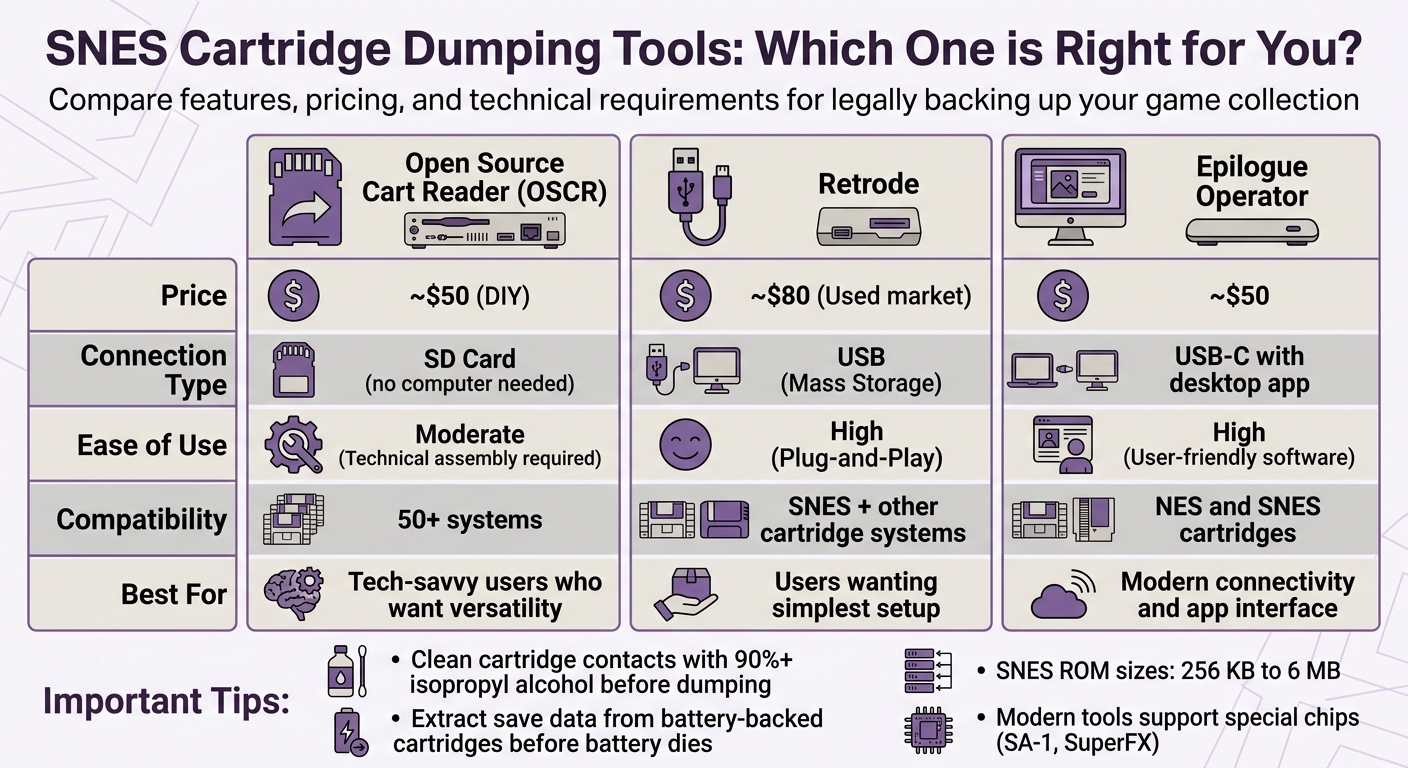
SNES Cartridge Dumping Tools Comparison: Features, Prices, and Ease of Use
When it comes to restoring unreleased SNES games, understanding the legal side of things is a must. Copyright laws play a big role in how ROMs can be handled. While the preservation community has made strides in restoration techniques, the legal landscape is still tricky and depends heavily on where you live. Let’s dive into a safe way to back up cartridges you already own.
How to Dump Your Own Cartridges
If you want to create backups of your games, the safest route is to dump cartridges you legally own. Dumping involves reading the ROM chip directly without bypassing any copy protection or digital locks. There are several tools available that make this process easier:
-
Retrode: This device works like a USB mass storage unit. Just insert your SNES cartridge, plug it into your PC, and copy the
.sfcfile directly. - Open Source Cart Reader (OSCR): Supporting over 50 systems, this tool dumps ROMs straight to an SD card - no computer needed. However, it requires some technical know-how to assemble.
- Epilogue Operator: This one comes with a desktop app and USB-C connectivity, making it compatible with both NES and SNES cartridges.
To ensure smooth operation, clean the cartridge contacts using a cotton swab and isopropyl alcohol (90% or higher). This helps avoid read errors. If your SNES cartridge has a battery-backed save (common in RPGs), consider extracting the save data before the internal battery dies. SNES ROM sizes typically range from 256 KB to 6 MB, and even games with special chips like SA-1 or SuperFX can now be dumped with modern tools.
| Device | Price | Connection Type | Ease of Use |
|---|---|---|---|
| Open Source Cart Reader (OSCR) | ~$50 (DIY) | SD Card | Moderate (Technical) |
| Retrode | ~$80 (Used) | USB (Mass Storage) | High (Plug-and-Play) |
| Epilogue Operator | ~$50 | USB-C | High (Desktop App) |
Public-Domain ROMs and Homebrew Games
For a completely legal alternative, consider homebrew games created by independent developers. These titles, along with tools like hakchi2 CE for the SNES Classic Mini, allow you to explore officially licensed backups without stepping into murky legal waters.
Nintendo's Policy on ROMs
Nintendo takes a strict stance on ROM downloads, viewing them as copyright infringement - even if you own the physical game. PlayMessiah puts it clearly:
"Downloading ROMs is still infringement. You may legally create your own backup."
There’s no legal gray area here: claims like "abandonware" or temporary downloads don’t hold up against copyright laws. Nintendo encourages using official services like Nintendo Switch Online or devices like the SNES Classic Edition instead of unauthorized ROMs. Held Games further emphasizes:
"What is universally clear is that distributing copies to others is not legal regardless of jurisdiction. Backups are for personal use only."
Before diving into ROM restoration, take time to understand the copyright and anti-circumvention laws in your area. These rules can differ widely depending on where you’re located.
sbb-itb-9a4764e
How to Restore SNES Games with ROM Hacks
If you've legally dumped your own SNES cartridges, you can take the next step: applying fan-made patches to bring unreleased or untranslated games to life. These patches, created by ROM hackers, modify only specific parts of the game file, ensuring the entire game isn't redistributed. The process is fairly simple, but following a checklist for playing ROM hacks is key to ensuring accuracy. This method allows fans to finally enjoy games that were never officially released or translated.
Patching ROMs with Lunar IPS
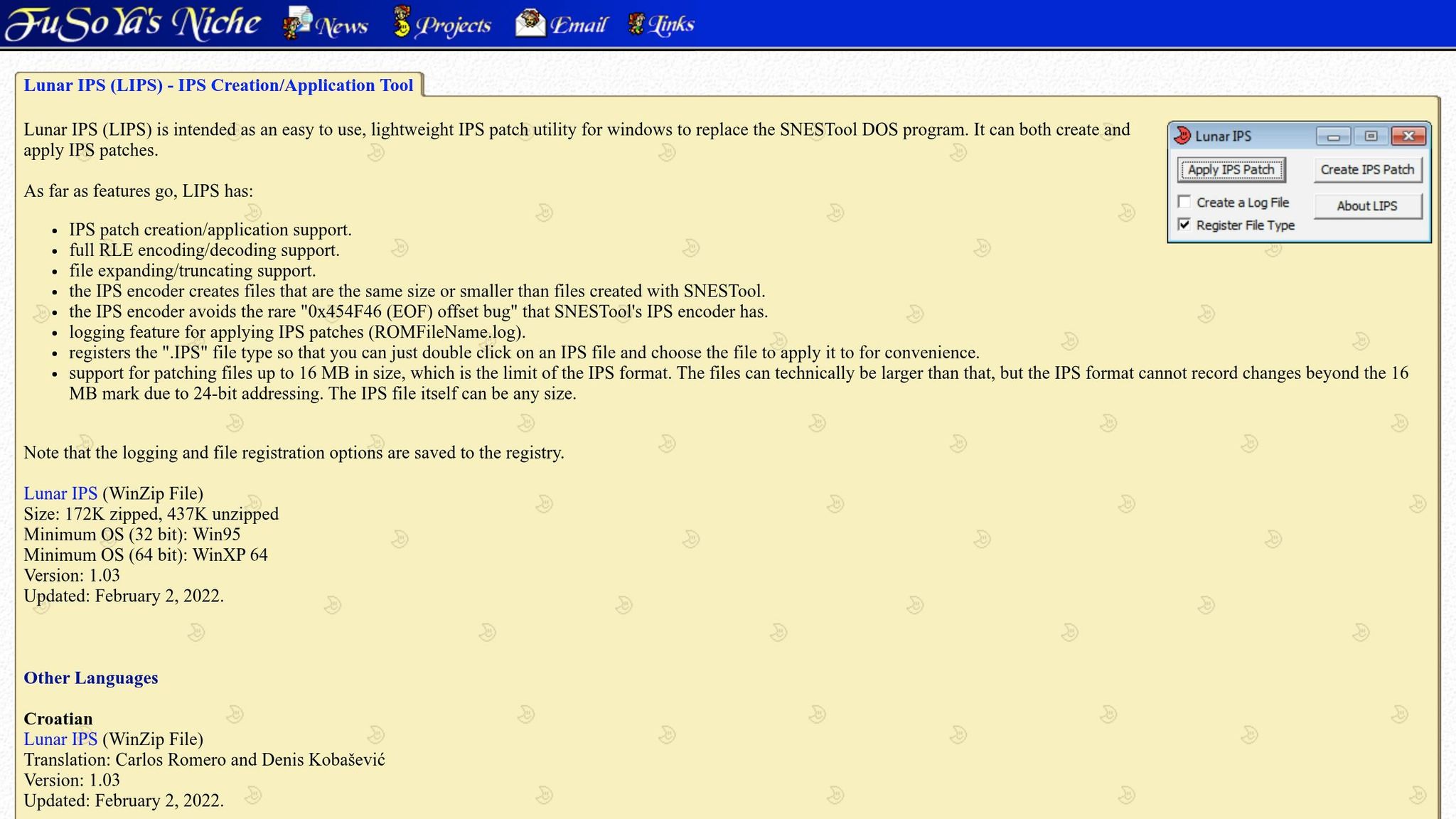
The go-to tool for patching SNES ROMs is Lunar IPS, which works with the commonly used .ips patch format. Other tools, like Floating IPS (FLIPS) and Delta Patcher, can handle additional formats such as .bps and .xdelta. Before diving in, always back up your original ROM and store it in a separate folder. If something goes wrong, you’ll want to have that clean dump safe and sound.
Here’s how to patch:
- Open your patching tool.
- Apply the .ips file to your original ROM.
- Save the newly patched ROM file.
One important note from the Emulation General Wiki:
"Any given patch can only function correctly with either a ROM with a header or one that is headerless; the README file should clarify which type the patch is intended for."
To ensure compatibility, check if your ROM’s header matches the patch requirements. Tools like TUSH or SNEStuff can help you add or remove headers as needed. Also, review the README file included with the patch - it will detail the necessary region (e.g., (J) for Japan, (U) for United States, or (E) for Europe), the ROM revision, and whether a header is required. Look for the [!] tag in the ROM filename, which indicates a verified, clean dump.
Keep in mind that the International Patching System (IPS) has a size limit of 16MB. For larger files, use the BPS format instead, which is more efficient and can reduce patch sizes by up to 50%.
Once your ROM is patched correctly, you’re ready to load it onto your hardware.
Making Patched ROMs Work on Original Hardware
To play your patched games on an actual SNES console, you’ll need a flash cartridge like the Super Everdrive or FXPak Pro (formerly SD2SNES). These devices let you load patched ROMs from an SD card, allowing you to experience fan translations on the original hardware.
Before transferring your patched ROM to a flash cartridge, test it on an emulator like Snes9x or bsnes. These emulators support on-the-fly patching, so you can place the patch file in the same folder as the ROM with matching filenames (e.g., "game.sfc" and "game.ips") to test it without permanently altering the file.
For use on hardware, you’ll need to create a permanently patched ROM file using the direct patching method mentioned earlier. Flash cartridges can’t apply patches on-the-fly. Additionally, make sure your patched ROM matches your console’s video format - NTSC for U.S. and Japanese systems, and PAL for European systems. While many flash cartridges are region-free, it’s still a good idea to double-check this before loading multiple games onto your SD card.
Custom Cartridges at BJ's Game Vault

If manually patching ROMs and flashing cartridges sounds like a hassle, there's an easier way. BJ's Game Vault offers pre-loaded custom cartridges that feature rare ROM hacks and fan translations, ready to play on your SNES. These cartridges save you time and effort, allowing you to dive straight into unique fan-made versions, including sequels, horror-themed hacks, and English translations of games never released in the U.S. For collectors who want regular access to exclusive ROM hack releases, check out the subscription options detailed in the next section.
ROM Hack Cartridges and Custom Game Services
BJ's Game Vault specializes in bringing "Retro Reinvented" to life, turning exclusive ROM hacks into physical cartridges that work with original consoles like the SNES, NES, and N64. As BJ's Game Vault puts it:
"Unlock rare ROM hacks, custom cartridges, and vintage collectibles you won't find anywhere else. Each game is tested and built for real retro consoles because collectors deserve the classics that never were."
Prices for these custom cartridges typically range from $35.00 to $50.00, with free shipping included. For instance, in May 2026, BJ's Game Vault offered Shiren the Wanderer 2 for the N64 - an English-translated version of Shiren's Castle and the Oni Invasion - giving U.S. collectors a chance to experience this Mystery Dungeon classic on its original hardware.
Ordering is simple: browse the SNES or Homebrew Cartridges section on the BJ's Game Vault website, choose your game, and check the version number and hardware requirements listed in the product description. Every purchase includes a satisfaction guarantee.
Subscription Boxes for Retro Collectors
For those who want a steady stream of retro gaming treasures, BJ's Game Vault also offers "The Vault Box", a subscription service designed for collectors. These curated boxes include rare ROM hack cartridges and retro collectibles, with subscription tiers ranging from $45 for the basic option to $85 for the premium package. Subscribers also get early access to exclusive deals.
Joining the mailing list is another way to stay ahead of the game, offering updates on rare cartridge drops and special promotions. Since these cartridges are built for original hardware, make sure your SNES console is in good condition and that the cartridge pins are clean using proper cleaning tools for the best gaming experience.
Testing and Maintaining Restored SNES Hardware
How to Clean Cartridge Pins and Consoles
If your custom SNES cartridges aren’t working as they should, dirty or corroded contacts might be the culprit. And no, blowing into your cartridges isn’t the answer - despite what childhood habits might tell you! The moisture from your breath can actually lead to long-term damage. As the ConsoleMods Wiki puts it:
"Blowing in your games can and does damage them!"
While blowing might seem to fix things temporarily, it only shifts the cartridge slightly, which doesn’t address the real issue.
For proper cleaning, stick to 90% or higher isopropyl alcohol (IPA). Lower concentrations contain more water, which can cause corrosion over time. Here’s how to clean those pins:
- Dampen one end of a cotton swab with IPA and gently scrub the pins.
- Use the dry end immediately after to remove any leftover liquid.
- For tougher oxidation, a white vinyl eraser (like a Sanford Magic Rub) works wonders. Rub it gently against the grain until the pins shine. Avoid pink rubber erasers, as they can be too abrasive and might damage the gold plating.
Don’t forget the console’s cartridge slot! First, unplug the console. Then, wrap a lint-free cloth around a credit card or thin piece of cardboard, dampen it with IPA, and slide it into the slot a few times. Repeat until the cloth comes out clean. Let the slot dry for at least 30 minutes before powering the console back on. For heavily soiled cartridges, you can open the shell with a 3.8mm game bit to clean the PCB pins directly. Once everything is clean, test the cartridge to ensure it’s functioning as expected.
Testing Custom Cartridges for Reliability
After cleaning, test your ROM hack cartridges right away to check for smooth video playback and stable audio. If glitches or issues pop up, go back and clean the contacts and slot again as described earlier.
To keep your cartridges in good shape over time, store them in a cool, dry spot and remove them from the console when not in use. This prevents unnecessary strain on the connector springs. Additionally, turn on your SNES every 6–12 months to keep its internal capacitors in working order. If you notice random freezes or distorted colors, it might be a sign that the console’s capacitors are aging.
Here’s a quick troubleshooting guide for common issues:
| Issue | Likely Cause | Recommended Action |
|---|---|---|
| Scrambled Graphics | Dirty contacts | Clean cartridge pins with IPA and a white vinyl eraser |
| Random Freezes | Dirty slot or bad capacitors | Clean the console slot and inspect capacitors |
| Game Won't Boot | Oxidation or grime | Clean both the cartridge and console contacts with IPA |
Conclusion
Restoring unreleased SNES games is all about preserving a piece of gaming history. From dumping cartridges to translating Japan-only titles like Shiren the Wanderer 2, fans and communities have stepped up to ensure these games aren’t lost to time. Tools like Lunar IPS make patching ROMs simple, while projects like Satellaview+ prove that dedicated efforts can even bring back long-defunct satellite gaming services from the '90s.
Bridging the gap between digital preservation and physical hardware has made these games feel playable again. For example, services like BJ's Game Vault offer retro-tested custom cartridges priced between $35.00 and $54.99, allowing collectors to enjoy ROM hacks and fan translations on original SNES consoles. As BJ's Game Vault explains:
"Unlock rare ROM hacks, custom cartridges, and vintage collectibles you won't find anywhere else. Each game is tested and built for real retro consoles because collectors deserve the classics that never were."
With perks like free shipping and options for fully customizable builds, these services ensure that preservation efforts extend beyond emulators and into tangible collections.
This combination of digital ingenuity and physical craftsmanship highlights the ongoing evolution of SNES game restoration. Whether you're cleaning cartridge pins, patching your first ROM, or exploring subscription services like The Vault Box, the tools for preserving and experiencing these games are more accessible than ever. Thanks to passionate fans, the SNES library continues to expand, keeping forgotten gems alive and playable even decades after the console’s prime.
FAQs
How do I tell if a ROM dump is clean?
When verifying if a ROM dump is unaltered, you’ll need to compare its hash values - such as CRC32, SHA1, or MD5 - against trusted databases like No-Intro. To calculate the checksum, you can use tools like Hashtab or QuickHash. If the hash values match those in the verified database, you can be confident the ROM is genuine and hasn’t been tampered with. This ensures it’s safe for use, whether you’re planning to restore or play it.
Why won’t a translation patch work on my ROM?
A translation patch can fail for several reasons, often tied to compatibility or application errors. For instance, the patch might be designed for a different ROM version, or it could be applied incorrectly. Other potential problems include using a corrupted or modified ROM. To minimize issues, make sure your ROM is clean, unaltered, and matches the patch's specific version. Carefully follow the patching instructions to ensure everything works as intended.
What do I need to play patched games on a real SNES?
To enjoy patched games on an actual SNES, you'll need a custom cartridge capable of running the patched ROM. This typically requires altering a donor cartridge by adding custom chips or adapters. Another option is to purchase pre-made custom ROM hack cartridges from specialized sellers, such as BJ's Game Vault. These cartridges are designed to work seamlessly with original SNES hardware, giving you that classic gaming experience.