


Transparency Effects in SNES ROM Hacks
Transparency effects on the SNES are not true hardware-level features but are achieved through Color Math in the Picture Processing Unit (PPU). This technique blends two screen buffers (Main and Sub Screens) to simulate effects like translucent water, ghostly sprites, and shadows. ROM hackers have pushed these effects further by using tools like HDMA for scanline-specific tweaks, enabling dynamic lighting and gradients.
Key projects include:
- Super Mario World Translucent Levels Hack (2020): Activates unused code for a translucent layer across levels but faces hardware limitations in specific scenarios.
- Super Castlevania IV Hacks: Restores and expands transparency effects, such as ghost sprites and lighting overlays, to enhance the gothic atmosphere.
- Super Punch-Out!! Hidden Feature: Reveals a transparency-based two-player mode, ensuring clear visibility of both fighters.
- Custom ROM Hacks: Examples like "DKC Lovebird Lights" and physical cartridges from BJ's Game Vault demonstrate advanced use of transparency across games.
Transparency effects work best on original SNES hardware or hardware-based clones, as emulators often struggle to replicate the PPU's precise color calculations. Physical cartridges, like those from BJ's Game Vault, ensure optimal performance and visual fidelity for these hacks.
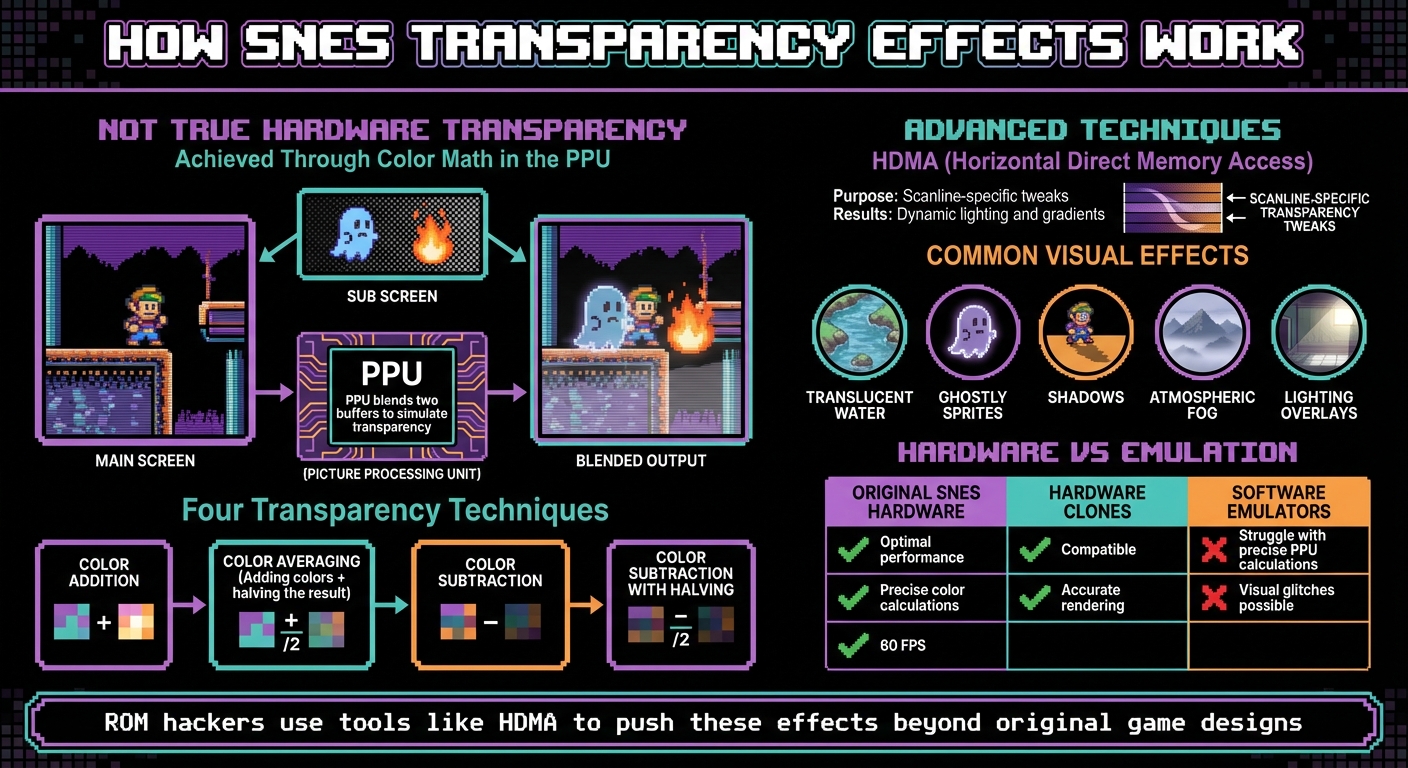
How SNES Transparency Effects Work: PPU Color Math Explained
1. Super Mario World Transparency
Super Mario World Translucent Levels Hack
In December 2020, ROM hacker nensondubois introduced the "Super Mario World Translucent Levels" hack. This modification activates unused code within the game, leveraging a rarely used SNES register mode to apply a translucent layer across all levels. Describing this feature, nensondubois stated:
"The game actually supports unused code to enable a rarely used SNES register mode to give all levels a single translucent layer."
Testing confirmed that the effect works seamlessly on original SNES hardware. This hack exemplifies how ROM hackers can push the boundaries of the SNES's simulated transparency, setting a new standard for future modifications.
That said, the hack isn't without its challenges. Hardware limitations lead to problems in specific scenarios. For instance, in levels featuring yellow moving platforms, the transparency effect doesn't display correctly. Similarly, in castle levels, giant crushing pillars become harder to see, and some enemies vanish due to conflicts with layering.
Even with these issues, the hack revealed untapped potential within the original Super Mario World ROM. As of March 2026, the patch has been downloaded over 540 times (see our checklist for playing ROM hacks to get started), showing sustained interest in creative transparency-based modifications. This approach has opened the door for even more inventive hacks, which are explored further in this discussion.
sbb-itb-9a4764e
2. Super Castlevania IV Transparency
Super Castlevania IV Restoration Hack
The original Super Castlevania IV pushed the SNES hardware to its limits, showcasing impressive transparency effects that brought ghosts and light overlays to life. These visual elements became a hallmark of the game's gothic horror vibe, setting it apart as a standout title on the console. This attention to detail has inspired ROM hackers to redefine classic games by restoring and even expanding upon these effects.
One notable example is the "Super Castlevania IV Uncensored" ROM hack, which reinstates several transparency-based assets and graphical effects that were toned down or removed for the North American release. A key restoration occurs in Level 8 (sections 8-1-1 and 8-1-2), where the hack replaces the opaque "green goop" from the Western version with blood effects that use transparency layers, staying true to the original aesthetic intentions [16,17].
Beyond simple restoration, hacks like Super Castlevania IV - Other Castle take things further. They use the game's existing transparency engine to craft entirely new levels that remain true to the original's eerie, atmospheric style. For instance, ghost dancers that fade in and out add a chilling touch, creating what fans have described as a "creepy and intriguing" experience.
The SNES's S-PPU (Super Picture Processing Unit) plays a critical role in handling these transparency effects, particularly for ghost sprites and lighting overlays. Hackers have also incorporated classic SNES features like Mode 7 and mosaic effects alongside transparency, enriching the visual appeal while staying faithful to the system's capabilities.
How transparency effects were achieved on the SNES | White_Pointer Gaming
3. Super Punch-Out Transparency
Super Punch-Out!! showcases an intriguing use of transparency within its code, building on techniques seen in other SNES games.
Hidden Two-Player Mode and Transparency Feature
Buried within Super Punch-Out!! is a transparency feature tied to a debugging tool or an unused two-player mode. This feature allows boxer sprites to appear translucent, a function that remained hidden in the retail version of the game. ROM hackers later uncovered that this transparency was critical for the game's dormant "Vs Mode", ensuring the foreground boxer didn't obstruct the view of the opponent during gameplay.
In August 2022, a hack called "Simplified Hidden Vs mode" was released, making this hidden two-player functionality easily accessible with a simple command. By using the SNES's transparency layers, the hack makes the foreground boxer semi-transparent, allowing both fighters to stay visible during matches. This feature, while part of the original code, was never activated in the standard release.
The transparency effect relies on a technique called Color Averaging, which works by adding colors together and halving the result to create a translucent appearance. This approach ensures visual clarity, even when sprites overlap. Documentation from The Cutting Room Floor explains how players can activate this feature:
In free match mode... Press Start to toggle transparency.
This functionality takes advantage of the SNES's blending capabilities. However, it does come with a limitation: sprites cannot appear transparent over other sprites because the SNES Picture Processing Unit (PPU) combines all sprites into a single layer. This means the transparency effect only works between sprites and background layers, but it still proves effective in maintaining clarity during the game's fast-paced action.
4. Custom ROM Transparency
Unlocking Hidden Hardware Features Through Custom Hacks
Custom ROM transparency hacks take the SNES hardware to new levels, revealing hidden features and refining transparency effects that were left untouched in the original games. For instance, modifications like the Super Mario World hack discussed earlier demonstrate how transparency layers, technically feasible on the SNES, were never utilized in retail versions. By tapping into these dormant features, developers open the door to even more inventive projects, with later hacks building on these breakthroughs.
Some developers go beyond reactivating existing features and create entirely new modifications. A standout example is rainbowsprinklez's "DKC Lovebird Lights", a hack for Donkey Kong Country released in September 2022. This modification applies the "Blackout Basement" lighting effect - originally limited to one level - across the entire game. The hack uses HDMA (Horizontal Direct Memory Access) to tweak the palette on each scanline, preserving the game's iconic mineshaft lighting effects. By carefully adjusting RGB intensities, it produces intricate lighting and transparency effects. As rainbowsprinklez explains:
By using color math, the game just changes the intensity of the RGB hues.
These hacks illustrate how register modifications and HDMA make it possible to manipulate the SNES’s four transparency effects - color addition, color averaging, color subtraction, and color subtraction with halving. The result? Visual effects that go far beyond the original game designs. These techniques not only expand the potential of SNES transparency but also serve as a springboard for further creativity in ROM hacking.
5. Secret of Mana Transparency
Title Screen Restoration and Environmental Updates
Secret of Mana (Seiken Densetsu 2) was a standout RPG of its time, thanks in part to its creative use of transparency effects. From the ghost dancer enemies that faded eerily into the background to the layered water effects, the game leveraged the S-PPU's capabilities to deliver a visually immersive experience. These features helped set the game apart, and ROM hackers have since worked to build upon its visual legacy.
In January 2024, developer Tomm introduced the Secret of Mana Climate Crisis Edition, a hack that reimagined over 35 maps and 7 dungeon areas. This edition used palette editing tools for custom color palettes for maps and monsters, reshaping the elemental themes of the eight palaces. Tomm explained the approach:
"Palettes, monsters and NPCs dialogues have been changed to create coherent environments while remaining true to the original game."
The game's title screen also received significant attention. The original English port had altered the Mana Tree image, cropping and expanding it in a way that left it blurry and pixelated. Hacks like Secret of Mana: Relocalized restored the original, higher-quality Mana Tree artwork. Hack creator Timbo described the issue:
"They butchered the original background image. Because of some graphical problems they cropped the image of the full Mana Tree at its roots and expanded it. The result is a blurry pixelated mess".
Through these efforts, both the environments and the iconic title screen have been revitalized, bringing new life to a classic.
6. BJ's Game Vault ROM Hacks

Physical Cartridges Designed for Hardware Precision
BJ's Game Vault specializes in creating physical ROM hack cartridges that are built to work seamlessly on original SNES hardware. These cartridges ensure that transparency effects are rendered exactly as the SNES Picture Processing Unit (PPU) intended. Unlike emulators, which rely on software to mimic hardware behavior, these cartridges use the SNES's native color math registers to calculate transparency at a smooth 60 frames per second. This hardware-focused approach eliminates issues like performance slowdowns or visual glitches that often occur with emulation. The result is a polished gaming experience that mirrors the creative use of transparency in classic SNES games.
One standout offering from BJ's Game Vault is The Legend of Zelda: Parallel Worlds, a complete reimagining of A Link to the Past. Released in March 2026, this physical SNES cartridge (US NTSC format) is priced at $49.99 and features entirely new overworlds and dungeon layouts. Designed to run exclusively on original NTSC systems, this cartridge avoids compatibility with emulator-only platforms like the Retron 5 or Retro Freak. This ensures that the game’s intricate mechanics and visual effects perform as intended.
Another notable title is Final Fantasy VI: Return of the Dark Sorcerer, a fan-created overhaul that took years to develop. Also priced at $49.99, this cartridge offers a fresh take on the beloved RPG, packed with new content and designed for authentic 16-bit hardware. All cartridges are rigorously tested for compatibility with original Super Nintendo NTSC systems and hardware-based clone consoles like the Retro Trio and Retron 3. This guarantees that transparency effects, such as water and fog, display flawlessly.
Conclusion
Transparency effects have become a standout feature in the world of SNES ROM hacking. By tapping into the SNES Picture Processing Unit's color math capabilities, hackers have created visuals like translucent water and atmospheric fog, which add both visual flair and gameplay complexity. These advancements have paved the way for hacks that breathe new life into classic games.
One notable example is the "Super Mario World Translucent Levels" hack, which unlocked unused code from the original game by activating a rarely used register mode. Achieving these feats often involves deep technical exploration. Developer Bregalad shared the challenges of mastering transparency effects:
The transparency on the SNES, while documented properly, made me have some headaches understanding how it works. Now that I've figured the truth... I'm writing a small document to spare someone else the headaches.
Due to their complexity, transparency effects perform best on original SNES hardware or hardware-based clones rather than software emulators.
For enthusiasts looking to experience these effects authentically, BJ's Game Vault (https://bjsgamevault.com) offers physical ROM hack cartridges tailored for original SNES systems. Priced between $36.44 and $49.99, these cartridges ship for free and are thoroughly tested for compatibility with NTSC consoles and popular hardware clones like the Retro Trio and Retron 3. This approach ensures that players can enjoy transparency effects at the smooth 60 frames per second performance the SNES PPU was designed for, preserving the creative vision of ROM hackers while delivering a seamless gaming experience.
FAQs
How does SNES transparency actually work?
The SNES achieves the illusion of transparency through clever use of color math and layer blending. By designating layers as subscreens and utilizing specific registers for color addition or subtraction, the console creates the appearance of see-through effects. Although it doesn’t support genuine transparency, these techniques work seamlessly in games to mimic the effect.
Why do transparency hacks look wrong on some emulators?
Transparency effects can sometimes look off when using certain emulators. This happens because emulators don’t always perfectly mimic the analog blending and CRT-specific visual quirks of the original SNES hardware. As a result, the way transparency is displayed may not match the original design.
What limits SNES transparency with sprites and layers?
The SNES lacks genuine transparency capabilities. Instead, it relies on simulated techniques such as color addition and averaging. While these methods can create the illusion of transparency, they come with limitations, restricting how sprites and layers visually interact.