


Study: AI Behavior in Fan-Made ROM Hacks
The retro gaming community has taken old classics and made them more engaging through ROM hacks. A key area of focus is AI behavior, which has evolved from simple patterns to more dynamic, human-like decision-making. Here's what you need to know:
- What Are ROM Hacks?: Fan-made modifications of classic games that tweak visuals, gameplay, and mechanics while keeping the original game engine intact.
- AI Improvements: Upgraded enemy and NPC behaviors, such as smarter combat strategies, probability-based decisions, and situational awareness.
-
Examples:
- Pokémon Hacks: Smarter Trainer AI with advanced move scoring, wild Pokémon using logical strategies, and competitive-level battles.
- Fire Emblem Hacks: Enemies now use better positioning, teamwork, and adaptive strategies instead of relying on stat boosts.
- Zelda Hacks: NPCs feel more lifelike with varied actions and dialogue, even on older hardware.
- Tools: Modders use hex editors, assembly tools, and even large language models (LLMs) for more dynamic AI behaviors.
These changes make retro games feel challenging and unpredictable, offering new experiences for players. Whether you're into tougher battles or smarter NPCs, ROM hacks are reshaping how we play classic games.
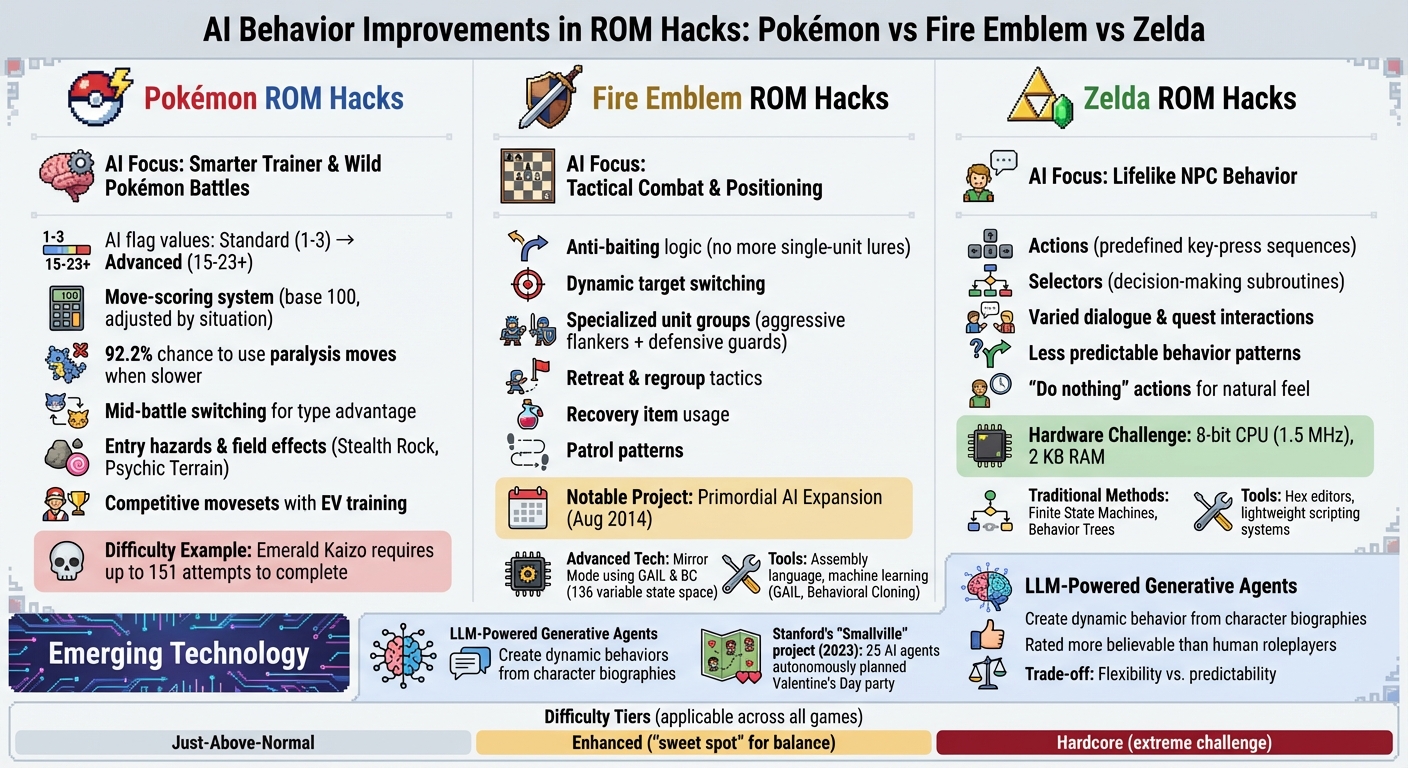
AI Behavior Improvements Across Pokémon, Fire Emblem, and Zelda ROM Hacks
This Romhack Has Custom AI And It Is CONFUSING
sbb-itb-9a4764e
AI Behavior Changes in Pokémon ROM Hacks
Pokémon ROM hacks have reshaped battle dynamics by upgrading the AI for both trainers and wild Pokémon. While the original games often relied on predictable and basic strategies, fan-made versions introduce smarter, more dynamic behaviors that make battles tougher and more engaging.
Improved Trainer AI Patterns
In ROM hacks based on games like FireRed and Emerald, trainers' decision-making is influenced by specific AI flag values. Standard trainers generally operate with lower values, such as 1 or 3, while Gym Leaders and Elite Four members are set to higher values like 7. Advanced hacks take this further, assigning values of 15, 23, or more, enabling a mix of intricate behaviors. Modern hacks also integrate a move-scoring system, where each move starts with a base score of 100 and is adjusted based on situational factors. For example, a move might lose points if it's ineffective due to immunity (-10 penalty) or gain points if it’s a priority move that could secure a knockout (+6 bonus).
Under "Expert" AI flags, trainers make decisions that feel deliberate. For instance, if an attacking Pokémon is slower than its opponent, there’s a 92.2% chance it will opt for a paralysis-inducing move like Thunder Wave to level the playing field.
ROM hacks like Radical Red take this a step further. Trainers in these games can switch Pokémon mid-battle to gain a type advantage or escape a bad matchup - something rarely seen in the original games. They also employ advanced strategies, such as setting up entry hazards like Stealth Rock or Spikes and using field effects like Psychic Terrain to disrupt player strategies. High-level AI even predicts player moves, selecting counters or defensive tactics based on likely player actions. To make battles even more challenging, trainers often use Pokémon with competitive movesets, EV training, and held items, mimicking the strategies of skilled human players.
Wild Pokémon have also seen significant AI upgrades, adding complexity to encounters that were once purely random.
Wild Encounter AI Improvements
Wild Pokémon in ROM hacks no longer rely on random move selection. Instead, they use a "Basic Flag" logic system that evaluates factors like type immunities (e.g., Volt Absorb or Levitate) and active status effects before choosing a move. This prevents redundant actions, such as attempting a status-inflicting move on a target already protected by Safeguard.
High-difficulty hacks like Emerald Kaizo and Radical Red push this further by introducing permanent weather or field conditions that wild Pokémon can exploit. These environmental factors force players to adapt their strategies to challenging scenarios. Completing such hacks can be so demanding that even skilled players have needed as many as 151 attempts to finish a successful run.
Some hacks also apply "Expert Flags" to wild encounters, allowing wild Pokémon to recognize and use move synergies specific to their situations. For example, they might prioritize Dream Eater only when the target is asleep, showcasing a level of strategy typically reserved for trainers.
These advancements in AI behavior make Pokémon ROM hacks a fresh and demanding experience, where every battle feels meaningful and unpredictable.
AI Modifications in Fire Emblem and Zelda ROM Hacks
Fire Emblem and Zelda ROM hacks have taken their own paths when it comes to improving AI. Fire Emblem hacks focus on smarter combat strategies, while Zelda hacks aim to make NPCs feel more lifelike. Both communities have worked hard to push beyond the limits of the original hardware, creating gameplay that feels more engaging and dynamic.
Enemy Tactics in Fire Emblem Hacks
In older Fire Emblem games, higher difficulty settings often relied on inflating enemy stats instead of improving AI strategy. As researcher J. Chuong pointed out, "The basis of the 'lunatic' mode of Fire Emblem: Awakening is more or less giving the AI an unfair advantage of stat points... this devolves the gameplay". Today’s ROM hacks, however, focus on smarter enemy behavior, with AI that uses better positioning, teamwork, and adaptive strategies.
One major improvement is the addition of anti-baiting logic. In the past, players could easily lure enemies into bad moves using a single strong unit. Modern AI is now programmed to hold key map positions, change targets dynamically, and even attempt to surround players rather than attacking recklessly. Some hacks divide enemy forces into specialized groups, such as aggressive units that flank players and defensive units that guard objectives. If attacking groups take heavy losses, they’re even designed to retreat and bolster the defensive line.
A notable example of these advancements is the Primordial AI Expansion for Fire Emblem 7 (GBA), launched by Crazycolorz5 in August 2014. This project expanded the game’s AI capabilities, allowing enemies to use recovery items and follow specific movement patterns, like patrolling in squares. More recently, in December 2025, researchers Yanna Elizabeth Smid, Peter van der Putten, and Aske Plaat from Leiden University introduced Mirror Mode for a Fire Emblem Heroes environment. This system uses advanced techniques like Generative Adversarial Imitation Learning (GAIL) and Behavioral Cloning (BC) to create AI that mimics individual player strategies. By working with a state space array of 136 variables - including unit stats, weapon types, and Manhattan tile distances - the AI forces players to constantly rethink their tactics.
While Fire Emblem hacks focus on tactical combat, Zelda hacks take a different route, prioritizing improvements to NPC behavior.
NPC Behaviors in Zelda Hacks
Unlike Fire Emblem, where the focus is on enemy tactics, Zelda hacks aim to make NPCs more engaging. These hacks face unique challenges, especially when working with older hardware like the NES. With an 8-bit CPU running at just 1.5 MHz and only 2 KB of RAM, creating complex NPC behavior is no small feat. Traditionally, NPCs were programmed using Finite State Machines (FSM) or Behavior Trees, but these approaches often resulted in repetitive and predictable interactions.
To work around these hardware limitations, hackers rely on a lightweight system of "actions" (predefined key-press sequences) and "selectors" (subroutines that decide which action to take). This approach allows NPCs to handle tasks like dialogue, quests, and interactions without overloading the system. Selectors also help reduce predictable behavior by occasionally choosing a "do nothing" action, making NPCs feel less robotic and more natural.
Although Zelda hacks haven’t adopted machine learning techniques as extensively as Fire Emblem mods, the community continues to refine NPC scripting for a more immersive experience. As Yanna Elizabeth Smid noted, “Realistic NPC behavior contributes significantly to the player immersion and satisfaction of the game”.
Tools for AI Modifications in ROM Hacks
Comparison of AI Hacking Tools
The evolution of AI in ROM hacks - spanning games like Pokémon, Fire Emblem, and Zelda - has been shaped by a mix of traditional and modern tools. These range from basic hex editors and assembly language utilities to advanced systems powered by large language models (LLMs) that enable dynamic AI behaviors.
For older platforms like the NES, SNES, and GBA, hackers often rely on hex editors and assembly tools to tweak AI routines. These traditional tools allow for precise control, directly editing game data to modify behaviors. On the other hand, newer methods use LLMs to develop what researchers call generative agents. Unlike fixed code, these agents create behaviors based on detailed character biographies.
LLMs, such as ChatGPT, have been instrumental in creating these generative agents. By processing data like fan-made scripts and official game modules, these systems can produce NPCs with dialogue and decision-making patterns that feel more organic and less pre-programmed. A notable example of this approach came in 2023, when researchers from Stanford University and Google showcased a project called "Smallville." In this simulated environment, 25 generative agents planned a Valentine's Day party and organized social events autonomously. However, the agents weren’t without flaws, occasionally displaying awkward phrasing or inconsistent social logic. Joon Sung Park, a Stanford computer science graduate student, highlighted the project’s significance:
"We've demonstrated the ability to create general computational agents that can behave like humans in an open setting".
Despite their potential, generative agents can sometimes behave unpredictably, absorbing unintended traits from their training data. Park emphasized the importance of ethical considerations in this area:
"My view is that it's always better to over-worry about ethical problems at the beginning so that we set the right guardrails, rather than underestimate their significance and regret it later".
When choosing tools for custom ROM hacks, developers must weigh precision against flexibility. While assembly-based tools provide unmatched control, they demand significant programming expertise. Conversely, LLM-based systems can produce more dynamic and engaging interactions but come with challenges like reduced predictability, ethical concerns over data sourcing, and the risk of fostering unhealthy parasocial dynamics.
Research Findings and Practical Applications
Study Results: AI Changes and Player Engagement
Recent research highlights how AI adjustments in ROM hacks can dramatically influence player engagement. These modifications are generally divided into three difficulty levels: "Just-Above-Normal", "Enhanced", and "Hardcore." Among these, the Enhanced tier is often considered the "difficulty sweet spot", offering a finely tuned balance of challenge and strategic AI behavior. Community case studies illustrate how this balance can escalate gameplay challenges while still maintaining fairness.
In June 2025, Nuzlocke University identified Pokémon Run & Bun as a new benchmark for achievement, surpassing Emerald Kaizo in its reputation within the community. Hardcore-level hacks, on the other hand, push players to their limits with intricate designs and demanding gameplay mechanics.
Adding to this, a study from Stanford University (April 2023) using the "Smallville" simulation found that 25 generative AI agents were perceived as more believable than human roleplayers by crowdworkers. Joon Sung Park, a graduate student in computer science who led the project, explained:
"Imagine a SIMS-like game that feels like a society of humanlike agents playing in that world. It's a meaningful opportunity to offer greater realism as well as interactivity".
Applications for Custom Cartridge Development
The findings from these studies are shaping the decisions behind custom cartridge manufacturing processes. At BJ's Game Vault (https://bjsgamevault.com), AI-modified ROM hacks with Enhanced Difficulty are prioritized for their balance of challenge and user-friendly features. This approach avoids the "sadistic" difficulties that some players find off-putting.
Developers are also experimenting with advanced AI layering, such as incorporating permanent weather effects, to make gameplay more tactical. As Nuzlocke University explains:
"Nuzlocking these games requires meticulous manipulation of the game mechanics and trainer AI, extremely specific encounter routing, and a willingness to sacrifice Pokémon for the greater good".
These advancements are not only enhancing gameplay but also setting new standards for what players can expect from custom ROM hacks.
Conclusion: AI in Fan-Made ROM Hacks
Recent advancements in AI behavior have reshaped the world of fan-made ROM hacks, breathing new life into retro gaming. These modifications have gone beyond simply ramping up difficulty levels. They’ve introduced smarter enemy strategies and more dynamic NPC interactions, creating experiences that feel fresh yet still rooted in nostalgia. From Pokémon hacks requiring strategic manipulation of trainer AI to Fire Emblem mods boasting enemies with advanced tactics, these updates turn classic games into challenges that rival modern strategy titles.
The addition of refined difficulty settings ensures a balance between accessibility and challenge, making these games enjoyable for a diverse range of players. Meanwhile, the rise of generative AI points to exciting possibilities for even more lifelike NPC interactions in future projects. For those looking to experience these enhanced classics on original hardware, BJ's Game Vault (https://bjsgamevault.com) offers meticulously crafted ROM hack cartridges. Priced between $35 and $50, these cartridges are rigorously tested to guarantee they work seamlessly on consoles like the NES, SNES, and N64.
Whether you're diving into hardcore challenges or revisiting beloved classics with a twist, following a checklist for playing ROM hacks can help, these fan-made modifications highlight the creativity and passion of the retro gaming community. By blending fan ingenuity, advancements in AI, and accessible physical formats, these games continue to evolve, offering players fresh ways to engage with old favorites.
FAQs
How do ROM hacks make enemy AI smarter without new hardware?
Fan-made ROM hacks take gaming to the next level by tweaking enemy AI through modifications to the game’s original code and logic. By reprogramming how the AI makes decisions, hackers can make enemies react more intelligently to player actions or adjust to different scenarios. This often involves editing internal scripts or assembly code to craft more responsive and dynamic behaviors, all while staying within the technical limits of the original hardware. It's a testament to the ingenuity of these creators and their ability to push classic games beyond their original design.
Do upgraded AI hacks still feel fair, or just harder?
Fan-made ROMs with upgraded AI often bring a tougher challenge while aiming to keep things fair. Many creators in the community work hard to strike a balance between increased difficulty and enjoyable gameplay. The goal is to ensure players feel accomplished and rewarded for their efforts, rather than overwhelmed or frustrated. These adjustments are carefully designed to cater to a range of skill levels, making the experience engaging for both newcomers and seasoned players.
Can AI-enhanced ROM hacks run on original consoles?
Yes, AI-enhanced ROM hacks can work on original consoles as long as they are modified correctly to ensure they align with the hardware's limitations. The gaming community has shown this by creating custom cartridges and reproduction games that function smoothly on classic systems.