

Checklist for Finding Rare Fan-Translated Games
Finding rare fan-translated games can be tricky, but this guide simplifies the process into five key steps:
- Research Reliable Sources: Use trusted platforms like Romhacking.net, GBAtemp.net, and BJ's Game Vault to locate fan translations and community reviews. These sites provide curated lists, updates, and technical guides.
- Download and Apply Patches Safely: Stick to reputable patch creators like Aeon Genesis and Dynamic Designs. Use tools like Floating IPS or Delta Patcher to apply patches to legal ROMs, ensuring compatibility and avoiding piracy.
- Explore Physical Cartridges: For collectors, custom cartridges from BJ’s Game Vault offer a plug-and-play experience on original hardware, tested for performance and backed by satisfaction guarantees.
- Verify Translation Quality: Check patch documentation, hash values, and community feedback to ensure the game is fully playable and aligns with your expectations.
- Compare Digital vs. Physical Options: Digital patches are free but require technical setup, while physical cartridges provide convenience and a collectible aspect for higher costs ($30–$80).
Whether you're after digital patches or physical cartridges, fan translations give you access to games like Mother 3, Sakura Taisen, and Sweet Home that were never officially localized. Follow this checklist to expand your retro gaming library with rare gems.
Step 1: Research Fan-Translation Resources
Explore Fan Translation Databases and Forums
Start your search with Romhacking.net, a leading database for fan translations, ROM hacks, and utilities. It features an advanced search tool and allows you to filter results by platform - like SNES or GBA - and tags such as "Fully Playable" to ensure you're finding complete translations.
Another great resource is Romhacks.org, which highlights featured fan translations and homebrew games. Its project pages and news feed are regularly updated, so browsing through the archives can reveal reimagined versions of classic titles or significant updates to existing projects.
For physical cartridge collectors, BJ's Game Vault offers English-translated versions of Japanese exclusives. Additionally, forums like GBAtemp.net, Sega-16, and Infinity Retro provide curated lists, expert discussions, and reviews to help you identify standout translations.
"There's a sea of fan translations, making it challenging to identify the best ones." - Jeremy1456, Infinity Retro
These community platforms also include technical guides and reviews, making it easier to evaluate the quality of various projects.
Once you've explored these resources, start building a list of rare games to focus on.
Compile a List of Popular Rare Titles
Now that you’ve identified reliable sources, it’s time to zero in on rare titles. Look for games on systems known for Japanese exclusives, such as the Super Famicom, Famicom, GBA, and Sega Saturn. Some noteworthy titles to consider include Mother 3, Sakura Taisen, and Sweet Home, all of which have a strong following and historical significance.
- Mother 3 (GBA): This game is often a top choice for collectors, thanks to its compelling story and innovative rhythm-based combat system.
- Sakura Taisen (Sega Saturn): A unique blend of strategy RPG mechanics and dating simulation elements.
- Sweet Home (Famicom): A survival horror RPG from Capcom that laid the groundwork for the Resident Evil series.
A notable recent release is the "USA Prototype Edition" patch for Final Fantasy I+II (NES), highlighted by ROMhacking.net in April 2026. This patch combines the original North American versions with unreleased prototype translations, fixing critical bugs in the process. Cross-referencing updates like this with community-curated lists ensures you’re adding high-quality gems to your collection.
sbb-itb-9a4764e
Step 2: Download and Apply Translation Patches Safely
Find Translation Patches from Trusted Sources
Once you've identified rare titles to translate, the next step is to secure a patch and apply it carefully to your ROM. Translation patches only modify specific parts of the data, leaving out copyrighted material. This makes them legal and a safer alternative to pre-patched ROMs, which often involve piracy and unreliable distribution practices.
Stick to trusted sources like Aeon Genesis (AGTP), DeJap, and Dynamic Designs, known for delivering polished, high-quality translations. Legitimate patches typically include a README file with essential details, such as the correct ROM region, version, and dump style (e.g., "No-Intro" or a clean "[!]" dump). Double-check this information to ensure your ROM matches the patch requirements - mismatches can lead to file corruption.
"The ROM data is copyrighted... ROM hackers smart enough to avoid becoming the respondent to a lawsuit... often resort to another solution: they upload only a patch for the original ROM image." - Emulation General Wiki
Before you start patching, always create a backup of your original ROM by saving a copy in a separate folder. This precaution helps you avoid losing data if something goes wrong during the process.
Use Patching Tools for ROMs
After downloading a trusted patch and backing up your ROM, it's time to apply the patch using the right tool. Different systems require different patching methods:
- IPS patches (NES/SNES): Use Floating IPS or Lunar IPS. Keep in mind, IPS patches don’t support ROMs larger than 16MB.
- UPS patches (GBA): Use upset for applying these patches.
- BPS patches (various systems): Try tools like Floating IPS.
- DS/PSP patches: Use Delta Patcher, which also checks ROM compatibility and flags mismatched versions.
For SNES games, check if the patch needs a headered or headerless ROM. Tools like TUSH can add or remove headers as required. If you’re patching a Sega Genesis or Mega Drive game and encounter a red screen crash, use a Checksum Fix tool to repair the file's integrity.
Some emulators make patching even easier with on-the-fly support. Place the patch and ROM in the same folder with matching filenames, and emulators like RetroArch, Snes9x, or mGBA will automatically apply the patch during gameplay. This approach keeps your original ROM files untouched, allowing you to test translations before making permanent changes or committing to custom game cartridge modifications.
Step 3: Get Physical Cartridges for Fan-Translated Games
Explore Custom Cartridges at BJ's Game Vault
Take your retro gaming collection to the next level with physical cartridges. This step transforms your digital patches into something you can hold and play. BJ's Game Vault is a go-to source for custom cartridges of rare ROM hacks and fan-translated games. They cater to consoles like the NES, SNES, Sega Genesis, N64, and Game Boy, ensuring compatibility with real retro hardware.
"Each game is tested and built for real retro consoles because collectors deserve the classics that never were." - BJ's Game Vault
Their N64 cartridges, priced between $44.99 and $49.99, include titles such as Viewpoint 2064 Final, Smash Remix v2.0, and Shiren the Wanderer 2: Shiren's Castle and the Oni Invasion. Plus, all orders come with free shipping. To sweeten the deal, BJ's Game Vault offers a Collector's Guarantee, meaning every cartridge is thoroughly tested for performance and backed by a satisfaction promise. Unsure about compatibility with clone consoles or modified systems? Use the "Shop By Section" menu to narrow down your options, or reach out to Vault Support for assistance.
Consider Subscription Box Options
If you’re a collector who loves surprises, subscription boxes are a fantastic way to keep your collection growing. BJ's Game Vault is working on The Vault Box, a subscription service tailored for retro enthusiasts. It offers two tiers:
- Basic Tier: $45/month for two ROM hack cartridges and one collectible.
- Premium Tier: $85/month for three ROM hack cartridges and three collectibles.
Both tiers include stickers and a discount card for your next purchase. The Vault Box is designed to deliver fan-translated games and unique collectibles right to your doorstep. While still in development, you can join their mailing list or Vault access program to get early updates on availability.
Step 4: Verify Game Authenticity and Rarity
Check Patch Integrity
To ensure your game is authentic, start by verifying the patch integrity through hash matching. This involves calculating a hash for your ROM or patch using algorithms like CRC32, MD5, SHA-1, or SHA-256. While MD5 is sufficient for basic file verification, SHA-1 is often preferred for checking ROM images due to its reliability. Tools like ROM Hasher or emulator-integrated options - such as FCEUX for NES games and SNES9X for SNES titles - can help you perform this step.
It’s important to understand the difference between a file hash (which includes the entire file) and a ROM hash (focusing only on game data). Systems like the NES, SNES, and Genesis often include extra header data that can alter the file hash, even if the game data remains the same. Always refer to the author’s documentation to determine whether the provided hash corresponds to the original ROM (before patching) or the translated ROM (after patching) before proceeding.
Once you’ve confirmed the patch’s integrity, you can move on to evaluating the rarity of the game with insights from the fan community.
Assess Rarity Through Community Insights
Understanding a game's rarity often requires diving into fan forums and community databases. These resources can provide a clearer picture of how sought-after a title is. For instance, the Mother 3 fan translation saw over 100,000 downloads in its first week alone. This project involved translating about 1,000 pages of dialogue, which would have cost an estimated $30,000 if done by freelance translators.
Another factor to consider is whether the game ever received an official English release. Many fan translations focus on Japanese-exclusive games that were never localized due to limited commercial appeal. Look for fully playable translations rather than partial patches. Some games, like Mystic Ark, even have multiple translation versions, so it’s worth comparing them.
Lastly, investigate the reputation of the group responsible for the translation. Renowned teams such as RPGe, DeJap, AGTP, and Starmen.net have built strong reputations for their quality work. In exceptional cases, a translation may even gain recognition from the original publisher, further cementing its status within the gaming community.
Nearly 1 Hour of 2025 English Fan Translations You Can Play RIGHT NOW!!
Step 5: Compare Digital Patches vs. Physical Cartridges
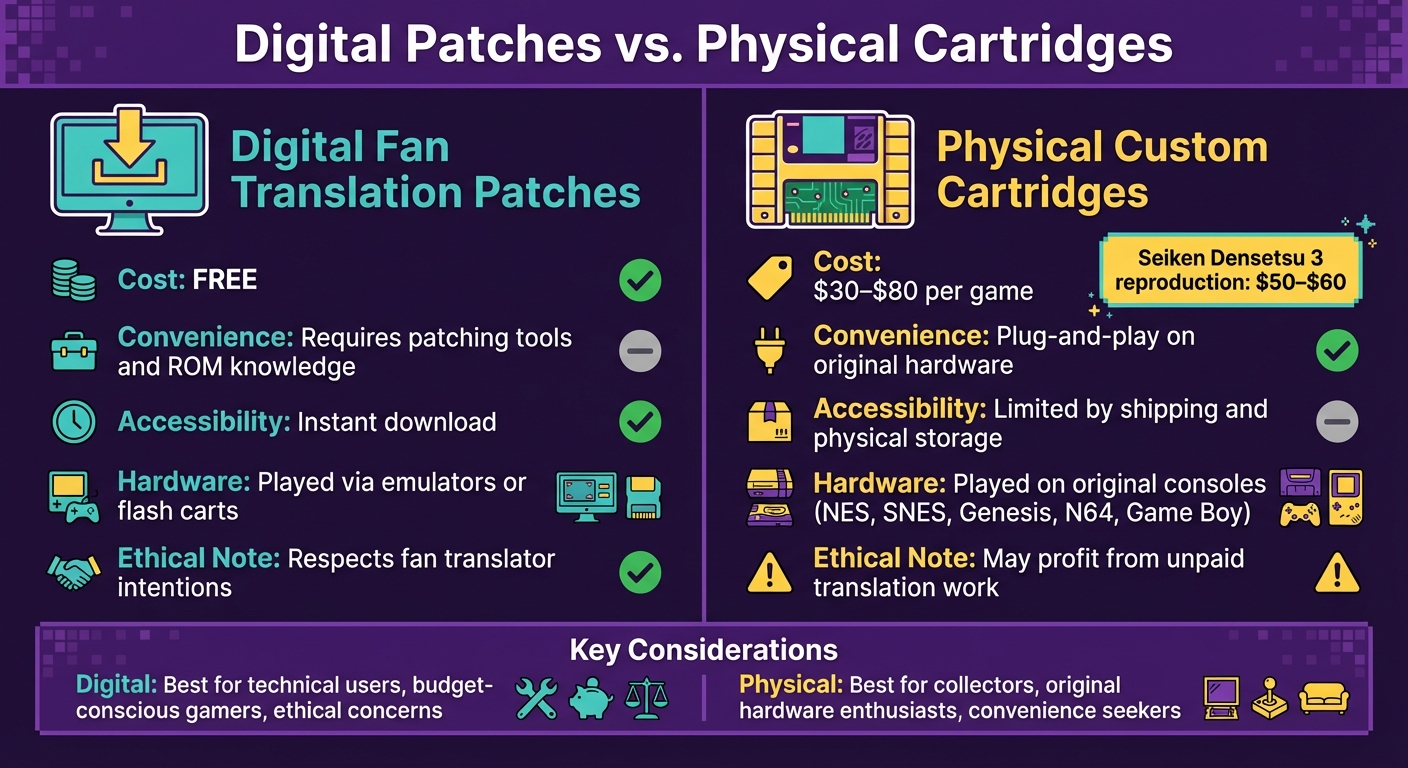
Digital Patches vs Physical Cartridges: Cost and Features Comparison
Continuing from the verification process, let’s break down the practical differences between digital patches and physical cartridges.
Cost and Accessibility
Fan translation teams typically release their patches for free, driven by passion rather than profit. On the other hand, reproduction vs. original cartridges usually cost between $30 and $80 per game. For instance, a reproduction cartridge of Seiken Densetsu 3 (the Japan-only sequel to Secret of Mana) often sells for about $50–$60.
Digital patches are instantly accessible for download, provided you have the necessary tools and know-how. Physical cartridges, however, offer the simplicity of plug-and-play functionality on original hardware, without requiring any additional setup. While digital patches save you money, they do require some technical effort. Physical cartridges, though pricier, deliver convenience right out of the box.
| Feature | Digital Fan Translation Patches | Physical Custom Cartridges |
|---|---|---|
| Cost | Free | $30–$80 per game |
| Convenience | Requires patching tools and ROM knowledge | Plug-and-play on original hardware |
| Accessibility | Instant download | Limited by shipping and physical storage |
| Hardware | Played via emulators or flash carts | Played on original consoles |
Pros and Cons
From an ethical standpoint, digital patches have a clear edge. As GameFAQs user ASAC_Schrader points out:
"When a merchant creates a reproduction cart, they are essentially profiting off of the original game and profiting off of the translation team".
Fan translation efforts often involve hundreds of hours of unpaid work, which makes it controversial when sellers monetize these projects without permission.
Physical cartridges also raise concerns about "donor" boards - reproduction cartridges are sometimes made by repurposing parts from less desirable original games. This practice reduces the availability of genuine cartridges and increases the chances of high-quality reproductions being mistaken for rare originals. Collectors might then unknowingly pay premium prices for items that aren't authentic.
That said, physical cartridges can appeal to collectors aiming to build a complete library, offering a tangible and aesthetic addition to their shelves. However, they lack true scarcity since they can be reproduced indefinitely. Digital patches, while requiring some technical setup, align better with the values of the fan translation community and respect the intentions of the creators.
Ultimately, this comparison helps you decide which option suits your collection goals and personal preferences.
Conclusion
Use this step-by-step checklist to track down rare fan-translated games. It’s a great way for retro gamers to discover, verify, and collect gems like Mother 3, Seiken Densetsu 3, or Sweet Home. Make sure the translations are complete - nobody wants to deal with beta patches. Once you've identified your must-have titles, decide whether you prefer free digital patches for convenience or physical cartridges for that classic experience on original hardware.
For those who want to enjoy these translations on vintage consoles, BJ's Game Vault offers custom cartridges designed for systems like the NES, SNES, Sega Genesis, N64, and Game Boy. Each cartridge includes a Collector's Guarantee, and prices start at under $50, with free shipping on every order.
If you're looking to build your collection more easily, subscription services can be a great option. The upcoming Vault Box subscription delivers rare finds regularly, starting at $45 per month. Each box includes curated cartridges and collectibles to keep your collection growing.
FAQs
How do I know a translation patch matches my ROM?
To make sure the patch works with your ROM, apply it using tools like IPS, BPS, or xDelta. The process should run smoothly without errors. After patching, verify the ROM by checking its checksum or file size to confirm it’s compatible with your hardware or emulator. Make sure the patch matches the ROM’s region and version, and don’t forget to review any included documentation for detailed compatibility notes.
What’s the safest way to avoid pre-patched ROM scams?
To steer clear of pre-patched ROM scams, always rely on trusted sources and verify the integrity of ROM files before downloading. Stick with well-known, reputable websites that are recognized for providing secure and legitimate distributions. Unofficial sites can often host malware or fake files, so it's best to avoid them altogether.
Be especially cautious with pre-patched ROMs, as they might include harmful code. Use tools recommended by the community to check the authenticity of the files. If a file or source seems suspicious, steer clear - it’s better to be safe than sorry. Taking these precautions can help you minimize the risk of falling victim to scams.
Are custom fan-translation cartridges legal to buy and own?
Custom fan-translation cartridges are typically legal to buy and own for personal use. These cartridges feature unofficial translations made by fans and generally don't violate official copyrights as long as they're used privately. That said, it's wise to check your local laws and regulations to make sure you're in the clear.